Table of Contents
When parents enroll their child in an online Quran program, one question naturally comes to mind:
“Is my child actually making progress?”
It is easy to look at the number of lessons completed, the number of pages read, or how many Surahs a child has memorized.
But these numbers do not always tell the full story.
A child can complete many pages while still struggling with pronunciation. Another child may memorize fewer verses but develop much stronger Tajweed, accuracy, retention, and confidence.
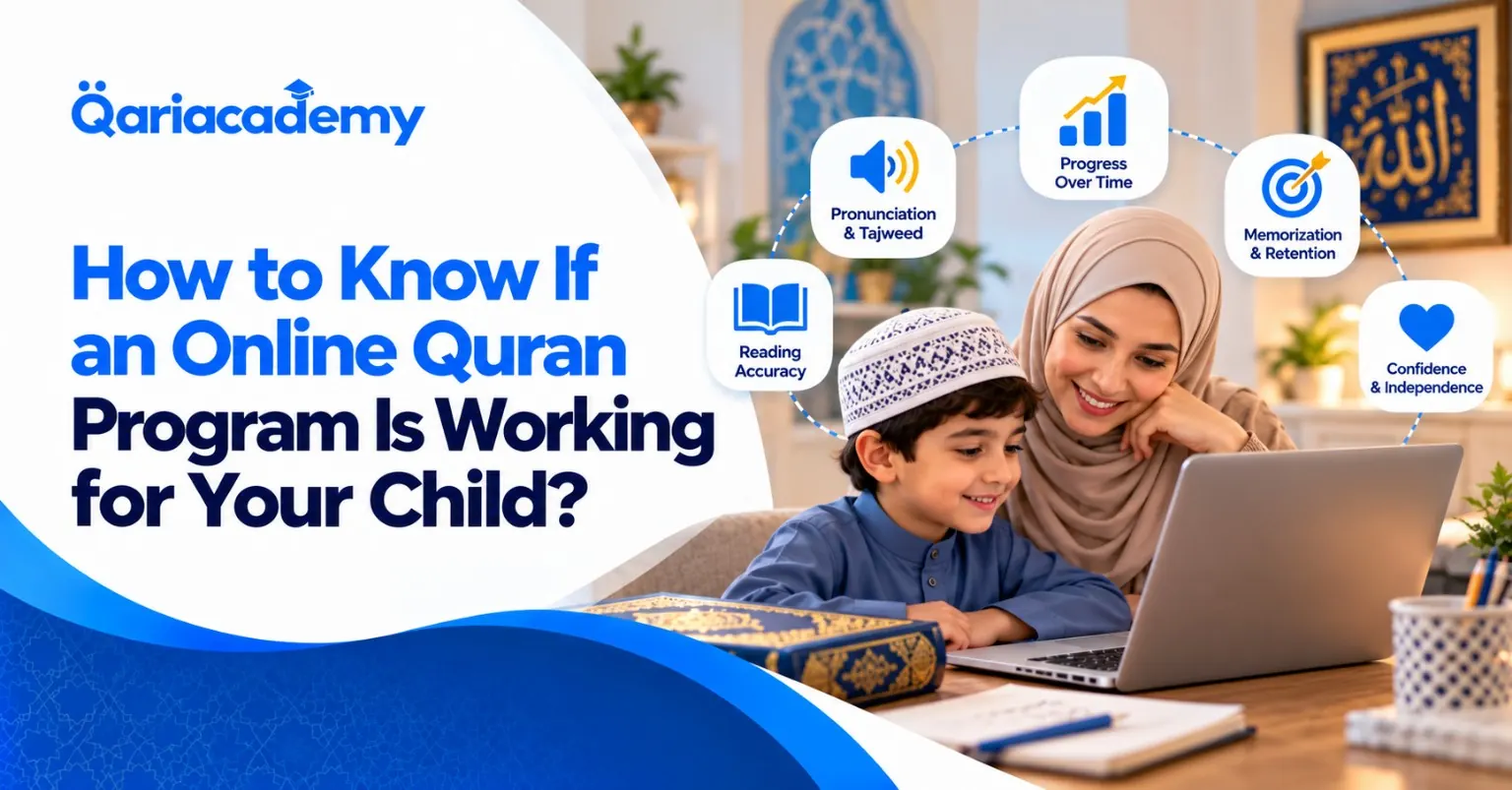
For parents trying to understand whether an online Quran program is genuinely helping their child, the better approach is to look at measurable changes in the child’s skills over time.
This guide explains what meaningful Quran progress looks like, what parents should monitor, what questions they should ask the teacher, and how to know whether an online Quran program is actually meeting their child’s needs.
What Does “Progress” Really Mean in Quran Learning?
Quran learning is not a single skill.
A child may be developing several abilities at the same time:
- Arabic letter recognition
- Quran reading
- Pronunciation
- Tajweed
- Reading fluency
- Memorization
- Retention
- Revision
- Confidence
- Independence
- Understanding
This means progress should not be reduced to:
“How many pages did my child finish?”
A better question is:
“What can my child do now that they could not do a few months ago?”
This is especially important for children who are still developing their Arabic reading skills.
For example, a child may spend several weeks working on a small number of pages but make significant improvements in recognizing letters, reading Harakat, correcting pronunciation, or reading without teacher prompts.
That is real progress.
1. Is Your Child Reading More Accurately?

Accuracy is one of the first things parents should monitor.
A child may appear to read quickly while making repeated mistakes.
Another child may read more slowly but pronounce the letters correctly and improve consistently.
When evaluating an online Quran program, listen for changes in:
- Letter pronunciation
- Harakat
- Similar Arabic letters
- Word recognition
- Stopping and starting correctly
- Common reading mistakes
For younger children, these improvements can be more meaningful than simply counting how many pages they have completed.
If your child is still developing basic Quran reading skills, QariAcademy’s Quran for Kids course is designed for children ages 5–15 and includes step-by-step reading, pronunciation, Tajweed, and gradual memorization.
2. Is Your Child’s Tajweed Improving?
Tajweed should not be treated as something that only matters after a child becomes fluent.
It should gradually become part of correct Quran recitation.
Parents do not need to become Tajweed experts to monitor progress.
Instead, ask the teacher:
- Which Tajweed mistakes does my child make most often?
- Which mistakes have improved?
- Which rules are still difficult?
- Is my child beginning to correct mistakes independently?
A good program should be able to identify these areas rather than simply saying:
“Your child is doing well.”
Specific feedback is much more useful.
For children who already know the Arabic alphabet and are ready to focus specifically on recitation quality, QariAcademy’s Quran Tajweed for Kids course focuses on Makharij, Tajweed rules, pronunciation, fluency, revision, and personalized feedback.
3. Is Your Child Becoming More Independent?
One of the most overlooked signs of Quran progress is independence.
At the beginning, a young learner may need the teacher to:
- Point to every word
- Repeat every verse
- Correct every mistake
- Remind them where to start
- Prompt them constantly
Over time, you should ideally see some of that support becoming unnecessary.
For example:
Early stage:
Teacher prompts → Child repeats.
Developing stage:
Child reads → Teacher corrects.
Stronger stage:
Child reads independently → Child notices some mistakes → Teacher refines the recitation.
That transition matters.
The goal of education is not for the child to remain dependent on the teacher forever.
4. Can Your Child Remember What They Learned?
Memorization is another area where parents need to look beyond the amount learned.
Suppose a child memorizes two pages this week.
That sounds positive.
But what happens next week?
Can the child still recite those pages accurately?
Can they connect the verses?
Can they recite without constant prompting?
Can they remember older material?
These questions tell you more about the quality of memorization.
For children studying Hifz, revision and retention need to be monitored alongside new memorization.
Parents interested specifically in structured Quran memorization can explore QariAcademy’s Quran Hifz for Kids course, where memorization can be approached according to the child’s level and learning pace.
5. Is Your Child Retaining Previous Material?
A common mistake is to measure Quran progress only through new material.
But Quran learning has two sides:
New learning + Retention
If a child keeps adding new Surahs while forgetting older ones, the total amount of stable memorization may not actually be increasing.
A healthy program should therefore include revision.
Parents can ask:
“How is my child doing with older material compared with new material?”
This question can reveal whether the child is building lasting knowledge or simply moving forward temporarily.
A Simple Retention Check
| Area | What Parents Can Look For |
|---|---|
| Yesterday’s lesson | Can the child remember it accurately? |
| Last week’s material | Can the child recite without major prompting? |
| Older Surahs | Are previously memorized passages still strong? |
| Pronunciation | Are old mistakes improving? |
| Independence | Can the child begin and continue without help? |
| Revision | Does the child have a consistent review routine? |
The important principle is simple:
Memorization is not complete simply because the child can recite it immediately after learning it.
6. Is Your Child’s Reading Becoming More Fluent?
Accuracy and fluency are related, but they are not identical.
A child may pronounce most words correctly but still read very slowly.
Over time, you may notice:
- Fewer pauses
- Faster recognition of familiar words
- Less dependence on the teacher
- Better connection between words
- More natural recitation
- Greater confidence
However, faster reading should not come at the expense of accuracy.
The goal is not:
“Read faster.”
The goal is:
“Read accurately, confidently, and increasingly fluently.”
7. Is Your Child Correcting Their Own Mistakes?
Self-correction is a powerful indicator of learning.
Imagine that a child mispronounces a word.
At the beginning, the teacher corrects the child.
Later, the teacher gives a small prompt.
Eventually, the child notices:
“I made a mistake.”
and corrects themselves.
That shows that the child is developing internal awareness of their recitation.
Parents can ask the teacher:
“Does my child notice and correct mistakes independently yet?”
This is much more informative than simply asking whether the child received a good grade.
8. Is the Program Adjusting to Your Child’s Level?
Children do not all learn Quran at the same speed.
One child may need more time with Arabic letters.
Another may already read fluently but need Tajweed correction.
Another may be ready for Hifz.
A fourth child may need a combination of reading, Tajweed, and memorization.
This is why a strong online Quran program should not simply move every child through exactly the same material at exactly the same pace.
QariAcademy’s Quran for Kids program describes one-on-one live lessons, structured learning, regular feedback, progress tracking, and lessons tailored to the child’s pace.
Parents can therefore ask:
“What is my child’s current level, and what is the teacher planning to work on next?”
That question helps reveal whether the program is genuinely personalized.
9. Does the Teacher Give Specific Feedback?
A useful progress report should tell parents something concrete.
Compare these two statements:
Weak feedback:
“Your child is doing well.”
Useful feedback:
“Your child has improved in letter recognition and reading fluency. They are still confusing some similar letters and need more practice with specific Tajweed rules.”
The second type of feedback gives parents something they can actually understand and act on.
QariAcademy’s Quran for Kids program highlights regular feedback and progress tracking as part of its teaching approach.
10. Is Your Child Becoming More Confident?
Confidence is easy to overlook because it is not always visible in a test score.
But parents may notice changes such as:
- The child volunteers to recite
- They are less afraid of mistakes
- They start reading without being asked
- They are comfortable reading in front of family
- They participate more actively during lessons
- They no longer need constant reassurance
Confidence does not mean that the child never makes mistakes.
It means mistakes no longer prevent the child from trying.
11. Is Your Child Consistent?
Progress depends partly on consistency.
Even a very good teacher cannot create strong long-term results if the child frequently misses lessons or rarely practices.
Parents should therefore look at:
- Attendance
- Homework completion
- Home practice
- Revision
- Lesson participation
- Regularity
Consistency does not mean studying for hours every day.
It means creating a routine the child can realistically maintain.
A Simple Monthly Progress Review
Parents can review their child’s progress once a month instead of evaluating every single lesson.
| Skill | Last Month | This Month | Next Goal |
|---|---|---|---|
| Quran Reading | Needed frequent prompts | Reads short passages independently | Improve fluency |
| Pronunciation | Several recurring mistakes | Fewer repeated mistakes | Refine difficult letters |
| Tajweed | Beginning stage | Understands basic rules | Apply rules consistently |
| Memorization | Short Surahs | Better retention | Strengthen revision |
| Confidence | Hesitant | More willing to recite | Increase independence |
| Home Practice | Irregular | More consistent | Maintain routine |
This type of comparison gives parents a much clearer picture than asking:
“Is my child progressing?”
What Should Parents Ask the Quran Teacher?
Parents do not need to wait for a problem before communicating with the teacher.
A short monthly conversation can be extremely useful.
Here are some questions worth asking:
About Reading
- Is my child’s reading accuracy improving?
- Which letters or words are still difficult?
- Is reading becoming more fluent?
About Tajweed
- Which Tajweed rules has my child learned?
- What mistakes are still recurring?
- Is my child beginning to apply the rules independently?
About Memorization
- How much new material is my child retaining?
- How strong is the older memorization?
- Does the current Hifz pace need adjustment?
About Independence
- Does my child still need frequent prompting?
- Can they recognize mistakes?
- Can they begin and continue a passage independently?
About Home Practice
- What should we practice at home?
- How much practice is enough?
- Which skill should we prioritize this month?
For more detailed guidance, parents can also read What Should Parents Ask a Quran Teacher About Their Child’s Progress?.
Signs That an Online Quran Program Is Working
A healthy program will usually produce several of these changes over time:
- Better reading accuracy
- Improved pronunciation
- Stronger Tajweed
- Better retention
- More independent reading
- More confident recitation
- Fewer repeated mistakes
- Better revision habits
- Greater consistency
- Clearer learning goals
Not every child will improve in every area at the same speed.
That is normal.
The important thing is that the overall direction is positive.
Signs That You May Need to Reconsider the Learning Approach
Parents should also pay attention when progress seems to have stopped.
For example:
- The same mistakes continue for months without a clear plan.
- The child cannot explain what they are currently learning.
- The teacher gives very little specific feedback.
- The amount of new material keeps increasing while retention decreases.
- Lessons feel identical regardless of the child’s needs.
- The child is consistently overwhelmed.
- There is no clear learning goal.
- Parents do not know what to practice between lessons.
One slow month does not necessarily mean a program is failing.
Children naturally have periods of faster and slower development.
What matters is whether the teacher can identify the reason and adjust the plan.
The First 90 Days Are Especially Important
Parents often expect dramatic results immediately.
A better approach is to think in terms of a foundation-building period.
During the first few months, the teacher should be learning about the child’s:
- Reading level
- Pronunciation
- Tajweed
- Memorization ability
- Attention
- Confidence
- Learning pace
- Strengths and weaknesses
QariAcademy’s guide The First 90 Days of Quran Learning: What Parents Should Expect explains why the early period should be viewed as a foundation rather than simply a race to complete pages.
By the end of an initial learning period, parents should ideally have a clearer answer to three questions:
Where is my child now?
What has improved?
What should we work on next?
Progress Should Be Measured Against the Child’s Own Baseline
One of the biggest mistakes parents can make is comparing their child with another child.
Your friend’s child may have memorized Juz Amma.
Your nephew may read Quran fluently.
Another child may already know several Tajweed rules.
But these children may have completely different starting points.
A better comparison is:
My child today vs. my child three months ago.
If your child used to need help with every word and now reads independently, that is meaningful progress.
If they used to make ten recurring pronunciation mistakes and now make three, that is progress.
If they memorized fewer Surahs but can retain them much better, that is progress.
Online Quran Learning Should Not Mean Passive Learning
Some parents worry that online learning cannot provide enough personal attention.
That depends heavily on the teaching model.
There is a major difference between:
A child watching a recorded Quran lesson
and
A child sitting live with a teacher who listens to every recitation.
In a one-on-one lesson, the teacher can:
- Listen closely
- Correct pronunciation immediately
- Adjust the pace
- Ask the child to repeat
- Identify recurring mistakes
- Change the activity when needed
- Provide personalized feedback
This is one reason QariAcademy uses one-on-one live Quran lessons rather than treating children as if they all need the same lesson.
Parents can explore QariAcademy’s online Quran classes to see how the academy approaches personalized Quran learning.
How Parents Can Support Progress Without Becoming the Teacher
Parents have an important role, but they do not need to become their child’s Quran teacher.
A healthy division of responsibilities can look like this:
Teacher:
- Teaches
- Corrects
- Assesses
- Sets learning goals
- Provides feedback
Parent:
- Creates a routine
- Encourages practice
- Helps the child attend consistently
- Communicates with the teacher
- Celebrates progress
Child:
- Participates
- Practices
- Reviews
- Gradually develops independence
This approach allows parents to stay involved without turning every Quran session at home into a stressful correction session.
For more guidance, read How to Practice Quran With Your Child Without Becoming Their Teacher.
A Simple 10-Minute Parent Check
Parents can occasionally listen to their child for just 10 minutes.
Choose:
- A recently learned passage
- An older memorized Surah
- A short reading section
Then observe:
1. Accuracy
Does the child read the words correctly?
2. Pronunciation
Are there recurring pronunciation problems?
3. Independence
How much prompting is needed?
4. Retention
Can the child remember older material?
5. Confidence
Does the child recite comfortably?
You do not need to correct everything.
Simply take notes and share useful observations with the teacher.
A Complete Quran Progress Scorecard
Parents who want a more structured approach can use a simple monthly scorecard.
| Area | Needs Attention | Developing | Strong |
|---|---|---|---|
| Reading Accuracy | Frequent mistakes | Improving | Consistently accurate |
| Pronunciation | Several recurring issues | Fewer mistakes | Strong pronunciation |
| Tajweed | Needs frequent reminders | Applies some rules | Applies rules independently |
| Retention | Quickly forgets | Retains with revision | Strong retention |
| Revision | Inconsistent | Regular with support | Consistent and independent |
| Fluency | Very slow | Improving | Comfortable reading |
| Confidence | Hesitant | Participates willingly | Recites confidently |
| Independence | Needs constant prompts | Some support needed | Mostly independent |
The purpose of a scorecard is not to give the child a grade.
It is to help parents and teachers identify the next learning priority.
What Real Quran Progress Looks Like
Real progress is often gradual.
It may look like:
A child who once struggled to recognize letters now reads words.
A child who needed the teacher to correct every line now notices some mistakes independently.
A child who memorized a Surah but forgot it quickly now retains it after consistent revision.
A child who was nervous about reciting now reads confidently.
A child who needed constant reminders now opens the Quran and starts practicing independently.
These changes may not look dramatic on a weekly basis.
But over several months, they can represent significant development.
Final Thoughts
Parents should not judge an online Quran program only by the number of pages completed or Surahs memorized.
A strong Quran learning program should help a child become:
- More accurate
- More fluent
- Better at Tajweed
- Stronger in retention
- More confident
- More independent
- More consistent
The best question is not:
“How much Quran did my child finish?”
It is:
“What has my child actually learned, retained, and become able to do independently?”
That is the difference between measuring activity and measuring learning.
If you are considering an online Quran program for your child, start by identifying their current level, defining realistic goals, and choosing a program that provides personalized instruction and meaningful progress feedback.
Frequently Asked Questions
How do I know if an online Quran program is working for my child?
Look for measurable improvement in reading accuracy, pronunciation, Tajweed, retention, fluency, confidence, consistency, and independence. The exact pace will vary from child to child.
How often should parents check their child’s Quran progress?
A detailed review once a month is usually more useful than judging every lesson. Parents can also have short informal checks at home to understand what the child remembers.
Should Quran progress be measured by pages?
Pages can be one useful indicator, but they should not be the only measurement. Accuracy, Tajweed, retention, revision, and independence are also important.
What if my child is memorizing Quran but forgetting older Surahs?
This may indicate that revision needs more attention. The teacher may need to reduce the amount of new memorization temporarily and strengthen retention of older material.
How can I tell if my child is improving in Tajweed?
Ask the teacher which Tajweed mistakes were present previously, which have improved, and which rules the child is currently working on. Specific feedback is more useful than a general statement that the child is doing well.
What should I ask my child’s Quran teacher?
Ask about reading accuracy, pronunciation, Tajweed, retention, revision, independence, confidence, and the child’s next learning goal. You can also ask what should be practiced at home.
Is one-on-one Quran learning better for children?
One-on-one instruction can be especially useful when a child’s level, pace, or learning needs differ from other students. The teacher can listen closely and adjust the lesson according to the child’s needs.
How long does it take for a child to make noticeable Quran progress?
There is no universal timeline. Progress depends on the child’s starting level, age, consistency, practice, lesson frequency, and individual learning needs. A better approach is to compare the child with their own baseline over several weeks or months.
Should parents correct their child during Quran practice?
Parents can support practice, but they do not need to correct every mistake. It is often better to let the teacher handle detailed correction while the parent focuses on encouragement, routine, and communication.
What if my child’s progress seems slow?
Slow progress does not automatically mean the program is ineffective. Ask the teacher what is causing the difficulty, what has improved, and whether the learning plan needs to be adjusted.
Recommended QariAcademy Courses
For children who need a structured Quran foundation, explore Quran for Kids.
For children who already read Arabic and need focused recitation and Tajweed development, explore Quran Tajweed for Kids.
For children working specifically on Quran memorization, explore Quran Hifz for Kids.
You can also explore QariAcademy’s full range of Quran and Arabic courses to find the program that best matches your child’s current level and goals.
Start Your Child’s Quran Journey
If you are looking for a personalized online Quran program where your child’s level, pace, and progress can be monitored, QariAcademy offers live one-on-one Quran lessons for children.