Table of Contents
Introduction
If you want to teach kids Makharij, you might worry about articulation points in Tajweed. Many parents ask: “How can my child pronounce ق and ك correctly?” or “Why does my child mix ص and س?”
The truth is, teaching kids Makharij can be easy and fun with playful techniques and clear guidance. Children can master these sounds naturally while enjoying the process.
Before diving into Makharij, ensure your child has a strong foundation in short vowels and Madd. Check out our articles on Fun with Sounds: Fatha, Kasra, Dhamma and 3 Simple Games to Teach Madd for the perfect preparation.
Why Makharij Matter in Tajweed
- Correct articulation preserves meaning.
- Early training builds lifelong speech habits.
- Children learn faster than adults and retain pronunciation better.
Step 1: Use Everyday Objects
- Mirror: Let kids see their mouth while pronouncing letters like ب، ف، م.
- Feather or tissue: Helps feel the airflow for letters like ح، هـ.
Internal Link: For more playful tips, see Fun with Sounds.
Step 2: Animal Sounds Game
- ص = snake “sssss”
- ق = crow “qaw-qaw”
- ع = baby crying sound
Kids love pretending—this makes articulation memorable and fun.
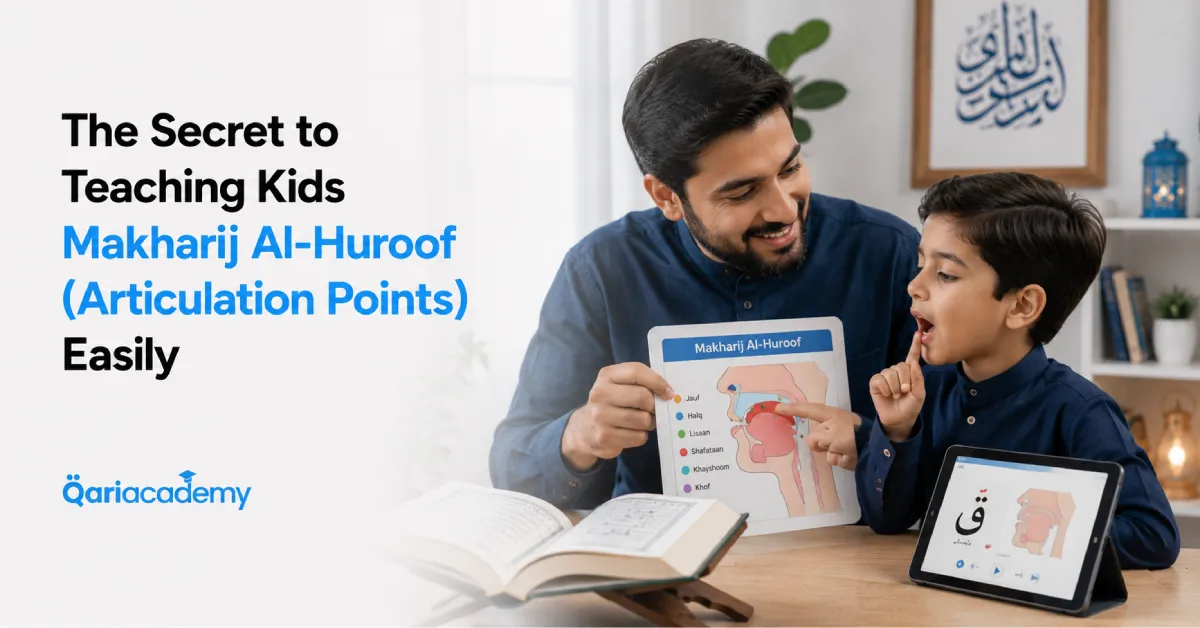
Step 3: Color Zones
- Draw a simple mouth diagram.
- Color lips, tongue, throat differently.
- Point to zones while practicing letters.
Step 4: Tajweed Tongue Twisters
Examples:
- “سالم سمع سوسو” (س vs ص)
- “قلب كبير قوي” (ق vs ك)
Repetition builds clarity, confidence, and fluency.
Internal Link: To strengthen Madd and vowels, combine practice with 3 Simple Games to Teach Madd.
Bonus Tip
- Keep sessions short (5–7 minutes).
- Focus on 1–2 letters per day.
- Encourage positive reinforcement and play.
At QariAcademy, we turn Tajweed into a playful, engaging experience. Help your child master Makharij and develop love for Qur’an recitation.
👉 Enroll today and start learning
FAQ: Teaching Makharij al-Huroof to Kids
1. Best age to start Makharij?
5–8 years old.
2. Child mixes similar sounds (س and ص)?
Use playful comparisons and repeat slowly.
3. Teach Arabic letters first?
Yes, then refine with Makharij.
4. Non-Arabic speakers struggle?
Not with games—kids learn easily.
5. How long to master?
A few weeks of short daily practice.
6. Exaggerating sounds okay?
Yes, initially; adjust later.
7. Frustrated child?
Keep it fun, reduce session time, praise small wins.
8. Link Makharij to Qur’an memorization?
Highlight tricky letters in familiar verses.
9. Correct mistakes immediately?
Gently, without stopping flow.
10. Sibling practice helpful?
Yes, increases motivation and fun.