
Table of Contents
Key takeaways
- Most children’s Tajweed mistakes come from sounds English doesn’t have, such as ح, ع and ق, and from heavy letters read lightly.
- The most common rule mistakes are a short madd, a missing ghunnah, no qalqalah bounce and stopping on a vowel.
- Correct one thing at a time: model the sound, let your child repeat it, then praise the effort.
- Leave detailed correction to the teacher; at home, keep it short and positive.
Introduction
Every child makes Tajweed mistakes while learning – that is part of the process. What helps is knowing which mistakes are most common, what they sound like, and how to fix them without making Quran time stressful.
This guide covers the mistakes teachers hear most often from children, especially those growing up with English, and gives a simple fix for each one that you can practise at home.
Quick answer – what are the most common Tajweed mistakes kids make? Saying ح like h, skipping ع, saying ق like ك, reading heavy letters lightly, saying ث and ذ like s and z, cutting the madd short, missing the ghunnah, forgetting the qalqalah bounce and stopping on a vowel. Fix them one at a time with short, positive practice.
Why Children Make These Mistakes
- English has no match for some letters, so children replace them with the closest English sound.
- Reading too fast squeezes the madd and hides the ghunnah.
- Copying – children repeat what they hear, including mistakes from siblings or classmates.
- Too many rules at once make a child guess instead of listen.
Letter Mistakes
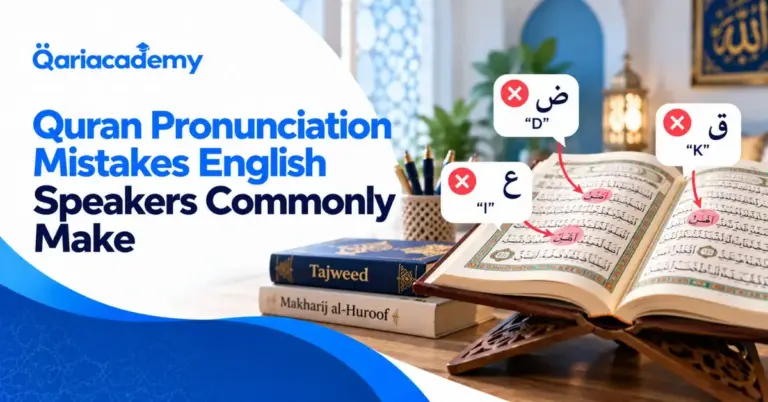
1. Saying ح Like ه or an English “h”
What you hear: a light, airy h instead of the deeper ح from the middle of the throat.
Quick fix: practise the pair حَ / هَ slowly, feeling the throat tighten for ح. Then try it in ٱلۡحَمۡدُ.
2. Skipping ع or Saying It Like ا
What you hear: عَ sounding like a plain “a”.
Quick fix: practise عَ / أَ side by side. ع comes from the middle of the throat with a slight squeeze.
3. Saying ق Like ك
What you hear: قُلۡ sounding like “kul”.
Quick fix: ق is made further back, where the back of the tongue meets the soft palate, and it is a heavy letter. Practise قَ / كَ as a pair.
4. Reading Heavy Letters Lightly
What you hear: ص like س, ط like ت, ظ like ذ.
Quick fix: heavy letters are said with the back of the tongue raised, which gives a fuller sound. Practise the pairs صَ / سَ, طَ / تَ and ظَ / ذَ.
5. Saying ث and ذ Like s and z
What you hear: ثَ like “sa” and ذَ like “za”.
Quick fix: both are said with the tip of the tongue lightly between the teeth – like the “th” in “think” for ث and in “this” for ذ.
Tip: Practise in front of a mirror so your child can see the tongue position for ث and ذ.
Rule Mistakes
6. Cutting the Madd Short
What you hear: قَالَ read as a quick “qala”.
Quick fix: the natural madd lasts two counts. Count on two fingers while stretching the sound.
7. Missing the Ghunnah
What you hear: إِنَّ or ثُمَّ read with no humming.
Quick fix: a noon or meem with shaddah is held with a nasal hum for two counts. Let your child hum it first, then read the word.
8. Forgetting the Qalqalah Bounce
What you hear: a flat, stopped sound on ق ط ب ج د when they have sukoon.
Quick fix: add a small bounce, as when stopping on ٱلۡفَلَقِ. Clapping once on the bounce helps.
9. Stopping on a Vowel
What you hear: stopping at the end of a verse but still pronouncing the last vowel, for example “ar-raheemi”.
Quick fix: when you stop, the last vowel is usually dropped and the letter is read with sukoon: ٱلرَّحِيمِ becomes “ar-raheem”. Never stop in the middle of a word.
10. Reading Too Fast
What you hear: letters blending together, madd and ghunnah disappearing.
Quick fix: slow down and read one verse at a time. Accuracy first – speed comes later on its own.
Quick Reference Table
| Mistake | What you hear | Quick fix |
|---|---|---|
| ح said like h | Light, airy sound | Practise حَ / هَ |
| ع skipped | Plain “a” | Practise عَ / أَ |
| ق like ك | “kul” for قُلۡ | Further back, heavier |
| Heavy letters read light | ص like س | Raise the back of the tongue |
| ث ذ like s and z | “sa”, “za” | Tongue tip between the teeth |
| Short madd | No stretch | Two counts on the fingers |
| No ghunnah | No humming | Hum for two counts |
| No qalqalah | Flat stop | A small bounce |
| Stopping on a vowel | “raheemi” | Drop the last vowel when stopping |
How to Correct Without Discouraging
- One mistake at a time. Choose the mistake you are working on this week and let the others wait.
- Model, then repeat. Say the word correctly and let your child copy you, rather than explaining the rule.
- Praise the effort. “That ح was much better” encourages more than “That’s wrong”.
- Record and compare. A short recording every week lets your child hear their own progress.
A 5-Minute Daily Correction Routine
| Minute | Activity |
|---|---|
| 1 | Listen to the target sound or word from a reciter |
| 2 | Practise the letter pair slowly |
| 3 | Practise two words that contain it |
| 4 | Read one verse with the word in it |
| 5 | Praise, and note it on a simple chart |
When to Leave It to the Teacher
Some sounds, especially the heavy letters and ض, need a trained ear and patient, face-to-face correction. If a mistake doesn’t improve after two or three weeks of home practice, ask your child’s teacher to focus on it in class rather than correcting it more often at home.
Want a teacher to check your child’s Tajweed? Our Tajweed for Kids course offers live one-on-one lessons with gentle, step-by-step correction.
Frequently Asked Questions
What is the most common Tajweed mistake children make?
Mixing up letters that English doesn’t have, especially saying ح like h and ق like ك, followed by reading heavy letters too lightly.
Should I correct every mistake my child makes?
No. Correct one mistake at a time, and let the teacher handle detailed correction. Too much correction at home can make Quran time stressful.
How long does it take to fix a Tajweed mistake?
Simple rule mistakes, such as a short madd, often improve within a week or two of daily practice. Letter sounds can take longer and benefit from a teacher.
Can I fix my child’s Tajweed if I don’t know Tajweed myself?
You can help with listening, routine and encouragement. Use recordings of skilled reciters and leave the detailed correction to the teacher.
At what age should children start learning Tajweed?
Children can start simple Tajweed once they read letters with their vowels, often around age 5 to 7.
Related guides: Tajweed rules for beginners · What Is Makharij? · Quran pronunciation mistakes English speakers make · 30-day Tajweed plan for kids.