For an English-speaking Muslim learning to recite the Quran, reading the Arabic letters on the page is only the beginning.
A learner may recognize the words, read a short Surah independently, and even memorize several Juz, while still making pronunciation mistakes that affect the accuracy of their recitation.
The reason is simple: English and Arabic do not use exactly the same sound system.
Some Arabic letters have no direct equivalent in English. Others may sound similar to an English speaker even though they come from different Makharij (articulation points) and have different characteristics.
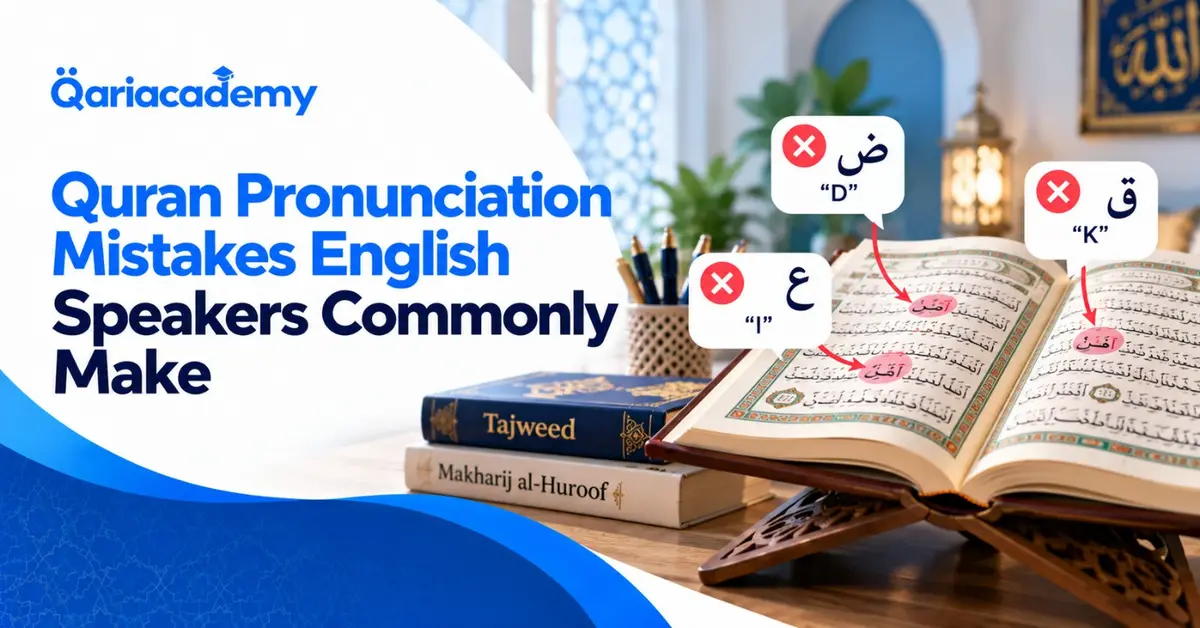
This can lead to mistakes such as confusing ق with ك, ح with ه, ص with س, or struggling with sounds such as ع، خ، غ، ض.
These mistakes do not mean that an English speaker cannot learn accurate Quran recitation. They mean that pronunciation needs to be taught deliberately, heard carefully, practiced repeatedly, and corrected before an inaccurate pattern becomes automatic.
For children and adults learning Quran online, this is one reason personalized Tajweed instruction can be especially useful. QariAcademy’s Quran Tajweed for Kids program focuses on correct articulation, Tajweed rules, fluency, revision, and individualized feedback.
Why English Speakers Struggle With Quran Pronunciation
The first challenge is that learners naturally interpret unfamiliar sounds through the sound system they already know.
If a particular Arabic sound does not exist in English, the learner may unconsciously replace it with the closest sound they know.
For example, someone may hear ق and produce something closer to ك because both sounds can initially seem similar.
Another learner may pronounce ح using the familiar English “h” sound, even though the Arabic ح is produced differently.
This is not simply a problem of memorizing the names of Arabic letters.
It is a coordination problem involving:
- Hearing the difference
- Understanding where the sound is produced
- Positioning the tongue, lips, or throat correctly
- Producing the sound
- Receiving feedback
- Repeating it correctly
QariAcademy’s guide on Common Tajweed Mistakes Made by English Speakers makes this distinction important: English does not contain every Arabic sound, so learners can develop substitutions when unfamiliar sounds are mapped onto familiar English ones.
Research on multilingual speech also shows why language background matters when evaluating pronunciation. ASHA notes that children’s speech development can be influenced by the languages and dialects they use and that cross-linguistic effects need to be considered rather than assuming one language’s sound patterns apply universally.
The Most Common Quran Pronunciation Mistakes English Speakers Make
The following are some of the pronunciation areas that deserve particular attention.
| Arabic letters | Common confusion | What the learner may do |
|---|---|---|
| ق / ك | Qaaf vs Kaaf | Pronounce both almost the same |
| ح / ه | Haa vs Haa | Use an English-like “h” for both |
| ع / ء | Ayn vs Hamzah | Drop or replace the ع |
| ص / س | Saad vs Seen | Make both light |
| ض / ظ | Daad vs Zhaa | Confuse the articulation or characteristics |
| ط / ت | Taa vs Taa | Lose the heaviness of ط |
| خ / ه | Khaa vs Haa | Replace خ with a softer sound |
| غ / ر | Ghain vs Raa | Produce an inaccurate throat or tongue sound |
The goal is not for a beginner to memorize this table.
The goal is for a teacher to identify which specific distinctions are actually causing problems for that learner.
1. Confusing ق and ك
One of the most recognizable difficulties is distinguishing ق from ك.
They are not interchangeable.
A learner who has never practiced Arabic articulation may hear them as similar because both are consonant sounds produced toward the back of the mouth.
But accurate Quran recitation requires the learner to recognize and reproduce their differences.
For example:
قُلْ
and
كُلْ
contain different letters and therefore require different pronunciation.
A useful correction process is:
- Listen to the teacher pronounce both letters.
- Repeat them individually.
- Compare them without rushing.
- Practice them in simple syllables.
- Move into Quranic words.
- Apply the distinction during actual recitation.
This is why pronunciation should not be corrected only after a child has already developed reading speed.
QariAcademy’s article When Reading Outpaces Tajweed explains that reading fluency and Tajweed accuracy do not necessarily develop at the same speed.
2. Pronouncing ح Like ه
The Arabic letters ح and ه can be particularly confusing for English speakers.
An English speaker already has an “h” sound, so it is natural to use that familiar sound when encountering Arabic ح.
But ح is not simply the Arabic version of English “h.”
It requires a different articulation and quality.
This is why repeatedly telling a child:
“Say ح correctly.”
is often not enough.
The child needs to hear the contrast and receive a physical explanation of where the sound is produced.
A teacher may isolate the sound first and then place it inside simple words before returning to Quranic verses.
A better progression
| Stage | Practice |
|---|---|
| 1 | Hear ح and ه separately |
| 2 | Repeat each sound |
| 3 | Practice simple combinations |
| 4 | Read words containing the letters |
| 5 | Apply them during Quran recitation |
The important principle is isolate → practice → apply.
3. Struggling With ع
The letter ع is another major challenge because English does not provide a direct equivalent.
A learner may:
- Skip the sound
- Replace it with a vowel
- Turn it into a hamzah-like sound
- Produce it too weakly
- Produce it with unnecessary tension
This is one of the situations where transliteration can actually make learning harder.
If a child learns Arabic Quran words mainly through English letters, they may start associating an Arabic sound with an approximate English representation rather than learning the Arabic articulation itself.
For Quran learning, the Arabic script and the teacher’s pronunciation should remain central.
4. Confusing ص and س
The difference between ص and س is another important distinction.
A learner may pronounce both approximately like an English “s.”
But ص is a heavy letter, while س is light.
The issue therefore is not only the consonant itself. It is also the quality of the sound.
This is where Tafkhim and Tarqiq become practical rather than theoretical.
A child does not necessarily need a long technical lecture about the terminology.
Instead, the teacher can help the child hear:
س → light
ص → heavy
Then the learner practices the contrast in words and short Quranic passages.
5. Struggling With ض
The letter ض is often difficult even for learners who have already developed reasonable Quran reading skills.
This is because its articulation and characteristics are unfamiliar to many non-native Arabic speakers.
It should therefore be treated as a specific pronunciation skill rather than simply telling the learner to “try harder.”
The teacher should identify what is actually happening:
- Is the learner replacing ض with د?
- Is the learner producing ظ instead?
- Is the tongue position incorrect?
- Is the learner relying on transliteration?
- Can the learner recognize the letter but not produce it?
Each problem requires a slightly different correction strategy.
6. Mispronouncing خ and غ
The Arabic letters خ and غ are also unfamiliar to many English speakers.
A learner may try to approximate them using familiar English sounds.
This can produce:
- A sound that is too soft
- A sound that is too far forward
- A sound that resembles another Arabic letter
- A pronunciation that changes from one word to another
The solution is not simply more repetition.
It is accurate repetition.
If a learner repeats the wrong sound twenty times, repetition can strengthen the wrong habit.
That is why correction needs to happen early.
Why Makharij Should Come Before Advanced Tajweed
One of the biggest mistakes parents can make is assuming that Tajweed means memorizing a long list of rules.
For a beginner, the foundation is often much simpler:
Can the child pronounce the Arabic letters accurately?
QariAcademy’s 30-Day Tajweed Plan for Kids begins with letters, sounds, articulation points, and short repetition before moving into more advanced areas such as Madd, Noon Saakinah, and other Tajweed rules.
This creates a useful progression:
| Learning stage | Main pronunciation priority |
|---|---|
| Arabic alphabet | Correct letter sounds |
| Qaida | Harakat and basic pronunciation |
| Early Quran reading | Makharij and sound distinctions |
| Developing reader | Madd, Ghunnah, Qalqalah and core rules |
| Fluent reader | Refinement and self-correction |
This does not mean a child should wait until they are an advanced reader before learning Tajweed.
It means Tajweed should grow with the child’s ability.
QariAcademy similarly explains that early Tajweed does not require overwhelming a young learner with technical terminology. Correct sounds can be introduced gradually while the child develops reading ability.
Common Tajweed Mistakes Beyond Individual Letters
Pronunciation problems do not stop with individual letters.
A learner may pronounce the letters reasonably well but still struggle with how those sounds behave during recitation.
Common areas include:
Madd
Some learners shorten a required elongation, while others stretch sounds longer than required.
The solution is to connect the rule to actual Quranic examples rather than treating Madd as an abstract definition.
Ghunnah
Learners may hear Ghunnah but apply it inconsistently, especially when reading quickly.
Qalqalah
Some learners make Qalqalah too weak.
Others exaggerate it and turn it into an additional vowel-like sound.
Heavy and light letters
A learner may know that certain letters are heavy but fail to maintain that quality while reading continuously.
Raa
The pronunciation of ر can change depending on the surrounding letters and vowel context. This is an area where listening and teacher correction are especially valuable.
QariAcademy’s existing guide on Common Tajweed Mistakes Made by English Speakers covers these areas, including Madd, Ghunnah, Qalqalah, Tafkhim, Tarqiq, and Raa.
Why Children Can Develop Pronunciation Habits So Quickly
Children are excellent imitators.
That is a major advantage when learning Quran—but it can also work against them if the model they repeatedly hear is inaccurate.
Consider two children.
Child A reads a passage incorrectly but receives immediate correction.
Child B reads the same passage incorrectly every day for six months without correction.
Both children may eventually learn the correct pronunciation, but Child B may first need to replace an established habit.
This is one reason QariAcademy emphasizes consistent practice and gentle correction in its Tajweed for Kids Parent’s Guide.
Should Parents Correct Their Child’s Quran Pronunciation?
Parents should certainly support Quran practice, but they should be careful about correcting sounds they are not confident about themselves.
If you are unsure whether your child’s pronunciation is correct, it is better to ask the teacher than to repeatedly give an uncertain correction.
A parent can focus on:
- Reminding the child to practice
- Listening to assigned passages
- Encouraging repetition
- Keeping the routine consistent
- Noticing recurring difficulties
- Sharing those difficulties with the teacher
The teacher can handle the technical pronunciation correction.
This distinction is especially important when the parent is also an English speaker or is not trained in Tajweed.
A Simple Home Practice Routine
A child does not necessarily need a long daily session to reinforce pronunciation.
A short, focused routine can be more productive.
| Time | Activity |
|---|---|
| 2 minutes | Review previously corrected sounds |
| 3 minutes | Practice the current lesson |
| 3 minutes | Read a short Quranic passage |
| 2 minutes | Repeat one difficult word or verse |
The objective is not to turn the parent into another Quran teacher.
It is to give the child enough repetition between lessons to prevent the material from disappearing.
QariAcademy’s How Long Does It Take a Child to Learn to Read the Quran? similarly emphasizes short, consistent practice and cautions parents against teaching pronunciation when they are unsure of it.
What an Effective Online Tajweed Lesson Should Look Like
For an English-speaking child, a strong one-on-one lesson should not consist of the teacher talking for most of the session.
The child needs significant time to:
Listen → Recite → Receive correction → Repeat → Apply
A practical lesson might look like this:
| Lesson component | Purpose |
|---|---|
| Review | Check previously learned sounds |
| New pronunciation | Introduce one or two specific difficulties |
| Guided practice | Teacher listens and corrects |
| Quran application | Use the sound in actual verses |
| Independent attempt | Check whether the child can apply it without prompting |
| Homework | Short targeted repetition |
This is one advantage of one-on-one instruction: the teacher can identify a child’s specific pronunciation pattern instead of assuming that every learner has the same difficulty.
QariAcademy’s Quran Tajweed for Kids course is designed around one-on-one lessons, gradual instruction, practice, revision, and personalized feedback.
When a Pronunciation Problem Needs More Attention
Not every mistake is a serious concern.
Learning a new language naturally involves errors, especially when the learner is dealing with sounds that do not exist in their first language.
However, parents should speak with the teacher when:
- The same mistake appears repeatedly.
- The child cannot distinguish two letters after repeated practice.
- The child consistently replaces one Arabic sound with another.
- Reading speed is increasing while pronunciation accuracy is not.
- The child memorizes verses but repeatedly recites them with the same pronunciation errors.
- The child is becoming frustrated by a particular sound.
- The parent cannot determine whether the pronunciation is correct.
For multilingual children, it is also important not to confuse a language-learning difference with a speech disorder. ASHA stresses that multilingual speech should be considered in the context of all the languages and dialects the child uses rather than judged solely against one language’s norms.
If a parent has a genuine concern about the child’s broader speech development—not simply Quranic pronunciation—the appropriate professional is a qualified speech-language pathologist.
A Practical Roadmap for English-Speaking Quran Learners
The process can be simplified into six stages:
Stage 1: Recognize Arabic letters
The learner should identify the letters visually and hear their correct sounds.
Stage 2: Build basic pronunciation
The learner practices articulation and Harakat.
Stage 3: Learn through connected words
Letters should no longer remain isolated. The child begins applying sounds to actual Arabic words.
Stage 4: Read Quranic text
Reading develops alongside pronunciation rather than separately.
Stage 5: Add core Tajweed
Madd, Ghunnah, Qalqalah, heavy/light letters, and other relevant rules are introduced progressively.
Stage 6: Refine and self-correct
As the learner becomes more advanced, the goal changes from simply correcting mistakes to helping the learner notice and correct some mistakes independently.
This approach is consistent with QariAcademy’s broader view that Quran learning involves more than memorization. Its How Children Really Learn Quran article describes Quran learning as a combination of reading, accurate recitation, memorization, understanding, and continued practice.
A Parent’s Checklist
Before assuming that your child is “good at Quran reading,” ask:
| Question | Why it matters |
|---|---|
| Can my child recognize the Arabic letters? | Shows basic reading foundation |
| Can my child distinguish similar sounds? | Indicates developing phonetic awareness |
| Are Makharij being practiced? | Supports accurate pronunciation |
| Does my child apply Tajweed while reading? | Shows transfer from theory to recitation |
| Are the same mistakes repeated? | May indicate a developing habit |
| Can my child self-correct? | Shows increasing independence |
| Does reading speed exceed accuracy? | May require more pronunciation focus |
The goal is not perfection from the first lesson.
The goal is accurate progress over time.
Final Thoughts
The most common Quran pronunciation mistakes English speakers make are often understandable.
They arise because English and Arabic have different sound systems, and many Arabic letters require articulation patterns that English-speaking learners have never practiced before.
The answer is not to overwhelm learners with Tajweed terminology.
Instead, build the foundation carefully:
Hear the sound.
Understand the articulation.
Practice it.
Apply it in Quranic words.
Receive correction.
Repeat it correctly.
For children, this process should be gradual, encouraging, and age-appropriate.
For parents, the most valuable role is not to become a Tajweed teacher. It is to create consistent practice, encourage the child, and communicate with the teacher about recurring difficulties.
If your child already knows the Arabic alphabet and is ready to improve Quranic pronunciation and Tajweed, QariAcademy’s Quran Tajweed for Kids program provides one-on-one instruction focused on accurate recitation, pronunciation, Tajweed, and personalized progress.
You can also learn more about QariAcademy’s online Quran classes and book a free trial to understand your child’s current level and learning needs.
Frequently Asked Questions
What is the most difficult Arabic letter for English speakers?
There is no single letter that is equally difficult for every English speaker. Sounds such as ع، ح، خ، غ، ق، ض can be challenging because their articulation or sound quality does not have a direct equivalent in English.
Why do English speakers confuse ق and ك?
The two letters can sound similar to an inexperienced learner, but they have different articulation points and characteristics. Focused listening, teacher demonstration, and repeated practice can help establish the distinction.
Can an English-speaking child learn Tajweed?
Yes. Children do not need to be native Arabic speakers to learn Quran recitation and Tajweed. The key is appropriate instruction, consistent practice, and individualized correction.
Should children learn Makharij before Tajweed rules?
Correct pronunciation should be part of the Tajweed foundation. Children do not necessarily need advanced Tajweed terminology immediately, but they should begin developing accurate letter sounds and articulation from the beginning.
How long does it take to fix Quran pronunciation mistakes?
It depends on the number and type of mistakes, the learner’s age and previous habits, and the consistency of practice. A learner with deeply established habits may need more focused correction than a beginner.
Should parents correct their child’s Quran pronunciation?
Parents can encourage and supervise practice, but they should avoid teaching a pronunciation they are not confident about. Technical correction is better handled by a qualified Quran teacher.
Can online Tajweed classes correct pronunciation?
Yes. In a one-on-one online lesson, the student can recite directly to the teacher, receive immediate feedback, and repeat the difficult sound or passage. QariAcademy’s Tajweed program uses this individualized approach.
What if my child reads Quran fluently but still makes pronunciation mistakes?
Reading fluency does not automatically mean pronunciation accuracy. If reading speed has developed faster than Tajweed, the teacher may need to slow down specific passages, isolate recurring errors, and rebuild accurate pronunciation habits. QariAcademy discusses this issue in When Reading Outpaces Tajweed.