
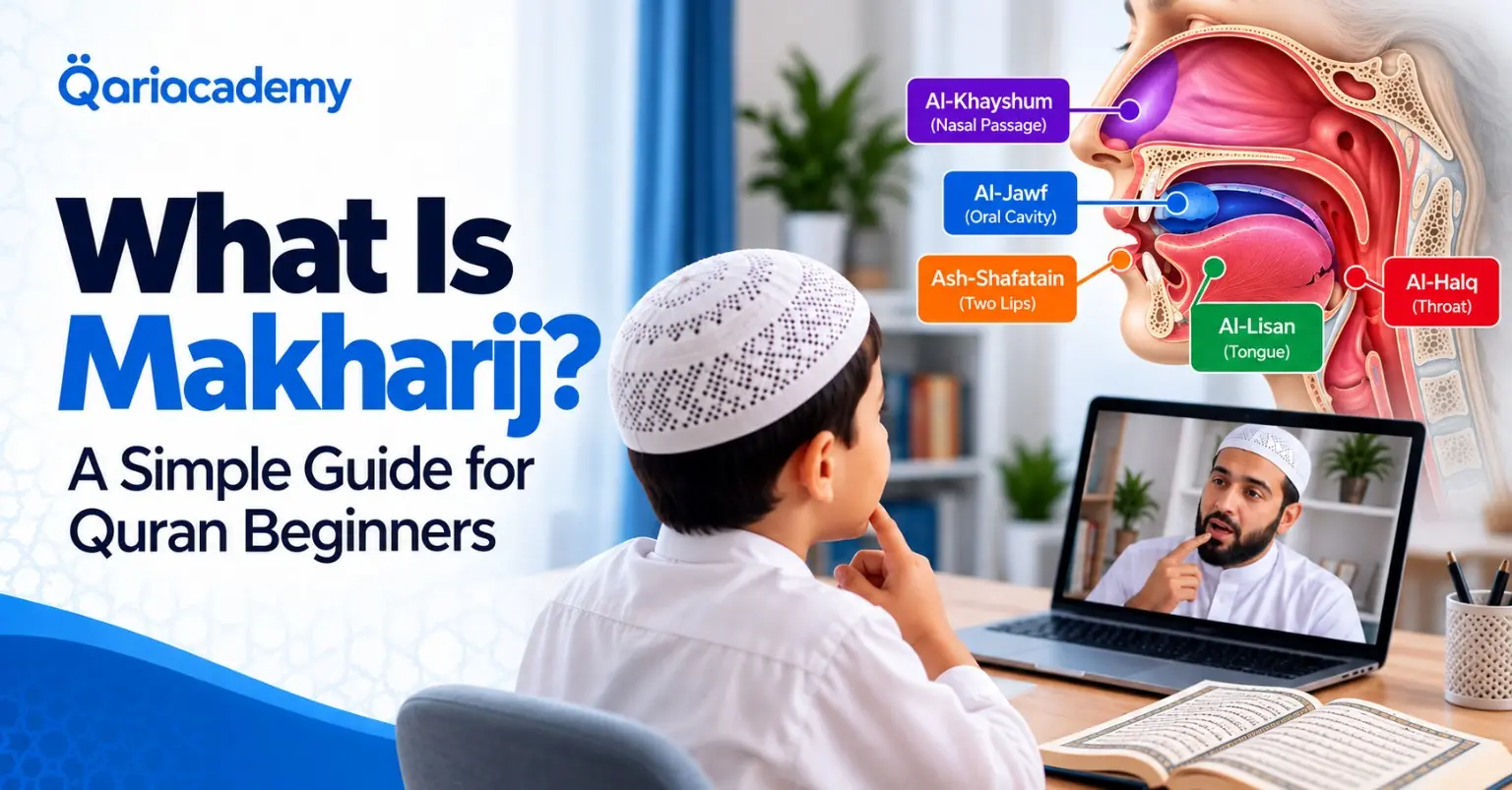
If you are learning to read the Quran and your teacher tells you to work on your Makharij, you may wonder what that word actually means.
Makharij is one of the foundations of accurate Quran recitation. It refers to the specific articulation points from which Arabic letters are produced. In simple terms, it teaches you where a letter should come from when you pronounce it.
This matters because Arabic contains sounds that may not exist in English or other languages. A learner may recognize the correct letter on the page but still pronounce it from the wrong place.
For Quran beginners, understanding Makharij does not mean memorizing a complicated Tajweed textbook. It means learning how your tongue, lips, throat, and mouth work together to produce Arabic letters correctly.
Once this foundation becomes stronger, other areas of Tajweed become easier to develop.
What Does Makharij Mean?
The Arabic word Makhraj (مَخْرَج) refers to the point or place from which a letter emerges. Makharij (مَخَارِج) is the plural.
In Quran recitation, Makharij al-Huruf means the articulation points of the Arabic letters.
A simple way to understand the concept is to compare:
ك and ق
Both can sound somewhat similar to a beginner, but they are not produced from exactly the same place.
The same applies to pairs such as:
- س and ص
- ت and ط
- د and ض
- ه and ح
- ك and ق
The difference is not simply an accent.
The position and movement of the speech organs matter.
This is why Makharij is introduced as a foundational part of Tajweed. QariAcademy’s Learn The Tajweed Rules: A Step-by-Step Guide for Beginners explains that correct pronunciation of Arabic letters, or Makharij, is one of the first foundations beginners should develop.
Why Is Makharij Important in Quran Recitation?
A beginner might think:
“If I know which letter is written, why do I need to study where it comes from?”
Because recognizing a letter visually and producing its sound correctly are two different skills.
A child may look at ح and know its name but pronounce it closer to ه.
An English-speaking learner may see ق but produce a sound closer to ك because English does not provide the same phonetic reference.
These problems can become habits if they are repeated for a long time.
QariAcademy’s article Common Tajweed Mistakes Made by English Speakers and How to Fix Them Online discusses why English-speaking learners often struggle with Arabic sounds that do not have direct equivalents in English.
The basic principle is:
See the letter → identify the letter → locate the articulation → produce the sound → receive correction → repeat.
| Without Makharij Awareness | With Makharij Awareness | Long-Term Benefit |
|---|---|---|
| Learner guesses the sound | Learner knows where it comes from | More accurate pronunciation |
| Similar letters become confusing | Differences become clearer | Better Quran reading |
| Errors may repeat | Teacher can isolate the sound | Easier correction |
How Many Makharij Are There?
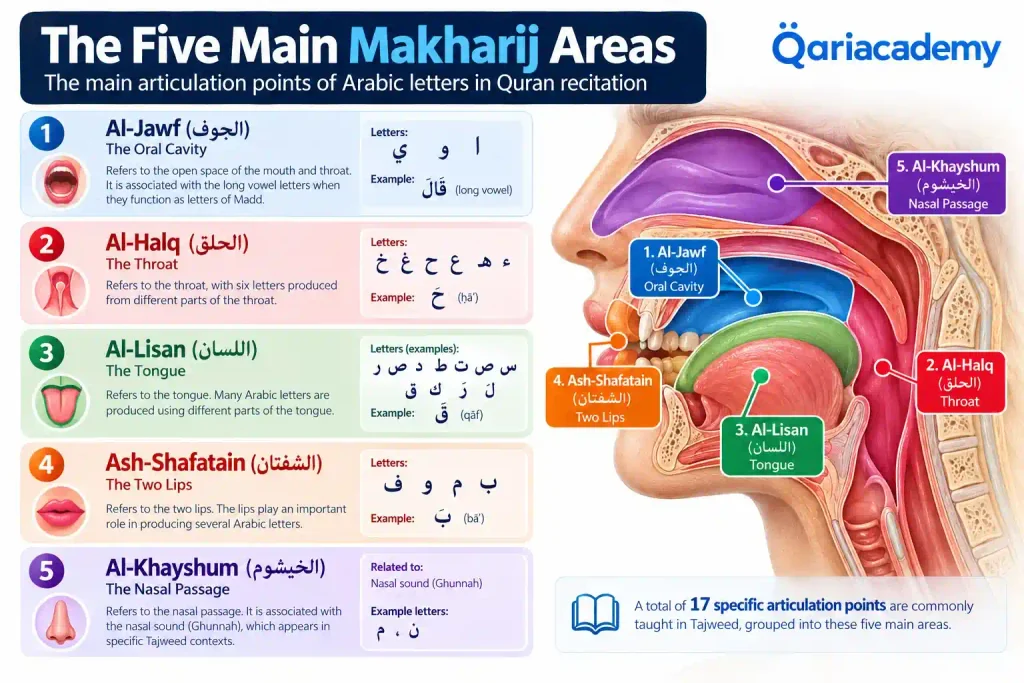
The commonly taught Tajweed classification identifies 17 specific articulation points grouped into 5 major areas.
The five areas are:
- Al-Jawf — the empty oral cavity
- Al-Halq — the throat
- Al-Lisan — the tongue
- Ash-Shafatain — the two lips
- Al-Khayshum — the nasal passage
For a complete beginner, you do not need to memorize all 17 points immediately.
It is more useful to understand the five major areas first.
Think of them as five broad regions where Arabic sounds are produced.
| Major Area | Meaning | Main Role |
|---|---|---|
| Al-Jawf | Oral cavity | Long vowel sounds |
| Al-Halq | Throat | Throat letters |
| Al-Lisan | Tongue | Large group of Arabic letters |
| Ash-Shafatain | Two lips | Lip-related letters |
| Al-Khayshum | Nasal passage | Ghunnah |
The traditional 17-point classification is widely taught in Tajweed, although classical scholars differed somewhat in how they counted and classified the articulation points. For beginners, learning the five major regions is usually more useful than becoming concerned with those technical differences.
1. Al-Jawf — The Empty Space of the Mouth
Al-Jawf (الجوف) refers to the open cavity of the mouth and throat.
The long vowel letters are associated with this area when they function as letters of Madd:
- ا
- و
- ي
For example, consider the long sound in words such as:
قَالَ
The sound is extended rather than produced by a specific point of contact between the tongue and another part of the mouth.
For beginners, the important idea is simple:
Al-Jawf is associated with the open flow of long vowel sounds.
You do not need to master advanced Madd terminology to understand this basic concept.
2. Al-Halq — The Throat
Al-Halq (الحلق) means the throat.
Several Arabic letters are produced from different areas of the throat.
These include:
ء — ه — ع — ح — غ — خ
For learners whose first language is English, some of these sounds can be particularly challenging.
For example:
- ه is different from ح
- ع is different from an ordinary English vowel sound
- خ does not have a direct equivalent in standard English
- غ also requires a sound unfamiliar to many beginners
This is one reason listening and teacher feedback are so valuable.
A written explanation can tell you that a sound comes from the throat.
It cannot completely replace hearing and producing the sound yourself.
QariAcademy’s Complete Online Quran & Tajweed Guide for Reverts (New Muslims) in the West also explains why unfamiliar Arabic sounds can be challenging for learners starting from zero.
3. Al-Lisan — The Tongue
Al-Lisan (اللسان) means the tongue.
This is the largest articulation region and includes many Arabic letters.
The exact position of the tongue changes depending on the letter.
This is where learners often need careful practice because moving the tongue slightly can produce a different sound.
Consider:
س / ص
or:
ت / ط
or:
ك / ق
A beginner may hear these differences only vaguely at first.
That is normal.
The objective is to gradually train both the mouth and the ear to recognize the difference.
QariAcademy’s article When Reading Outpaces Tajweed: How Children Develop Habits That Become Difficult to Correct specifically explains why Makharij should be developed early rather than waiting until a child has already developed strong reading habits.
4. Ash-Shafatain — The Two Lips
Ash-Shafatain (الشفتان) refers to the two lips.
Several Arabic letters depend heavily on lip position.
Examples include:
- ب
- م
- و
- ف
Try saying:
بَ
Your lips come together.
Now compare it with:
فَ
The lower lip interacts with the upper front teeth.
The physical difference may seem small, but it is important.
For beginners, practicing in front of a mirror can sometimes help because they can actually observe the movement of their lips.
| Letter | Main Area | Beginner Observation |
|---|---|---|
| ب | Lips | Lips close together |
| م | Lips | Lips close together |
| و | Lips | Rounded lips |
| ف | Lip + upper teeth | Lower lip meets upper front teeth |
The goal is not to make the learner obsess over anatomy.
The goal is to make the correct mouth position easier to reproduce.
5. Al-Khayshum — The Nasal Passage
Al-Khayshum (الخيشوم) refers to the nasal passage.
It is particularly associated with Ghunnah, the nasal quality heard in certain Quranic recitation rules.
This is different from simply “speaking through your nose.”
Ghunnah has specific applications within Tajweed.
For a beginner, it is enough to understand that the nasal passage plays an important role in certain Quranic sounds and rules.
More detailed rules such as Noon Sakinah, Tanween, and Meem Sakinah can be introduced gradually.
QariAcademy’s Quran Tajweed Step-by-Step: 30-Day Plan for Kids uses a progressive approach that starts with letters and sounds before moving into more advanced Tajweed patterns.
Visual Guide: The Five Main Makharij Areas
[Insert QariAcademy Makharij infographic here]
The illustration should show a simple front/side view of the mouth and throat with five clearly labeled areas:
- Al-Jawf — Oral cavity
- Al-Halq — Throat
- Al-Lisan — Tongue
- Ash-Shafatain — Lips
- Al-Khayshum — Nasal passage
A visual guide is particularly useful here because beginners can understand the physical locations much faster when they can see them rather than only read their names.
Makharij Is Not the Same as Tajweed
This distinction is important.
Tajweed is the broader system of principles used to recite the Quran correctly.
Makharij is one important component of that system.
A simple way to think about it is:
Makharij = Where the sound comes from
Sifaat = Characteristics of the sound
Tajweed = The broader framework for correct Quranic recitation
For example, knowing that ق comes from a particular part of the tongue helps establish its articulation.
But Tajweed involves much more than articulation alone.
It also includes areas such as:
- Letter characteristics
- Madd
- Ghunnah
- Noon Sakinah and Tanween
- Meem Sakinah
- Qalqalah
- Stopping and starting
This is why beginners should not try to memorize every Tajweed rule at once.
Build the foundation first.
Why Beginners Should Learn Makharij Early
One common misconception is:
“My child should first learn to read the Quran, and we can fix Tajweed later.”
There is some logic behind this. A child does need basic reading skills before applying many advanced Tajweed rules.
But that does not mean pronunciation should be ignored.
A better progression is:
Basic reading + correct pronunciation → stronger Quran reading → applied Tajweed → fluency
QariAcademy’s Learn The Tajweed Rules: A Step-by-Step Guide for Beginners places Makharij and correct letter pronunciation at the beginning of its step-by-step Tajweed framework.
This is particularly important for children.
If a child repeatedly pronounces a letter incorrectly, that pronunciation can become familiar.
Later, the teacher has to teach the correct sound while also helping the child replace the old habit.
How Should a Beginner Practice Makharij?
You do not need a one-hour Makharij session every day.
Focused practice is often more useful.
A simple practice cycle can be:
1. Choose One Difficult Letter
Do not practice ten difficult letters at once.
Choose one.
For example:
ح
2. Hear the Correct Sound
Listen to a qualified teacher or reliable reciter.
3. Watch the Mouth Position
Pay attention to what the tongue, throat, or lips are doing.
4. Produce the Sound
Try it yourself.
5. Receive Feedback
This is the part many self-learners miss.
You may think you are producing the sound correctly while a teacher can immediately hear the difference.
6. Repeat in Simple Combinations
Move from:
ح
to:
حَ — حِ — حُ
and eventually into words and Quranic examples.
| Practice Stage | Example | Purpose |
|---|---|---|
| Isolated letter | ح | Learn articulation |
| With Harakah | حَ حِ حُ | Stabilize pronunciation |
| Letter combination | Simple combinations | Connect sound and reading |
| Quranic word | Relevant Quranic example | Transfer the skill |
This progression is much more useful than simply reading a list of Makharij definitions.
Can You Learn Makharij Without a Teacher?
You can certainly study the concepts independently.
You can learn the five major regions, watch demonstrations, listen to recitations, and practice.
But accurate pronunciation is difficult to evaluate entirely by yourself.
You hear your own voice through your own body and internal hearing. A teacher hears the sound externally and can compare it with the intended pronunciation.
That is why live correction can be particularly valuable.
A useful learning cycle is:
Teacher demonstrates → Student attempts → Teacher listens → Teacher corrects → Student repeats
QariAcademy’s Online Quran Classes explains how beginner Quran classes can focus on Arabic alphabet, pronunciation, foundational reading skills, and Tajweed with guided instruction.
How Parents Can Help Children With Makharij
Parents do not need to become Tajweed teachers themselves.
Their most valuable role is to create an environment where practice is consistent and mistakes are safe.
You can:
- Encourage your child to repeat difficult letters.
- Ask the teacher which two or three sounds need the most attention.
- Practice briefly at home.
- Avoid making fun of pronunciation mistakes.
- Celebrate improvement rather than perfection.
- Avoid comparing your child with siblings or friends.
- Let the teacher handle detailed correction when possible.
QariAcademy’s The First 90 Days of Quran Learning: What Parents Should Expect emphasizes the importance of assessment, appropriate placement, regular correction, revision, and realistic progress expectations during the early stages of Quran education.
How QariAcademy Can Help
Makharij is much easier to understand when the learner receives individual feedback.
At QariAcademy, one-on-one Quran and Tajweed lessons allow the teacher to listen carefully to the student’s pronunciation, identify recurring errors, and adjust practice according to the learner’s level.
For a child, this can mean spending additional time on a few difficult sounds rather than moving through a fixed lesson simply because the lesson schedule says it is time to move on.
For an adult beginner, it can mean identifying the Arabic sounds that are most difficult because they do not exist in the learner’s first language.
The objective is not to overwhelm students with Tajweed terminology.
It is to help them hear, produce, correct, and apply the sounds gradually.
Conclusion
So, what is Makharij?
In simple terms, Makharij is the study of where Arabic letters are produced.
It helps Quran learners understand how the tongue, lips, throat, mouth, and nasal passage contribute to accurate pronunciation.
For beginners, you do not need to memorize every technical detail on your first day.
Start by understanding the five major articulation areas.
Then work on difficult letters individually.
Practice with Harakat.
Compare similar sounds.
Apply the sounds while reading the Quran.
And, most importantly, receive correction from someone who can actually hear whether your pronunciation is accurate.
Makharij is not about making your recitation sound sophisticated.
It is about building the physical foundation for reading the words of the Quran correctly.
Once that foundation becomes stronger, Tajweed becomes easier to apply, Quran reading becomes more confident, and the learner has a much stronger base for continued Quran development.
If you or your child would benefit from personalized Quran and Tajweed instruction, explore QariAcademy’s Quran Programs and find a learning path suited to your current level.
Frequently Asked Questions
1. What is Makharij in Tajweed?
Makharij refers to the articulation points from which Arabic letters are produced. It is an important foundation of Tajweed and helps learners pronounce Quranic letters accurately.
2. How many Makharij are there?
The commonly taught Tajweed classification identifies 17 specific articulation points within five major regions: Al-Jawf, Al-Halq, Al-Lisan, Ash-Shafatain, and Al-Khayshum.
3. Is Makharij the same as Tajweed?
No. Makharij is one component of Tajweed. Tajweed covers a broader set of principles for accurate Quranic recitation, including articulation, letter characteristics, Madd, Ghunnah, and other rules.
4. Why is Makharij difficult for English speakers?
Some Arabic sounds do not have direct equivalents in English. This can make letters such as ح, ع, خ, غ, ص, ض, ط, ظ, and ق unfamiliar to English-speaking learners.
5. Can children learn Makharij?
Yes. Children can learn correct articulation gradually. The teaching approach should be age-appropriate, with short practice sessions, demonstrations, repetition, and gentle correction.
6. Do I need a Quran teacher to learn Makharij?
A learner can study the concepts independently, but teacher feedback is highly valuable for pronunciation. A teacher can hear mistakes that learners may not notice themselves and provide specific corrections.