Table of Contents
Introduction: The Modern Dilemma of Islamic Education
For generations, the traditional Madrasa (local mosque weekend school or after-school Quran program) was the sole avenue for Muslim children and adults to learn Quranic recitation, memorization, and basic Islamic studies. Families would send their children to the neighborhood Islamic center every afternoon or weekend, relying entirely on local resources to preserve their Deen.
However, the rapid growth of digital technology—coupled with the demanding lifestyle of Muslim families living in Western nations like the USA, UK, Canada, and Australia—has created a major shift in Islamic education.
Parents now face a critical decision: Should they send their children to a local physical madrasa, or enroll them in a structured 1-on-1 online Quran academy?
While both options aim to connect students with the Book of Allah (SWT), they offer vastly different learning environments, teaching methodologies, schedules, and educational outcomes.
This comprehensive 3,000+ word comparison guide analyzes Online Quran Classes vs. Local Madrasa across every key metric—including instructor qualifications, Tajweed precision, safety, cost efficiency, and flexibility—helping you make the best choice for your family.
Part 1: Detailed Side-by-Side Comparison Matrix
To help you evaluate both options at a glance, the table below breaks down the key structural differences between modern 1-on-1 virtual academies like QariAcademy and traditional brick-and-mortar local madrasas.
| Feature / Metric | Traditional Local Madrasa | Specialized Online Quran Academy |
| Teacher Qualifications | Often limited to local community volunteers, students, or part-time imams. | Native Arab scholars holding degrees & Ijazah from Al-Azhar University. |
| Student-to-Teacher Ratio | Group settings (15 to 30+ students per teacher). | Dedicated 1-on-1 private instruction (1 student per teacher). |
| Learning Speed & Pacing | Fixed class pace determined by the group’s average capability. | 100% personalized pacing adapted to your child’s learning speed. |
| Correction Precision | High potential for unnoticed phonetic errors in noisy group settings. | Immediate micro-correction of every Tajweed slip in real-time. |
| Schedule & Flexibility | Fixed hours (e.g., Saturdays 10 AM–2 PM or weekdays after school). | 24/7 custom scheduling across all US/UK/Global time zones. |
| Commute & Convenience | Requires daily driving, traffic stress, and pickup/drop-off routines. | Zero commute; learn comfortably from home on laptop, PC, or tablet. |
| Parental Oversight | Low visibility; parents rarely sit inside the active classroom. | Full transparency; parents can watch live classes or review session logs. |
| Female Instructor Availability | Extremely limited or non-existent in smaller local communities. | Guaranteed access to verified female scholars for sisters and young kids. |
| Cost & Value | Tuition plus hidden commute costs (fuel, time, vehicle wear). | High-value direct tuition with flexible monthly family packages. |
Part 2: In-Depth Evaluation of Key Educational Factors
5 Core Comparison Pillars
- Instructor Quality: Local generalists vs. Native Al-Azhar scholars.
- Tajweed Accuracy: Group background noise vs. Micro-audio focus.
- Safety & Oversight: Closed physical doors vs. Open home learning.
- Time Efficiency: Hours in traffic vs. Direct home learning.
- Individual Attention: 1/30th teacher time vs. 100% focused attention.
1. Instructor Qualifications & Language Proficiency
Local Madrasa
In many Western communities, physical mosques struggle with staffing constraints. Teachers are frequently well-meaning local volunteers, older students, or imams who may not hold formal degrees in Quranic Recitation or Tajweed. Furthermore, language barriers can occur: older native-born imams may struggle with English fluency, while young Western-born assistants may lack deep classical Arabic training.
Online Quran Academy
Virtual platforms recruit globally, bypassing geographic limitations. Specialized academies like QariAcademy hire certified native Arab scholars—primarily graduates from prestigious institutions like Al-Azhar University in Cairo. These scholars hold traditional Ijazah credentials with continuous chains of narration (Sanad) back to Prophet Muhammad (PBUH) and speak fluent English tailored to Western students.
2. Student Attention & Correction Precision
Local Madrasa vs. Online Classroom Dynamics
Local Madrasa (Group Dynamic)
[Teacher Speaks to 25 Students simultaneously}
- Result: A student recites for only 2–3 minutes per hour.
- Errors in Tajweed often pass unnoticed in group noise.
Online Classroom (1-on-1 Dynamic)
$$\text{[Scholar]} \Longleftrightarrow \text{[Student]}$$
- Result: 100% active focus for 30–60 full minutes.
- Every single phonetic mistake is corrected instantly.
Local Madrasa
In a classroom of 20 to 30 children, a teacher can rarely give more than 2 to 5 minutes of direct 1-on-1 recitation time per child during a 2-hour session. The rest of the time, children sit passively filling out workbooks or repeating verses in unison, where subtle phonetic errors (Lahn Khafiy) easily go uncorrected.
Online Quran Academy
In a dedicated 1-on-1 virtual setting, 100% of the class time belongs to your child. The scholar listens intently through high-definition audio, identifying and correcting precise articulation points (Makharij), nasal lengths (Ghunnah), and vowel extensions (Mudood) the exact second they occur.
3. Safety, Supervision, and Parental Oversight
Local Madrasa
While mosques are sacred community spaces, sending young children to physical locations involves safety logistics. Parents must drop off their kids, rely on volunteer supervision during class breaks, and trust that environment controls are maintained behind closed doors.
Online Quran Academy
Online learning offers complete transparency and home-based physical safety:
- Classes take place directly in your living room or home office.
- Parents can sit next to their child, monitor tutor interactions, and assess teaching quality at any moment.
- Digital portals log class progress, attendance, homework assignments, and teacher notes automatically.
4. Time Efficiency and Lifestyle Integration
Living in modern Western metropolitan areas often means managing packed schedules filled with regular school, homework, sports, and family duties.
Traditional Madrasa Time Sink
[Drive 20 Mins]} + [Wait for Class 15 Mins]} + [2-Hour Group Class] + [Drive 20 Mins]
Total Time Spent: ~ 3 Hours (For 5 mins of actual recitation practice)
Online Classroom Time Efficiency
[Log In 1 Min]} + [30-Min High-Yield 1-on-1 Lesson]} + [Log Out 1 Min]
Total Time Spent: 32 Minutes (For 30 mins of active recitation practice)}
Online learning eliminates driving time and waiting periods, converting wasted commute hours into focused, productive learning time.
Part 3: Why Specialized 1-on-1 Online Learning Excels for Specific Demographics
Different family members have distinct educational needs. Here is how online Quran instruction adapts to various student profiles:
1. Young Children (Ages 4 to 10)
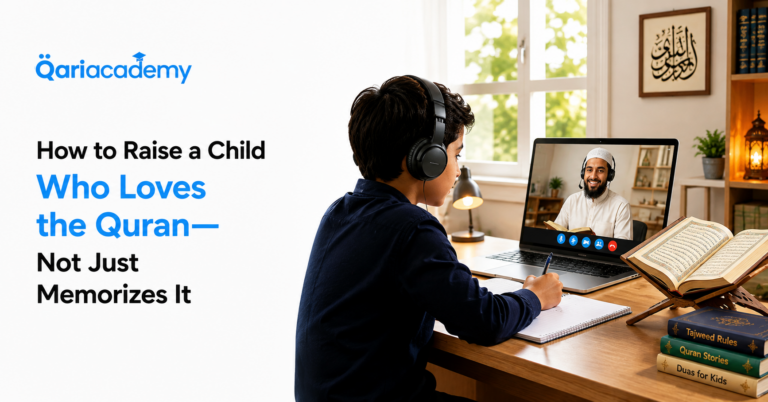
Young children easily get distracted in large, noisy group classrooms. 1-on-1 online tutors use gamified learning tools, digital whiteboards, interactive screen sharing, and short, highly engaging 30-minute sessions that hold young minds focused while building visual-auditory connections.
2. Adult Learners and Reverts (Converts)
Adults who want to learn Quran reading or Tajweed often feel embarrassed sitting in local physical classes alongside young children. Online academies provide complete privacy, dignity, and a non-judgmental environment where adults can learn at their own pace without hesitation.
3. Muslim Sisters and Adult Women
Finding qualified female Quran scholars locally can be challenging in many Western cities. Online platforms grant instant access to a large network of verified female scholars holding higher degrees and Ijazah, ensuring a comfortable, private environment for sisters.
Part 4: Common Myths About Online Quran Learning Addressed
Despite its widespread adoption, some parents hold outdated assumptions regarding online Quran instruction.
Myths vs. Reality in Online Learning
- Myth 1: “Children can’t focus on a laptop screen for Quran.”
- Reality: 1-on-1 direct interaction keeps kids 10x more engaged than sitting passively in a 30-student physical room.
- Myth 2: “Online tutors cannot correct complex Tajweed properly.”
- Reality: HD audio headsets allow native Arab scholars to hear subtle vocal placement far clearer than in a noisy room.
Part 5: Why QariAcademy Is the Premier Virtual Solution
At QariAcademy, we have built a modern digital learning environment designed specifically to address the challenges faced by Western Muslim families.
The QariAcademy Advantage
- Al-Azhar Certified Tutors: Native Arab scholars with Ijazah.
- Custom Bilingual Curriculum: Easy English explanations for kids.
- Advanced Virtual Classrooms: HD audio, whiteboards, & portal logs.
- Total Scheduling Freedom: Re-schedule or adjust anytime online.
- World-Class Al-Azhar Scholars: We select top-tier native Arab tutors holding Ijazah qualifications from Al-Azhar University, ensuring your family learns authentic Quranic phonetics.
- Fluent English Communication: Language barriers are eliminated; complex Tajweed mechanics are explained clearly in accessible English.
- Complete Scheduling Control: Book, reschedule, or adjust classes around your work, school, and family schedule with ease.
- Dedicated Progress Tracking: Receive regular digital updates detailing completed Surahs, Tajweed rules mastered, and personalized homework exercises.
Frequently Asked Questions (FAQ)
Q1: Is an online Quran class as religiously valid as learning in a physical mosque?
Answer: Yes, absolutely. The core requirement of Quranic learning is authentic oral transmission from a qualified scholar to a student. Throughout Islamic history, scholars have utilized the best available communication technology of their eras to teach sacred knowledge.
Q2: What hardware or software do we need to start online classes?
Answer: All you need is a reliable internet connection, a computer, laptop, or tablet, and a simple headset with a microphone for clean, clear audio transmission.
Q3: Can we combine online Quran reading with Islamic Studies?
Answer: Yes! QariAcademy offers integrated customized curricula that combine Quran reading, Tajweed, Islamic Studies (Aqidah, Seerah, Fiqh of daily worship), and daily Duas into one complete educational track.
Q4: How do prices compare between local madrasas and online academies?
Answer: When factoring in commute costs, fuel, vehicle wear, and time spent driving, private 1-on-1 online instruction at QariAcademy often delivers significantly higher educational value per dollar than traditional group tuition.
Conclusion: Making the Right Choice for Your Family’s Spiritual Growth
Both local madrasas and online academies seek to preserve the light of the Quran in our hearts. However, when evaluating educational quality, Tajweed precision, scheduling flexibility, safety, and individual student focus, 1-on-1 online learning offers clear structural advantages for the modern Western family.
Do not let geographic limitations or busy schedules hinder your child’s Quranic growth.
Experience the Difference Today with QariAcademy
Elevate your family’s Quran learning journey with private 1-on-1 instruction from certified native Arab scholars.
🎁 Claim Your FREE 1-on-1 Assessment & Trial Lesson Today
Experience our virtual classroom, meet your scholar, and receive a customized learning roadmap—100% free with zero obligation.
👉 [Click Here to Register for Your Free Trial at QariAcademy]