Introduction
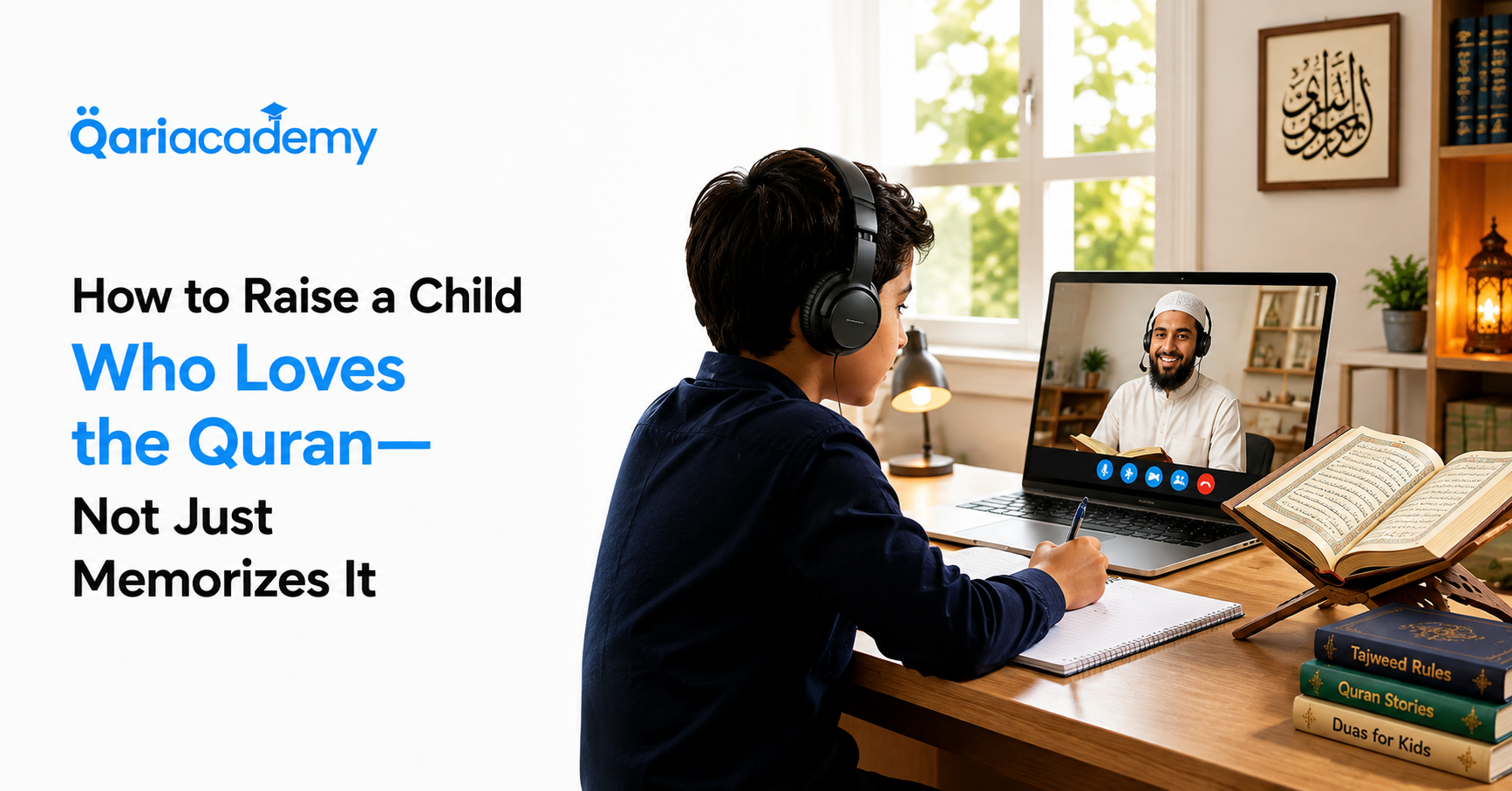
How to Raise a Child Who Loves the Quran—Not Just Memorizes It is a question that goes much deeper than memorization schedules and daily lesson plans.
A child can memorize many Surahs and still grow up feeling that the Quran is something they were required to study during childhood.
Another child may memorize more slowly but begin opening the Mushaf independently, listening to recitation, asking what verses mean, and returning to the Quran even when nobody reminds them.
Which child is developing the stronger relationship?
The second.
Memorization is an important part of Quran education, but it should not become the only definition of success. Allah describes the Quran as guidance: “Indeed, this Quran guides to that which is most suitable.”
And the Prophet ﷺ said: “The best among you are those who learn the Quran and teach it.”
The goal, therefore, is not simply to raise a child who can recite a large amount from memory.
It is to raise a child who gradually knows the Quran, understands it, feels connected to it, and wants to keep returning to it.
Love Should Be Built Alongside Learning
Parents sometimes make an understandable mistake: they focus so heavily on achievement that the emotional experience of learning gets overlooked.
The child hears:
“Did you memorize today’s verses?”
“How many pages did you finish?”
“Why did you forget?”
“Your brother is ahead of you.”
Over time, the child may begin measuring the Quran by performance rather than connection.
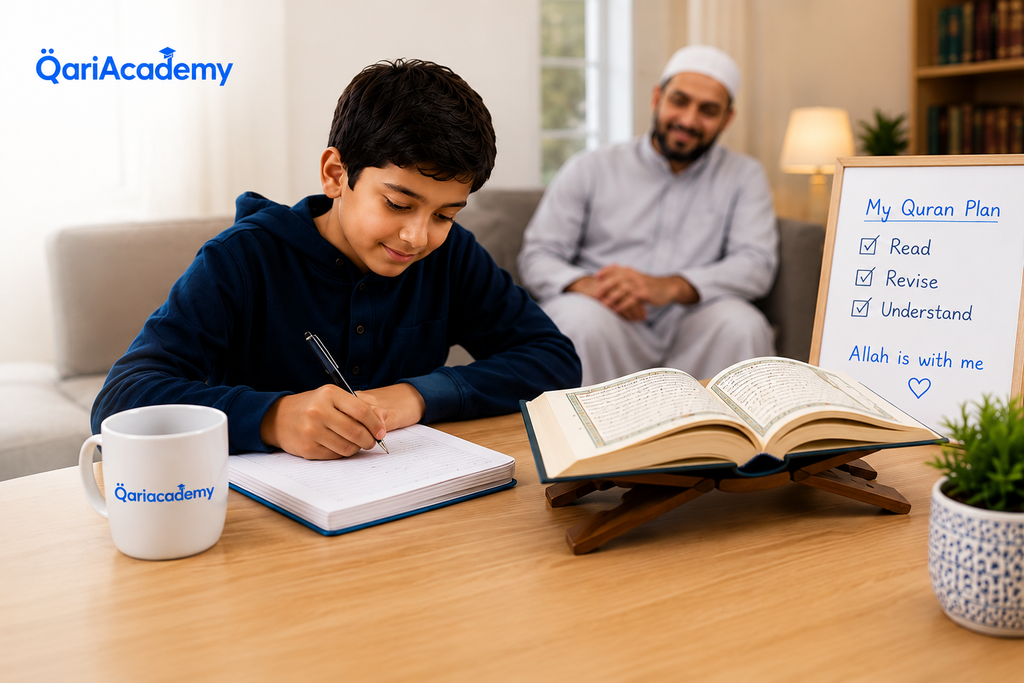
A healthier approach combines expectations with warmth.
| Instead of Focusing Only On | Also Build |
|---|---|
| Pages memorized | Understanding |
| Speed | Accuracy |
| Completion | Retention |
| Teacher correction | Confidence |
| External rewards | Internal motivation |
This does not mean lowering standards.
It means teaching the child that the Quran is worth learning because it is the Book of Allah, not merely because adults are measuring their performance.
QariAcademy’s How to Make Your Child Love Daily Quran Recitation Without Pressure explores how positive environments, achievable routines, encouragement, and meaningful engagement can help children develop a healthier relationship with daily recitation.
Let Your Child Experience the Quran, Not Just Recite It
A child who only hears, “Repeat after me,” may become good at repetition without developing curiosity.
Instead, occasionally ask simple questions:
- What do you think this verse is teaching us?
- Which word did you recognize?
- What happened in this Surah?
- How could we apply this lesson today?
- Which part did you enjoy?
The questions should match the child’s age.
A five-year-old does not need a detailed Tafsir lesson.
A ten-year-old can begin discussing the meaning of short Surahs.
A teenager can explore themes, vocabulary, context, and how Quranic guidance relates to real decisions.
Allah says:
﴿أَفَلَا يَتَدَبَّرُونَ الْقُرْآنَ﴾
“Do they not then reflect on the Quran?”
That gives parents an important principle: Quran learning should gradually move from pronunciation toward understanding and reflection.
Make Meaning Part of Memorization
You do not have to choose between Hifz and understanding.
They can reinforce each other.
Suppose your child is memorizing Surah Al-Asr. Alongside memorization, discuss the basic meaning of words such as Asr, khusr, iman, and sabr in an age-appropriate way.
When the child later hears those words, they are no longer just sounds.
They carry meaning.
| Learning Layer | Child Begins To Ask |
|---|---|
| Reading | “How do I read this?” |
| Tajweed | “How do I recite it correctly?” |
| Memorization | “Can I remember it?” |
| Understanding | “What does it mean?” |
| Reflection | “What does it teach me?” |
| Application | “How should I act?” |
This is one reason QariAcademy’s Beyond Memorization: What Does It Really Mean for a Child to “Learn” the Quran? argues that genuine Quran learning includes reading, accurate recitation, memorization, understanding, reflection, and gradually increasing independence.
Don’t Turn Hifz Into a Race
There is nothing wrong with ambitious memorization goals.
The problem begins when quantity becomes more important than retention and the child’s overall development.
A child who memorizes ten verses quickly but forgets them shortly afterward has not necessarily progressed more meaningfully than a child who memorizes five verses and retains them accurately.
QariAcademy’s recent guide, Hifz for Kids: How Much Quran Should a Child Memorize Each Week?, emphasizes that the better question is not simply how much a child memorizes, but how much they can accurately retain, review, and recite without becoming overwhelmed.
A sustainable Hifz structure should therefore include:
New memorization → Recent revision → Older revision
Revision is not lost time.
It is part of memorization.
Protect the Child’s Confidence
A child who repeatedly hears that they are slow, forgetful, or behind may eventually stop believing they can improve.
This is especially dangerous because Quran learning requires persistence.
Mistakes should be corrected, but correction should communicate:
“You can improve this.”
not:
“You are bad at Quran.”
| Healthy Feedback | Harmful Pattern |
|---|---|
| “Let’s try that verse again.” | “You always forget.” |
| “Your pronunciation improved.” | “Why can’t you do this?” |
| “This part is difficult; we’ll practice it.” | “This should be easy.” |
| “You made fewer mistakes today.” | “Look how far behind you are.” |
QariAcademy’s The Psychology of Quran Learning: How Confidence, Motivation, and Mastery Shape a Child’s Progress explains why confidence, competence, motivation, appropriate challenge, and the teacher-child relationship can influence how children approach Quran learning.
Give Children Reasons to Look Forward to Quran Time
“Fun” does not mean turning Quran into a game all the time.
It means making learning engaging enough that the child does not experience every lesson as a burden.
Depending on age, this could include:
- Short focused activities
- Stories from the Quran
- Listening to beautiful recitation
- Visual progress tracking
- Reading together
- Simple Quran vocabulary
- Asking questions
- Celebrating genuine improvement
For younger children especially, long periods of passive correction can quickly reduce engagement.
QariAcademy’s Make Quran Learning Fun for Kids Online recommends interactive learning, active participation, storytelling, focused sessions, and positive reinforcement.
Let the Family Model Quran Love
Children notice what adults do far more than what adults tell them.
If the parent says:
“You need to read Quran.”
but the child rarely sees the parent open the Mushaf, the message becomes weaker.
Instead, let your child occasionally see you:
- Reading Quran
- Listening to recitation
- Reflecting on a verse
- Making Dua
- Referring to Quranic guidance in everyday life
The goal isn’t to perform religiosity for the child.
It is simply to make the Quran visibly present in family life.
Create a Routine That Can Survive Real Life
A perfect schedule that lasts two weeks is less valuable than a modest routine that survives school, sports, travel, exams, and family responsibilities.
This matters especially for Muslim families in the USA, UK, and Canada, where children may spend most of their day in English-speaking schools and have demanding extracurricular schedules.
QariAcademy’s A Realistic Hifz Routine for Busy Muslim Children emphasizes fitting Quran learning into a child’s real life rather than attempting to make memorization consume every available hour.
A realistic routine might be:
School day: 10–15 minutes of review
Quran lesson day: Lesson + short home revision
Weekend: Longer family reading or meaning discussion
The exact schedule should be individualized.
Consistency matters more than creating an impressive timetable.
Don’t Let Screens Become the Enemy
You probably cannot eliminate gaming, YouTube, tablets, or other digital entertainment from a modern child’s life.
Trying to make Quran “compete” directly with highly stimulating entertainment is also unlikely to work.
Instead, create predictable boundaries.
For example:
Homework → Quran → Free time
or:
After Maghrib → Quran routine → Gaming
The child learns that Quran is simply one normal part of the day.
The goal is not:
“You can play only after you suffer through Quran.”
It is:
“Quran is part of our family rhythm.”
Choose a Teacher Who Understands the Child
A teacher can dramatically influence how a child feels about Quran learning.
A technically knowledgeable teacher who constantly overwhelms a child may not produce better long-term results than a teacher who combines knowledge with patience, encouragement, and appropriate challenge.
Look for a teacher who can answer:
- What is my child’s current level?
- What is holding them back?
- What should we prioritize next?
- How much revision do they need?
- How can we improve their confidence?
- Is the material too easy or too difficult?
QariAcademy’s How to Support Your Child’s Quran Learning Online highlights the value of communication, consistency, parent support, and individualized one-on-one learning.
Adjust the Approach as Your Child Gets Older
The child who needs songs, repetition, and short activities at age five may need something completely different at age twelve.
| Age/Stage | Main Priority | Parent’s Role |
|---|---|---|
| Young child | Familiarity and positive experience | Model and encourage |
| Early reader | Reading and confidence | Maintain consistency |
| Developing learner | Tajweed, Hifz, revision | Support the routine |
| Older child | Meaning and deeper skills | Discuss and guide |
| Teenager | Independence and ownership | Mentor rather than manage |
As children grow, gradually move from:
Parent reminds → Child remembers
Teacher directs → Child participates
Teacher corrects → Child self-corrects
External motivation → Internal motivation
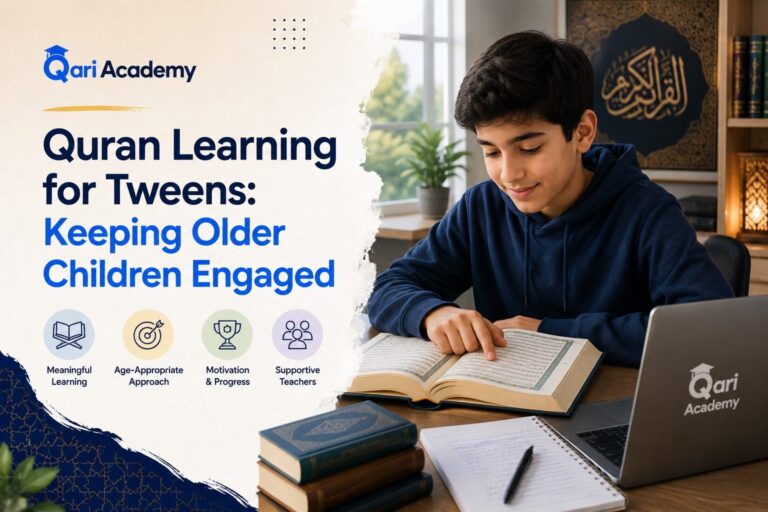
QariAcademy’s Quran Learning for Tweens: How to Keep Kids Engaged discusses this transition toward autonomy, self-correction, goal-setting, and shared responsibility.
What If Your Child Already Dislikes Quran?
Don’t immediately respond with more pressure.
First ask why.
| Possible Problem | Better Question |
|---|---|
| Lessons feel boring | Is the material too repetitive? |
| Child avoids Hifz | Is the workload realistic? |
| Frequent mistakes | Is the foundation strong enough? |
| Child feels behind | Are we comparing them too much? |
| Resistance after school | Is the timing appropriate? |
| Loss of interest | Does the child understand why they are learning? |
Sometimes the solution is not to demand more.
It may be to change the method.
QariAcademy’s When Hifz Becomes Stressful: How to Protect Your Child’s Love for the Quran explores the cycle that can develop when pressure leads to anxiety, weaker performance, more correction, and even more pressure.
A Simple 7-Day Plan for Parents
You don’t need to transform your child’s entire Quran education this week.
Try these five steps:
- Choose one short daily Quran time that is genuinely realistic.
- Spend five minutes on meaning, not just memorization.
- Praise one specific improvement rather than only praising completion.
- Read Quran yourself where your child can naturally see you.
- Ask one meaningful question about what your child learned.
At the end of the week, ask yourself:
Is my child only becoming better at reciting Quran, or are they also becoming more comfortable, curious, confident, and willing to return to it?
That is a much more valuable measurement.
Conclusion
Learning the Quran is not a race to produce the largest memorization number at the youngest age.
Hifz is beautiful.
Tajweed is essential.
Reading fluently is important.
But these skills become even more meaningful when they lead somewhere deeper.
Toward understanding.
Toward reflection.
Toward good character.
Toward independence.
And ultimately, toward a relationship with the Quran that continues long after childhood.
Allah describes the Quran as a source of guidance, and describes hearts becoming softened through remembrance of Him.
So if you want to know how to raise a child who loves the Quran—not just memorizes it, begin by changing what you measure.
Don’t only ask:
“How much did my child memorize?”
Also ask:
“Does my child understand more?”
“Is their recitation improving?”
“Are they retaining what they learned?”
“Do they feel confident?”
“Are they beginning to return to the Quran independently?”
And eventually, the most meaningful question:
“When nobody is telling my child to open the Quran, will they still want to?”
That is the long-term goal.
For parents who want a structured learning environment that can develop reading, Tajweed, Hifz, revision, and understanding according to the child’s individual level, QariAcademy’s one-on-one Quran programs can provide a personalized path rather than forcing every child through the same approach.
Explore QariAcademy’s Online Quran Programs
Frequently Asked Questions
How do I make my child love the Quran?
Build positive associations, keep the routine realistic, model Quran engagement yourself, connect memorization with meaning, and avoid making every Quran interaction a test of performance.
Should my child memorize Quran even if they don’t understand it?
Memorization can begin before full understanding, especially with younger children. However, meaning should gradually be introduced according to the child’s age and ability.
Is memorizing more Quran always better?
No. Retention, accurate recitation, revision, understanding, and sustainable learning are also important measures of progress.
What if my child hates Quran lessons?
First identify the reason. The workload, lesson timing, teaching style, difficulty level, repeated correction, or lack of understanding may all contribute. Increasing pressure without identifying the cause can make the problem worse.
How can parents support Quran learning without being Quran teachers?
Parents can create a consistent routine, listen, encourage, model Quran engagement, communicate with the teacher, and help the child maintain revision. They do not need to provide all the instruction themselves.
When should a child become independent in Quran learning?
Independence should develop gradually. As children mature, they can increasingly participate in setting goals, remembering practice times, identifying mistakes, and managing revision.
Internal Articles Used — 10 Verified Articles
- How to Make Your Child Love Daily Quran Recitation Without Pressure
- Beyond Memorization: What Does It Really Mean for a Child to “Learn” the Quran?
- Hifz for Kids: How Much Quran Should a Child Memorize Each Week?
- The Psychology of Quran Learning: How Confidence, Motivation, and Mastery Shape a Child’s Progress
- Make Quran Learning Fun for Kids Online
- A Realistic Hifz Routine for Busy Muslim Children
- Quran Learning for Tweens: How to Keep Kids Engaged
- When Hifz Becomes Stressful: How to Protect Your Child’s Love for the Quran
- How to Support Your Child’s Quran Learning Online
- Top Ways to Motivate Your Child to Continue Quran Memorization