Table of Contents
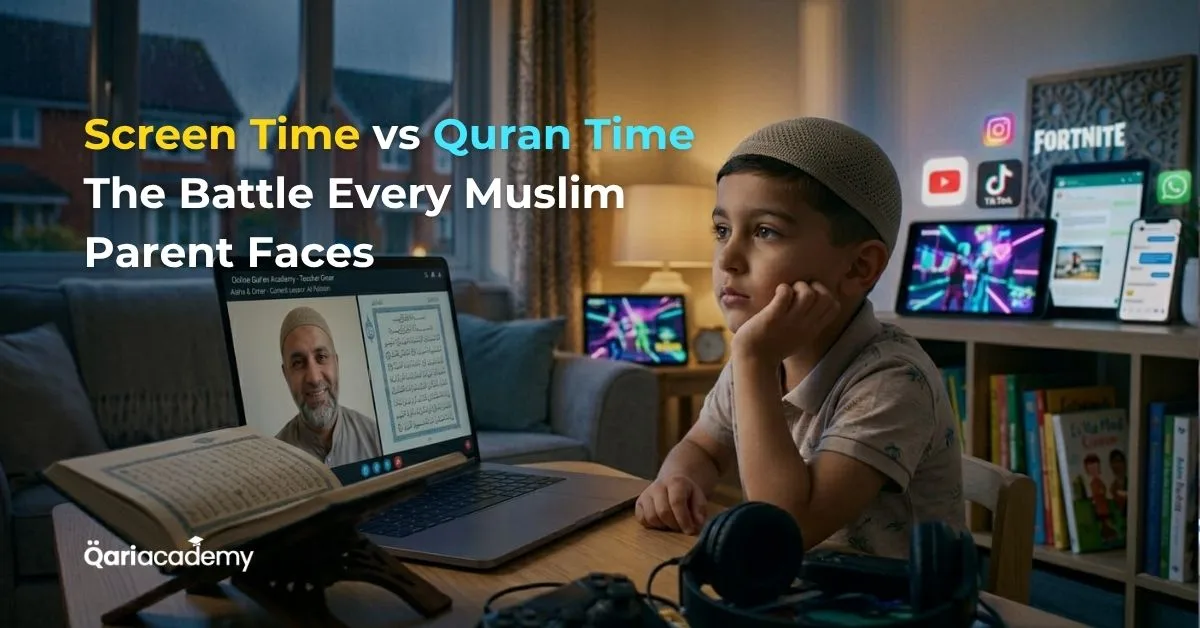
In the modern digital age, parents face an ongoing daily challenge: managing the delicate balance between Screen Time vs. Quran Time. Children today are born into a world saturated with digital devices, endless entertainment options, high-speed internet, and instant gratification. Smartphones, gaming consoles, tablets, and streaming platforms occupy a major portion of a child’s daily routine. When it comes time to sit down for religious education, parents often encounter resistance, lack of focus, and boredom. This creates an urgent question for Muslim families worldwide: how can we shift the dynamic of Screen Time vs. Quran Time so that learning the Book of Allah becomes an exciting, deeply engaging, and rewarding experience for distracted young minds?
The challenge is not simply about removing devices or banning technology. In fact, total prohibition often leads to frustration and resentment. Instead, the true solution lies in redirecting that digital energy. By transforming the online learning environment into an interactive, visually stimulating, and structured routine, we can balance Screen Time vs. Quran Time effectively. Rather than allowing technology to be a source of distraction, we can harness digital tools to foster a lifelong love for Quran recitation, Tajweed, and memorization.
The Neurobiology of Attention: Why Kids Prefer Screen Time over Quran Time
To solve the friction between Screen Time vs. Quran Time, parents and educators must first understand how modern technology affects a child’s brain development and attention span. Today’s entertainment platforms are engineered using complex algorithms designed to trigger frequent releases of dopamine—the chemical responsible for pleasure, motivation, and reward.
- Dopamine Loops in Video Games: Fast-paced video games deliver instant feedback, vivid animations, score counters, and immediate rewards. This conditions the child’s brain to expect rapid stimulation every few seconds.
- Passive Content Consumption: Platforms featuring short-form videos demand zero mental effort or active participation. The brain becomes accustomed to passive intake without needing to concentrate deeply.
- The Static Nature of Traditional Pedagogy: When a child moves from an intense digital gaming session directly to a traditional Quran lesson involving static pages and repetitive drills, their brain experiences an immediate sensation of boredom.
This sensory drop-off explains why the struggle between Screen Time vs. Quran Time feels so intense. The child’s brain is not inherently rejecting the Holy Quran; rather, it is suffering from a sensory deficit caused by high-dopamine digital consumption. To overcome this hurdle, online Quran education must adapt by offering high-energy, interactive, and structured learning methods that keep young minds genuinely interested.
The Hidden Costs of Unregulated Screen Time on Childhood Development
Unmonitored and excessive digital exposure has severe impacts on a child’s cognitive, emotional, and spiritual well-being. When Screen Time vs. Quran Time is left unmanaged, the consequences go far beyond simple distraction during class.
- Shortened Attention Spans: Constant task-switching between social apps and video games damages a child’s ability to engage in deep work or sustained study, which is essential for Quran memorization (Hifz).
- Cognitive Fatigue: Excessive screen viewing depletes mental energy, leaving children exhausted, irritable, and unable to focus when it is time for evening Quran lessons.
- Loss of Spiritual Connection: When entertainment occupies the majority of a child’s waking hours, spiritual reflections and moral values are pushed to the background, creating a gap in their Islamic upbringing.
By actively addressing the conflict of Screen Time vs. Quran Time, parents protect their children from the mental exhaustion caused by passive media consumption while instilling divine values that guide their character and morality.
Bridging the Gap: Transforming Digital Exposure into Spiritual Growth
The core philosophy of balancing Screen Time vs. Quran Time is not to view technology as the enemy, but as a bridge. Online Quran learning platforms have revolutionized access to Islamic education, allowing qualified teachers to connect with students anywhere in the world. However, simply placing a child in front of a web camera with an electronic PDF is not enough.
To make Screen Time vs. Quran Time a productive balance, online classes must incorporate multi-sensory engagement techniques. Children learn best when they can see, hear, interact, and receive positive reinforcement in real-time. When digital tools are paired with child-centered pedagogy, screen time ceases to be a mindless distraction and becomes a powerful gateway to learning the Word of Allah.
This paradigm shift requires a structured approach that includes gamified learning, personalized instruction, and a home environment optimized for focus. When parents partner with professional online academies that understand modern child psychology, winning the battle of Screen Time vs. Quran Time becomes an attainable and joy-filled reality.
Start Your Child’s Journey with Qari Academy
Is your child struggling to stay focused during online Quran lessons? It is time to turn screen time into a productive, rewarding experience with Qari Academy.
At Qari Academy, we specialize in bridging the gap between digital distraction and Quranic excellence. Our expert, certified tutors are specially trained in child psychology and modern interactive teaching techniques designed to keep young students engaged, motivated, and excited to learn.
- 1-on-1 Interactive Classes: Customized lessons tailored specifically to your child’s learning speed and interest.
- Certified Tajweed Experts: Friendly, patient teachers who make complex Tajweed rules simple and fun.
- Gamified Progress Tracking: Interactive milestones and real-time encouragement that keep kids inspired.
Don’t let endless screen distraction compromise your child’s spiritual growth. Join Qari Academy today and discover how engaging online Quran learning can be!
Screen Time vs. Quran Time: How to Make Online Classes Engaging for Distracted Kids (Part 2)
Continuing our deep dive into the dynamic of Screen Time vs. Quran Time, we move from understanding the neurobiological challenges to implementing practical, actionable educational strategies. Once parents and educators recognize that digital devices naturally condition children for constant stimulation, the objective becomes clear: we must design Quran lessons that match or exceed that level of engagement. Transforming passive digital distraction into active spiritual devotion requires structured pedagogical techniques that turn the struggle of Screen Time vs. Quran Time into a seamless, enjoyable daily habit.
To bridge this gap effectively, online Quran education must embrace modern learning psychology. By borrowing proven engagement principles from interactive software—such as gamification, chunked learning sessions, and multi-sensory feedback—we can transform the way children approach Tajweed, recitation, and Hifz.
Strategy 1: Gamifying the Quran Learning Process
Gamification is one of the most effective tools for winning the battle of Screen Time vs. Quran Time. Children do not love video games merely because of graphics; they love them because games satisfy their innate desire for achievement, feedback, and progression. When these same motivational mechanics are applied to Quran education, children develop an eager interest in their lessons.
Key Elements of Gamified Quran Education:
- Interactive Badges and Achievements: Assigning visual rewards for completing specific milestones—such as mastering the rules of Noon Sakinah, reciting Surah Al-Mulk without error, or maintaining a 10-day attendance streak—provides immediate positive reinforcement.
- Leveling Up: Instead of presenting Quran learning as an endless, overwhelming task, break the curriculum into clear levels (e.g., Level 1: Basic Arabic Letters; Level 2: Short Vowels; Level 3: Introductory Tajweed). This gives children a clear sense of advancement.
- Visual Quest Maps: Utilizing digital roadmaps where students can track their progress through the Juz’ visually helps convert abstract learning into a tangible journey.
When gamification is integrated thoughtfully, the traditional friction point between Screen Time vs. Quran Time vanishes. The screen transforms from a source of mindless entertainment into a rewarding platform for spiritual achievement.
Strategy 2: The Micro-Session Framework (Chunking Method)
A primary reason children lose focus during online classes is cognitive overload. Asking a young child accustomed to fast-paced digital media to sit quietly through a 60-minute passive lecture is unrealistic. To master Screen Time vs. Quran Time, online instruction should utilize the chunking method—breaking lessons down into dynamic, micro-activity blocks.
| Time Block | Target Activity | Cognitive Purpose |
| 00 – 05 Min | Warm-Up & Recitation Review | Reactivates prior memory without introducing heavy new material. |
| 05 – 15 Min | Core Instruction (New Verses or Tajweed) | Capitalizes on peak focus for high-density learning. |
| 15 – 20 Min | Interactive Quiz / Educational Game | Tests understanding while resetting attention spans through fun interaction. |
| 20 – 30 Min | Guided Practice & Multi-Sensory Drill | Encourages active student participation, voice repetition, and visual coding. |
By switching activities every 5 to 10 minutes, educators prevent mental fatigue and keep the child’s brain continually stimulated. This structured variety ensures that during Screen Time vs. Quran Time, the time spent with the Quran is energetic, high-yield, and entirely focused.
Strategy 3: Multi-Sensory Digital Tools in Action
Digital screens do not have to compete with religious study; they can enhance it when multi-sensory techniques are applied. The modern online classroom allows teachers to engage auditory, visual, and kinesthetic learning channels simultaneously, making Screen Time vs. Quran Time a mutually reinforcing process.
- Color-Coded Tajweed Interfaces: Visual learners benefit enormously from digital Mushafs that use distinct colors for rules like Ghunnah, Iqlab, and Madd. Allowing the child to highlight these rules directly on an interactive screen turns rule learning into an active puzzle.
- Synchronized Audio-Visual Recitation: Listening to expert Qaris while watching words highlight in real-time strengthens correct pronunciation (Makharij) and aids memorization through dual-channel coding.
- Digital Whiteboards for Letter Tracing: Younger children learn letter shapes and joining rules much faster when they can draw and trace directly on an interactive screen using digital pens or touch interfaces.
Practical Comparison: Passive Screen Exposure vs. Active Quran Engagement
To illustrate how targeted digital methodology redefines Screen Time vs. Quran Time, consider how the same device functions under two different paradigms:
- Passive Screen Time: Child consumes uncurated online media $\rightarrow$ Low mental effort $\rightarrow$ Rapid dopamine spikes $\rightarrow$ Shortened attention span and irritability.
- Active Quran Time (Interactive Learning): Child interacts with certified tutor using digital tools $\rightarrow$ Active mental participation $\rightarrow$ Meaningful sense of accomplishment $\rightarrow$ Enhanced discipline and spiritual calm.
By substituting passive media consumption with structured digital Quran lessons, parents turn potentially harmful device usage into a powerful vehicle for character development.
Transform Your Child’s Learning Experience with Qari Academy
Balancing Screen Time vs. Quran Time requires the right educational partner. At Qari Academy, we combine modern interactive technology with traditional Islamic scholarship to create an unparalleled learning experience for young minds.
Our expert teachers know how to keep energetic and distracted children engaged throughout every lesson. Through gamified progress tracking, multi-sensory tools, and personalized 1-on-1 sessions, we make Quran education the highlight of your child’s daily routine.
- Child-Centered Teaching Methods: Lessons designed around your child’s unique personality, attention span, and learning pace.
- Interactive Digital Classrooms: Engaging whiteboards, real-time quizzes, and color-coded Tajweed tools that hold attention.
- Certified Native Arabic Tutors: Qualified teachers skilled in building warm, encouraging relationships with young learners.
Give your child the gift of engaging Quranic education today. Enroll in Qari Academy now and watch them thrive in both knowledge and spiritual devotion!
Screen Time vs. Quran Time: How to Make Online Classes Engaging for Distracted Kids (Part 3)
In our exploration of Screen Time vs. Quran Time, we have analyzed the neurological roots of digital distraction and established effective interactive teaching methods. However, even the most innovative curriculum can fail if the physical and psychological home environment works against it. Winning the daily dynamic of Screen Time vs. Quran Time requires a holistic partnership between the online academy, the certified instructor, and the home environment created by parents.
When parents align their home environment with interactive learning, children stop viewing religious education as a daily chore. Instead, they begin to view their dedicated online classes as an enjoyable, refreshing experience that stands out from their routine entertainment habits.
Optimizing the Physical Home Environment for Quran Study
Distractions rarely occur in a vacuum; they are heavily influenced by the immediate physical surroundings. To optimize the balance between Screen Time vs. Quran Time, parents must establish a physical space that minimizes sensory clutter and encourages cognitive focus.
Key Environment Rules:
- The Dedicated Learning Desk: Avoid holding online Quran classes on a bed or living room sofa where children relax or watch television. Create a fixed, quiet learning corner equipped with a comfortable chair and proper lighting.
- The Single-Tab Rule: Open tabs, background messaging apps, and desktop notifications are primary sources of distraction. Ensure that all non-class applications are closed before the session starts to keep attention fixed on the teacher.
- Secondary Screen Removal: Gaming consoles, smartphones, and secondary tablets should be moved entirely out of the child’s sightline during class. Removing the physical presence of alternative entertainment reduces internal friction.
By structuring the environment intentionally, parents send a clear psychological signal to the child: Quran Time is a dedicated, valued, and uninterrupted priority that commands full respect and focus.
The Role of the Online Teacher: From Reciter to Mentor
The battle of Screen Time vs. Quran Time cannot be won through stern discipline alone. It requires a fundamental shift in how educators connect with young minds. A certified teacher must act not merely as a corrector of Tajweed mistakes, but as an inspiring mentor who builds an emotional bridge with the student.
Effective Quran Teacher Traits:
- Empathy & Warmth: Builds immediate rapport, trust, and emotional comfort with the child.
- Dynamic Tone Control: Uses expressive voice modulation to prevent monotony during recitation.
- Constructive Praise: Reinforces even small steps of progress instantly to boost self-esteem.
- Patient Storytelling: Connects verse meanings and themes directly to the child’s daily life experiences.
When a tutor uses positive reinforcement—such as praising a student’s effort to correctly pronounce difficult Arabic letters like Haa (ح) or Ayn (ع)—the child experiences an authentic sense of internal pride. This emotional reward effectively replaces the quick dopamine hits offered by video games, successfully rebalancing Screen Time vs. Quran Time through personal connection and genuine growth.
Addressing Emotional Resistance: Mindful Parenting Strategies
It is entirely natural for children to display initial resistance when transitioning from entertainment screens to structured learning. How parents respond during these moments determines whether the child develops a positive or negative relationship with the Quran.
- Avoid Comparison: Comparing a distracted child to siblings or peers creates frustration and resentment toward religious study. Celebrate individual progress, no matter how small.
- Implement Bridge Routines: Moving immediately from an intense gaming match directly into a Quran lesson causes cognitive conflict. Insert a 10-minute “cool-down” buffer zone involving a light snack, fresh water, or wudu to reset the child’s mind.
- Connect Recitation to Context: Children engage deeply with stories. When learning a new Surah, share the historical context (Asbab al-Nuzul) or lessons behind the verses. Understanding the why transforms memorization into an inspiring narrative journey.
Combining emotional mindfulness with structured consistency ensures that Screen Time vs. Quran Time becomes a peaceful, unifying routine for the whole family.
A Direct Comparison: Environment Optimization Impact
| Environmental Variable | High Distraction Setup | Optimized Learning Setup (Qari Academy Approach) |
| Workspace Location | Bed, couch, or noisy common area | Quiet, dedicated desk with proper ergonomics |
| Device Configuration | Multiple open tabs, active notifications | Dedicated browser window, single-task focus |
| Transition Routine | Direct leap from video games to class | 10-minute cool-down buffer with Wudu |
| Teacher Interaction | Rigid correction only | Interactive, encouraging, story-driven mentorship |
Partner with Qari Academy for Lasting Success
Navigating the daily balance of Screen Time vs. Quran Time requires professional support, proven interactive methodologies, and compassionate tutors who genuinely care about your child’s spiritual and emotional development.
At Qari Academy, we specialize in transforming online Quran learning into a vibrant, engaging experience that fits seamlessly into your child’s world. Our certified, native Arabic tutors combine classical Tajweed expertise with modern pedagogical techniques designed specifically for distracted digital natives.
- Tailored 1-on-1 Sessions: Custom learning plans designed around your child’s personality, pace, and attention span.
- Child-Centric Pedagogy: Tutors who use warm encouragement, interactive digital tools, and engaging storytelling.
- Flexible Scheduling Options: Classes structured to fit your busy lifestyle without stressing your family routine.
Help your child build a lifelong, loving connection with the Word of Allah. Subscribe to Qari Academy today and watch their confidence and spiritual love grow!
Screen Time vs. Quran Time: How to Make Online Classes Engaging for Distracted Kids (Part 4)
As we conclude this comprehensive guide on managing Screen Time vs. Quran Time, we focus on long-term sustainability, concrete educational implementation, and preserving the spiritual fruits of this journey. Building a healthy, lifetime relationship with the Book of Allah is not a short sprint; it is an ongoing process of habit formation, emotional alignment, and gradual mastery. When digital tools are harnessed correctly, parents can successfully turn potential screen distractions into valuable opportunities for lifelong Islamic learning.
By integrating clear Tajweed milestones, maintaining a supportive family routine, and partnering with qualified educators, the dynamic of Screen Time vs. Quran Time permanently transforms from a source of daily friction into a rewarding spiritual habit for your children.
Making Tajweed Simple and Fun for Young Learners
One of the primary reasons children lose interest during online Quran sessions is the complex language used to explain Tajweed rules. Traditional terminology can feel dry or intimidating to young minds accustomed to fast-paced digital feedback. To win the battle of Screen Time vs. Quran Time, Tajweed concepts must be presented through intuitive, visual, and memorable techniques.
Interactive Tajweed Concepts:
- Color-Coded Visual Rules: Instead of relying solely on verbal definitions, use visual colors to represent phonetic rules. For instance, assign Green for Ghunnah (nasal sound), Blue for Qalqalah (bouncing sound), and Red for extended Madd (vowel lengthening). Children quickly spot these visual cues on their screens.
- Sound-Action Associations: Teach physical mechanics through engaging physical actions. For example, explain Qalqalah as a “bouncing ball sound” on specific letters ($\text{ق, ط, ب, ج, د}$), encouraging the child to make a gentle bouncing motion with their hand as they recite.
- Animal & Nature Analogies: Explain breath control and voice modulation using familiar concepts from nature. Comparing long vowels (Madd) to a smooth, flowing river helps children grasp duration without getting bogged down in complex linguistic rules.
Simplifying complex concepts turns Tajweed practice from a dry academic exercise into an engaging, interactive puzzle that keeps young minds fully attentive throughout Quran Time.
Long-Term Strategies for Sustainable Quranic Habits
Achieving a healthy balance between Screen Time vs. Quran Time requires consistency over intensity. Short, daily interactions produce far better memorization and character development than long, irregular sessions.
Sustainable Habit Building Formula:
- Micro-Consistency: 20 to 30 minutes of daily practice yields far better results than 2 hours once a week.
- Anchor to Existing Habits: Schedule Quran Time immediately following a fixed daily event, such as Salat Al-Asr.
- Celebrate Effort over Perfection: Praise focus, sincerity, and patience rather than focusing solely on perfect recitation.
- Family Role Modeling: Children naturally emulate what their parents practice daily with love and devotion.
When parents model these behaviors and establish fixed daily rhythms, children accept Quran Time as a natural, peaceful, and valued anchor in their daily routine.
Comprehensive Summary: Balancing Screen Time vs. Quran Time
Throughout this multi-part guide, we have examined the multi-faceted approach required to navigate the Screen Time vs. Quran Time dynamic in modern households:
- Understanding the Brain: Recognize that fast-paced digital screens condition children for high stimulation, requiring educators to use dynamic, multi-sensory teaching methods.
- Gamification & Structure: Utilize point systems, visual maps, interactive tools, and chunked lesson structures to maintain high motivation and prevent fatigue.
- Environment & Mentorship: Create a dedicated, distraction-free home learning space and partner with compassionate tutors who offer warm, positive encouragement.
- Interactive Tajweed: Present Quranic sciences through engaging visual colors, practical sound analogies, and intuitive learning exercises.
Give Your Child the Ultimate Spiritual Advantage with Qari Academy
Mastering the balance of Screen Time vs. Quran Time does not have to be a lonely or stressful battle. By partnering with Qari Academy, you gain access to a world-class online educational platform designed specifically to inspire, engage, and educate young digital natives.
At Qari Academy, we combine authentic Islamic scholarship with modern educational technology. Our certified, native Arabic tutors understand how to capture a child’s imagination, simplify complex Tajweed rules, and foster a genuine, long-lasting love for the Holy Quran.
- Tailored 1-on-1 Interactive Lessons: Customized instruction tailored to your child’s unique pace, personality, and focus style.
- Certified, Child-Friendly Instructors: Highly skilled teachers trained in modern child psychology and dynamic teaching methods.
- Engaging Digital Classrooms: Interactive whiteboards, gamified milestone tracking, and color-coded visual Tajweed tools.
- Flexible Global Scheduling: Effortlessly integrate live Quran classes into your family’s daily routine anywhere in the world.
Do not let mindless digital distractions undermine your child’s spiritual development. Transform screen time into a lifetime of blessings, confidence, and devotion today.
Subscribe to Qari Academy now and start your child’s interactive Quran journey!