Table of Contents
For many Muslim women, learning the Quran is a deeply personal journey.
Some sisters grew up in Muslim families and learned to read the Quran as children but never had the opportunity to develop their Tajweed properly. Others may have memorized several Surahs but feel uncertain about their pronunciation. Some are new Muslims who are opening the Quran for the first time. Others may have studied Arabic years ago and now want to rebuild their Quran reading skills from the beginning.
And there is another group that is often overlooked: women who already know how to read the Quran but want to improve.
They may want to correct their Makharij, improve their fluency, study advanced Tajweed, strengthen their Hifz, or simply recite the Quran with greater confidence and accuracy.
For all of these learners, private instruction can make a significant difference.
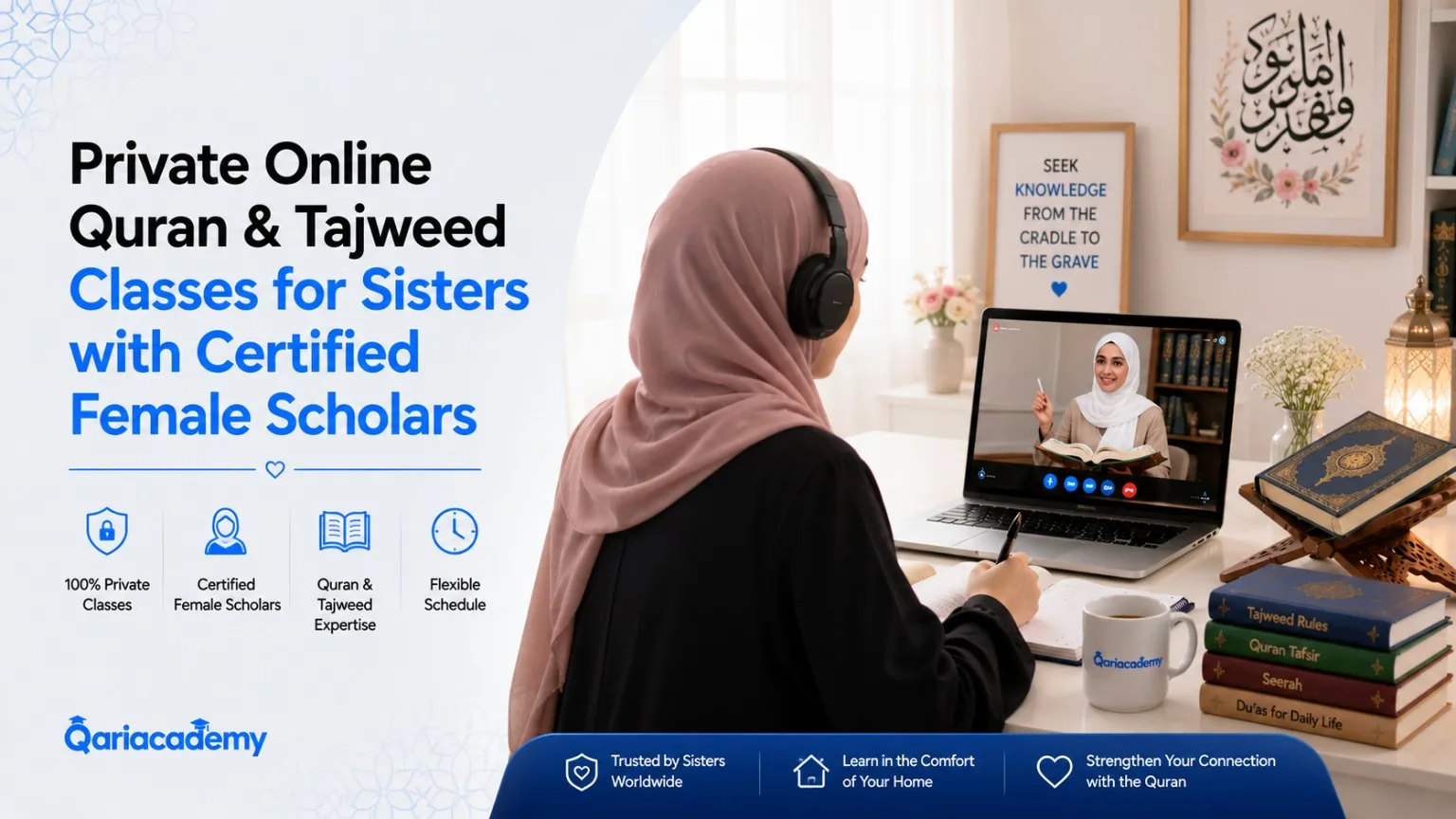
That is why Private Online Quran & Tajweed Classes for Sisters have become such a practical option for Muslim women who want focused, personalized Quran education while maintaining privacy, flexibility, and comfort.
The Quran itself emphasizes measured and careful recitation: “and recite the Quran properly in a measured way.”
This is not simply about reading faster.
It is about learning to recite with care.
And for a sister who wants to improve, having a qualified female teacher who can listen carefully, identify mistakes, explain Tajweed rules, and guide her step by step can transform the learning experience.
This comprehensive guide explains what to look for in Private Online Quran & Tajweed Classes for Sisters, why one-on-one female instruction can be beneficial, what you can learn, how online lessons work, how to choose the right teacher, and how to build a sustainable Quran-learning routine.
Part 1: Why Private Quran Classes Can Be the Right Choice for Sisters
Every Student Has a Different Quran Journey
One of the biggest problems with traditional group learning is that students rarely begin at exactly the same level.
Imagine a Quran class with ten women:
- Student A: Has memorized Juz Amma.
- Student B: Only knows Al-Fatihah.
- Student C: Reads fluently but struggles with Tajweed.
- Student D: Understands Arabic.
- Student E: Is learning the Arabic alphabet for the first time.
How can one teacher give all five students exactly what they need?
It is possible to manage a mixed-level classroom, but personalization becomes difficult. This is one of the strongest arguments for Private Online Quran & Tajweed Classes for Sisters.
- One Student ➔ One Qualified Female Teacher ➔ One Tailored Learning Plan
- If your pronunciation is strong but your Tajweed knowledge is weak: The teacher emphasizes Tajweed.
- If your Tajweed knowledge is good but your fluency is slow: The lessons focus on reading practice.
- If you are a complete beginner: The teacher starts with the Arabic alphabet and basic Quran reading.
- If you already have strong Quran skills: The teacher moves toward advanced topics.
Why Female Quran Teachers Can Make a Difference
For many Muslim women, studying with Female Quran Teachers Online provides an additional level of comfort. A sister may feel more relaxed discussing her learning difficulties, asking questions, making mistakes, and practicing repeatedly with another woman.
This is particularly valuable for adult learners. There is no need to pretend that you understand something when you don’t. You can simply ask:
- “Can you explain that again?”
- “Am I pronouncing this correctly?”
- “Can we repeat this verse?”
- “Why is this letter pronounced this way?”
- “Could you listen to me one more time?”
That openness creates better learning.
QariAcademy states that it offers male and female teachers and allows students to request a female teacher according to preference and availability. Its classes are one-on-one and designed around individual student needs.
Privacy and Comfort Matter
For some sisters, privacy is not simply a preference — it is an important part of choosing an educational environment.
A private online lesson allows a woman to learn from a comfortable space at home. She does not need to travel, nor worry about whether a physical classroom is suitable for her schedule. She can focus entirely on the lesson.
For women who are balancing work, children, university, marriage, household responsibilities, or other commitments, this convenience removes a major barrier.
One-to-One Attention Helps Identify Small Mistakes
One of the most difficult things about Quran recitation is that some mistakes feel extremely small to the student. You may believe that you are pronouncing two letters correctly because they sound almost identical to you. A trained Female Quran Tutor can immediately recognize the difference.
Arabic contains sounds that can be difficult for English speakers and even for Arabic speakers who have not studied Quranic pronunciation formally. A teacher helps identify problems with:
- Makharij (Articulation Points)
- Letter characteristics (Sifaat)
- Madd (Elongation)
- Ghunnah (Nasalization)
- Qalqalah (Echoing sound)
- Rules of Noon Sakinah & Tanween
- Rules of Meem Sakinah
- Stopping and starting (Waqf & Ibtida)
- Heavy and light letters (Tafkhim & Tarqiq)
This kind of correction is difficult to achieve through passive learning alone. You need someone to hear you.
Learning the Quran Is Not a Race
Another misconception is that a good Quran student is simply someone who completes the most pages. That is not the right measurement.
If a sister reads ten pages quickly while making persistent pronunciation mistakes, increasing speed will not solve the problem. Sometimes progress requires slowing down.
| Evaluation Question | Objective Focus |
| “Am I becoming more accurate?” | Correcting pronunciation & Tajweed rules |
| “Am I becoming more fluent?” | Reading with smooth, continuous pacing |
| “Am I understanding and applying?” | Connecting recitation with heart and action |
| “Can I maintain this consistently?” | Building a sustainable long-term habit |
A sustainable Quran journey is far more valuable than a short burst of intense study followed by months of inactivity.
The Spiritual Dimension of Quran Learning
Quran education is not merely an academic activity; it is deeply connected to worship.
The Prophet Muhammad ﷺ said that the best of people are those who learn the Quran and teach it. That gives Quran learning a special place in the life of a Muslim.
For a sister who is beginning or restarting her Quran journey, the objective should not be perfection on day one. The objective is sincere effort:
- Learn ➔ Make Mistakes ➔ Receive Correction ➔ Practice ➔ Improve & Continue
Part 2: What You Can Learn in Private Online Quran & Tajweed Classes
| Module | Core Focus Areas | Targeted Outcomes |
| 1. Quran Reading from Scratch | Arabic Alphabet, Short/Long Vowels, Sukoon, Shaddah, Tanween | Recognizing and connecting Arabic letters into words |
| 2. Foundational Qaida | Structured Noorani / Baghdadi Qaida | Moving progressively from letters to full Quranic verses |
| 3. Makharij Precision | Articulation points (e.g., س/ص, ت/ط, د/ض, ذ/ظ, ه/ح, ك/ق) | Eliminating subtle native-language accent mistakes |
| 4. Systematic Tajweed Rules | Noon/Meem Sakinah, Madd, Ghunnah, Qalqalah, Tafkhim/Tarqiq | Applying rules naturally during recitation |
| 5. Quran Memorization (Hifz) | Juz Amma, Selected Surahs, Revision (Muraja’ah) | Building structured retention alongside new lessons |
| 6. Quranic Arabic | Common vocabulary, roots, basic grammar, sentence structures | Understanding the direct meaning of verses while reading |
| 7. Fluency & Confidence | Guided reading practice, rhythm, pacing, stopping rules | Reciting smoothly without frequent hesitation |
Deep Dive into Tajweed Rules
Once basic reading is established, students in Online Tajweed Classes for Sisters systematically study:
- Noon Sakinah & Tanween: Izhar, Idgham, Iqlab, and Ikhfa.
- Meem Sakinah: Ikhfa Shafawi, Idgham Shafawi, and Izhar Shafawi.
- Madd: Understanding different forms of elongation and applying them correctly.
- Tafkhim & Tarqiq: Knowing precisely when letters are pronounced heavily or lightly.
- Waqf & Ibtida: Learning appropriate stopping and starting points to preserve meaning.
Part 3: Why Online Learning Works So Well for Busy Sisters
- Busy Daily Schedule ➔ Zero Commute Time ➔ 1-on-1 Focused Environment ➔ Consistent Quran Growth
Key Advantages of Online Quran Classes for Women
- Flexible Scheduling: Whether you are a working woman early in the morning, a mother while children are at school, a university student in the evening, or free only on weekends, classes adapt to your timezone.
- Zero Commute Friction: Eliminates the 30–60 minutes spent driving to an Islamic center. You finish your work, open your laptop, and begin learning immediately.
- Study From Home Comfort: All you need is a reliable internet connection, a device, a quiet space, and your Quran. Accessible even for sisters living in areas with few local qualified female scholars.
- 100% Focused Attention: Unlike group classes where students get distracted or wait for others, the entire session belongs to you for reading aloud, asking questions, and fixing mistakes.
- Modern Educational Tools: Live video instruction, digital Quran copies, audio recitations, digital assignments, progress tracking, and completion certificates.
QariAcademy specifically states that it offers flexible scheduling, digital learning materials, quizzes, attendance tracking, and completion certificates within its live one-on-one plans.
Part 4: How to Choose a Female Quran Teacher
Don’t choose a teacher based only on a nice voice. A beautiful recitation is valuable, but teaching requires specific pedagogical skills.
- Formal Qualification / Ijazah ➔ Teaching Experience & Patience ➔ Clear Communication & Feedback
Selection Criteria for Female Quran Tutors
- Qualifications: Does she have formal Quran or Tajweed training? Does she hold an Ijazah where relevant?
- Teaching Ability: Can she explain complex Tajweed concepts in simple, understandable terms?
- Patience: Does she allow you to repeat sounds without becoming frustrated?
- Correction Precision: Can she catch minor Makhraj slips and guide your vocal placement?
- Clear Curriculum: Is there a structured path forward, or are lessons unstructured?
- Personalization: Does she adjust the lesson pace to match your daily capacity?
Note on Certifications: A certificate demonstrates training, but it doesn’t guarantee teaching compatibility. This is why taking a trial lesson is crucial to evaluate communication, patience, and teaching style before committing.
QariAcademy offers a free one-on-one trial before commitment, according to its official enrollment information.
Part 5: A Practical Quran Learning Plan for Sisters
Tailored Weekly Study Models
- Beginner Plan: 2–3 Lessons/Week + 15–20 Min Daily Practice ➔ Alphabet, Vowels, Al-Fatihah
- Intermediate Plan: 2 Lessons/Week + 20–30 Min Daily Practice ➔ Tajweed Rules, Makharij, Fluency
- Advanced Plan: 1–2 Lessons/Week + 30–45 Min Daily Practice ➔ Hifz, Muraja’ah, Ijazah, Quranic Arabic
The Recommended 30-Minute Daily Practice Routine
You do not need hours of daily free time to make steady progress. A structured half-hour block works best:
- 10 Min: Recitation ➔ 5 Min: Tajweed Rule ➔ 5 Min: Tough Words ➔ 5 Min: Listening ➔ 5 Min: Revision
- 10 Minutes — Recitation: Read a short passage slowly with full concentration.
- 5 Minutes — Tajweed: Focus on applying one specific rule (e.g., Ikhfa or Ghunnah).
- 5 Minutes — Difficult Words: Repeat words or verses you struggled with in class.
- 5 Minutes — Listening: Listen to a qualified Qari recite your assigned passage.
- 5 Minutes — Revision: Recite yesterday’s material to lock it into long-term memory.
Anchoring Quran Habits to Daily Routines
Instead of trying to “find time,” attach your Quran practice to existing daily habits:
- After Fajr ➔ 15 minutes of quiet Quran recitation.
- After Isha ➔ Review one memorized Surah before sleeping.
- Midday Break ➔ Listen to your assigned passage while resting.
Part 6: Quran Learning for Different Types of Sisters
- Complete Beginner: Starts with Alphabet & Basic Vowels
- Re-learning Adult: Rebuilds Childhood Knowledge & Fixes Gaps
- Weak in Tajweed: Shifts Focus to Rules & Makharij Precision
- Hifz Student: Balances New Memorization with Revision
- Working Professional: Utilizes Structured 2-Day Weekly Sessions
- Busy Mother: Leverages Flexible Home Scheduling
Part 7: Common Mistakes to Avoid
- Mistake 1: Relying Only on Motivation — Motivation fluctuates; daily habits build lifelong success.
- Mistake 2: Reading Without Correction — Uncorrected mistakes become hard-to-break habits.
- Mistake 3: Memorizing Rules Without Application — Tajweed is meant to beautify recitation, not just be memorized as theory.
- Mistake 4: Prioritizing Speed Over Accuracy — Slow and accurate recitation is always superior to fast and faulty reading.
- Mistake 5: Changing Teachers Constantly — Give a qualified teacher time to understand your unique learning style.
- Mistake 6: Studying Too Intensely at First — Over-studying leads to burnout; consistency wins.
- Mistake 7: Comparing Yourself to Others — Everyone starts at a different baseline; focus on your own trajectory.
- Mistake 8: Neglecting Revision in Hifz — Without structured review, new memorization quickly fades.
Part 8: Creating a Long-Term Quran Journey
The goal is not simply to finish a single course; the goal is to build an enduring connection with the Book of Allah.
- Basic Reading ➔ Tajweed & Fluency ➔ Hifz & Memorization ➔ Quranic Arabic & Tafsir ➔ Ijazah & Teaching
Why Sisters Should Start Even If They Feel “Too Old”
There is no age limit on learning the Quran. Whether you are 20, 35, 50, or 70, starting today is immensely valuable. Adult learners bring a level of maturity, life experience, and sincere appreciation for the Quran that transforms their learning into a deeply spiritual experience.
Private Online Quran & Tajweed Classes for Sisters at QariAcademy
For sisters looking for Private Online Quran & Tajweed Classes for Sisters, QariAcademy offers one-on-one online Quran education with certified female scholars and experienced teachers.
- Free 1-on-1 Trial ➔ Level Assessment ➔ Customized Curriculum ➔ Flexible Live Classes
What to Expect From Your First Assessment Lesson
Your initial session goes beyond random page reading. The teacher conducts a clear assessment:
- Evaluates your reading of basic Arabic letters and words.
- Listens to your recitation of Al-Fatihah and selected short verses.
- Identifies your strengths in Makharij and Tajweed.
- Discusses your personal goals (Fluency, Tajweed, Hifz, or Quranic Arabic).
- Designs a customized step-by-step learning roadmap for you.
Setting Specific, Measurable Quran Goals
| Broad Wish | Specific Actionable Goal |
| “I want to improve my Quran.” | Goal 1: Correct my Makharij for heavy and light letters in 6 weeks. |
| “I want to learn Tajweed.” | Goal 2: Complete the rules of Noon Sakinah & Tanween this month. |
| “I want to memorize.” | Goal 3: Memorize Juz Amma with solid revision over the next 6 months. |
| “I want to understand.” | Goal 4: Study 200 common Quranic vocabulary words this semester. |
Final Conclusion: Start Your Quran Journey With the Right Teacher
Learning the Quran is one of the most rewarding investments a Muslim woman can make. For sisters seeking privacy, flexibility, personal attention, and a self-paced environment, Private Online Quran & Tajweed Classes for Sisters offer the ideal framework.
You do not need perfect Arabic or prior expertise to begin — you simply need to start from where you are today. A certified female teacher will guide you step by step, helping you fix mistakes, build confidence, and deepen your spiritual bond with the Quran.
⭐ Ready to take the first step?
Your Quran journey starts with one lesson, one page, one corrected letter, and one consistent step at a time.