Table of Contents
Introduction
Have you ever wanted to improve your Quran recitation but felt embarrassed because you were afraid of making mistakes?
Maybe you have avoided reading aloud in front of family members.
Maybe you hesitate when someone asks you to recite.
Maybe you know that your pronunciation needs improvement, but the thought of having someone correct you makes you uncomfortable.
Or perhaps you are an adult who never properly learned to read the Quran and now feel that you are “too old” to start from the beginning.
You are not alone.
For many adults, overcoming Quran recitation embarrassment is one of the biggest psychological barriers to improving their Quran reading.
The problem is rarely a lack of intelligence.
It is often fear.
- Fear of making mistakes.
- Fear of being judged.
- Fear that someone will think, “How can an adult Muslim still not read the Quran properly?”
But that fear can become the very thing preventing you from improving.
The truth is simple:
You cannot improve a recitation mistake that you are too embarrassed to expose.
- If you never read aloud ➔ a teacher cannot hear the problem.
- If nobody hears the problem ➔ nobody can correct it.
- If nobody corrects it ➔ the mistake can remain for years.
This is why learning in a private, supportive environment can be transformative.
And this is where Learn Tajweed at Home for Adults becomes especially valuable.
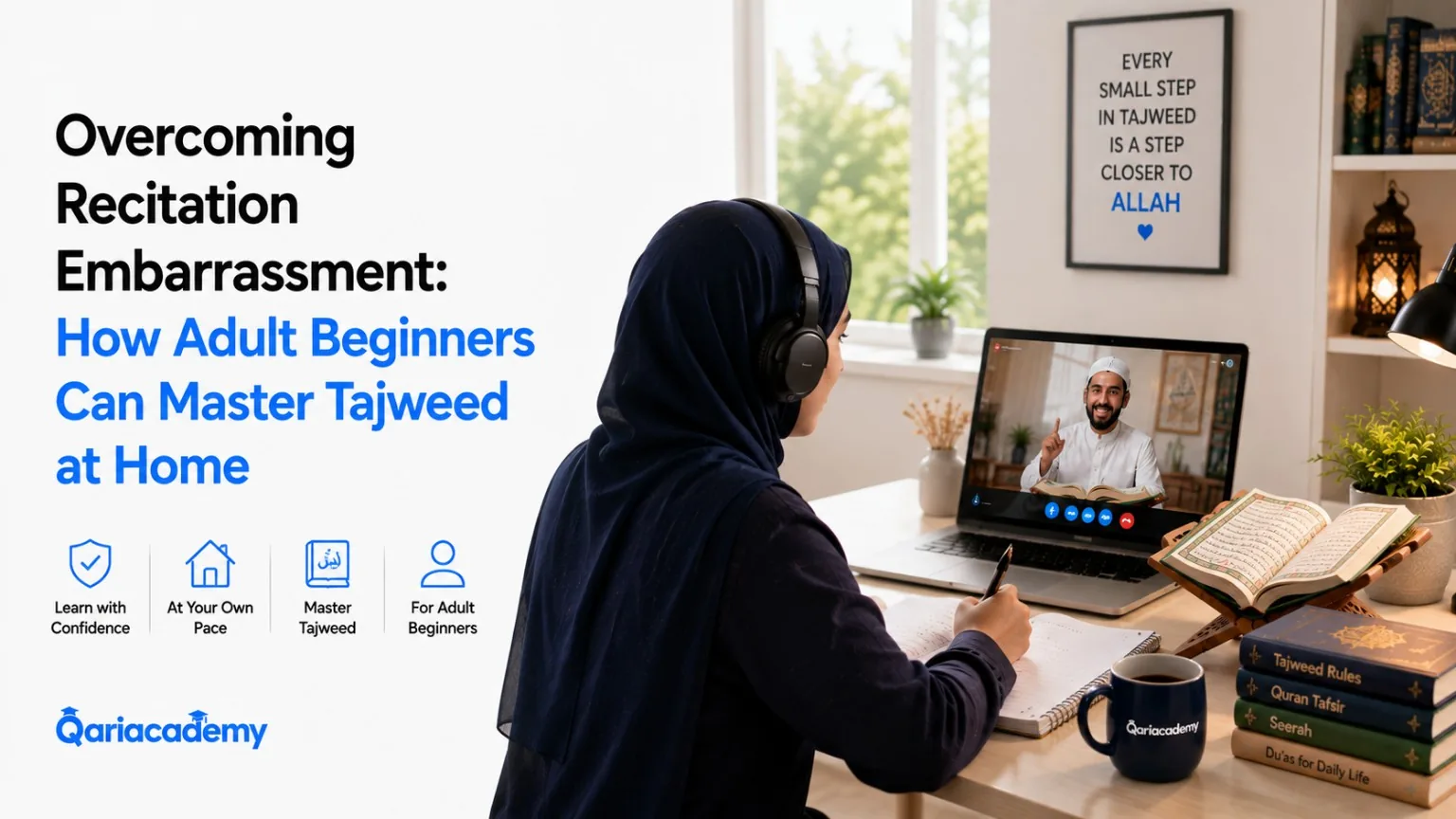
Instead of struggling in a crowded classroom, an adult learner can work privately with a qualified teacher, practice at a comfortable pace, ask questions freely, repeat difficult verses, and gradually build confidence.
The objective isn’t to become perfect immediately.
The objective is to become better—one letter, one word, and one verse at a time.
Part 1: Understanding Quran Recitation Embarrassment and Breaking the Fear Cycle
Why Adults Feel More Embarrassed Than Children
Children generally expect to make mistakes.
If a child pronounces an Arabic letter incorrectly, they often simply try again.
Adults are different.
Adults are much more conscious of how they appear to others.
An adult may think:
“I’m supposed to know this already.”
“I’ve been Muslim for years.”
“My children can read better than me.”
“Everyone at the mosque will notice my mistakes.”
“I’ll embarrass myself.”
These thoughts can create a psychological barrier.
The person may continue listening to Quran.
They may watch Tajweed videos.
They may buy Quran books.
They may download applications.
But they avoid the one thing that would actually reveal their weaknesses: reciting aloud to a qualified teacher.
This creates a cycle:
The Negative Fear Cycle:
Fear⟶Avoidance⟶No Correction⟶Little Progress⟶More Fear
Breaking this cycle requires a different approach.
Instead:
The Positive Growth Cycle:
Practice⟶Correction⟶Improvement⟶Confidence⟶More Practice
This is the foundation of successful adult Quran learning.
You Are Not Too Old to Learn Tajweed
One of the most damaging beliefs an adult learner can have is:
“I should have learned this when I was younger.”
Maybe you should have.
Maybe you didn’t.
But neither fact changes what you can do today.
The Quran is not reserved for people who started learning as children.
- Adults can learn Arabic reading.
- Adults can improve Makharij.
- Adults can study Tajweed.
- Adults can memorize Surahs.
- Adults can correct years of pronunciation habits.
- Adults can start from the alphabet if necessary.
The important question is not: “Why didn’t I learn this earlier?”
The useful question is: “What can I do from today onward?”
Regret consumes energy.
Learning uses energy productively.
Choose learning.
The Difference Between Reading and Reciting With Tajweed
Some adults believe that if they can pronounce the Arabic letters approximately correctly, they already know Tajweed.
Not necessarily.
Quranic recitation involves several layers of skill:
- You need to recognize letters.
- You need to read vowels correctly.
- You need to pronounce letters from their appropriate articulation points.
- You need to understand relevant Tajweed rules.
- You need to know how sounds interact.
- You need to understand elongations.
- You need to recognize when letters are heavy or light.
- You need to understand appropriate stopping and starting.
And eventually, these skills need to become natural during continuous recitation.
This is why Tajweed for Adult Beginners should be taught progressively.
Trying to memorize every rule at once can create unnecessary confusion.
Tajweed Is a Skill, Not Just a List of Rules
A student might memorize the definition of Qalqalah.
They might memorize the names of the rules of Noon Sakinah.
They might be able to explain Ghunnah.
But if they cannot apply those rules while reading, their theoretical knowledge has limited practical value.
Tajweed must move through three stages:
1. Understand (Know rule meaning)⟶2. Recognize (Identify in Quran)⟶3. Apply (Use correctly while reciting)
That third stage requires practice.
And practice requires reading aloud.
This is another reason why Learn Tajweed at Home for Adults can be so effective.
You can create a private environment where making mistakes is expected.
The Quran Does Not Demand That You Become Perfect Overnight
Many adult learners create unrealistic expectations.
They expect to pronounce every letter correctly after a few lessons.
Then they make mistakes.
They become frustrated.
Then they quit.
This is backwards.
A beginner should expect mistakes.
A new skill requires repetition.
If your teacher corrects you ten times on the same sound, that does not mean you are failing.
It means you are training.
Think about learning to drive.
You didn’t master every movement during your first lesson.
You practiced.
You made mistakes.
You received correction.
Eventually, many movements became automatic.
Quran recitation also requires repeated practice.
Make Your Home a Safe Learning Environment
One of the biggest advantages of learning Tajweed at home is privacy.
You can sit in a quiet room.
Open your Quran.
Connect with your teacher online.
And practice without worrying about an audience.
You can stop and ask questions.
You can repeat the same word ten times.
You can tell the teacher: “I don’t understand where my tongue should be.”
You can practice a difficult letter repeatedly.
You can make mistakes without feeling humiliated.
That environment can make overcoming Quran recitation embarrassment much easier.
Part 2: How Adult Beginners Can Learn Tajweed Step by Step
Step 1: Assess Your Current Level Honestly
Before creating a study plan, determine where you are.
| Diagnostic Area | Self-Assessment Questions |
|---|---|
| Letter Recognition | Can you recognize all Arabic letters in their various forms? |
| Connecting Rules | Can you connect letters smoothly to form words? |
| Vowel Marks | Can you read words with short vowels (Fathah, Kasrah, Dammah)? |
| Independent Reading | Can you read Quranic verses independently without transliteration? |
| Core Surahs | Can you recite Al-Fatihah confidently and accurately? |
| Rule Awareness | Do you know any Tajweed rules, and can you spot your own mistakes? |
These questions help determine your starting point.
Don’t exaggerate your level.
Don’t minimize it either.
An accurate assessment allows you to learn efficiently.
Step 2: Master the Arabic Alphabet and Basic Reading if Necessary
If you cannot read Arabic, start there.
There is no shame in it.
Learn:
- Letter shapes.
- Letter names.
- Short vowels.
- Long vowels.
- Sukoon.
- Shaddah.
- Tanween.
- Connected letters.
Move gradually from isolated letters to words.
The objective is to develop decoding ability.
Eventually, you want to look at an unfamiliar Quranic word and attempt to read it rather than feeling completely lost.
Step 3: Focus on Makharij
Makharij is one of the most important foundations of Quran recitation.
The Arabic language contains sounds that may not exist in English or other languages.
For example, English-speaking learners may struggle with:
ح خ ع غ ص ض ط ظ ق
The solution is not simply listening to the teacher once.
You need repeated correction.
A teacher can explain where the sound originates and demonstrate the position of the tongue, throat, lips, or mouth.
Then you imitate ➔ The teacher listens ➔ The teacher corrects ➔ You repeat.
This is why live instruction can be particularly valuable.
Step 4: Learn One Tajweed Rule at a Time
Don’t attempt to memorize an entire Tajweed curriculum in one weekend.
Instead, build gradually.
You might start with:
- Basic pronunciation.
- Noon Sakinah and Tanween.
- Meem Sakinah.
- Qalqalah.
- Madd.
- Ghunnah.
- Heavy and light letters.
- Waqf and Ibtida.
The exact sequence can vary according to your teacher and level.
The important principle is:
Learn⟶Apply⟶Review⟶Repeat
Step 5: Practice Directly From the Quran
Avoid keeping Tajweed separate from Quran reading for too long.
If you learn a rule today, find examples of that rule in the Quran.
Read them.
Listen to them.
Repeat them.
Then try to identify the same rule elsewhere.
This turns theoretical knowledge into practical skill.
Step 6: Record Your Own Recitation
If you are comfortable doing so, occasional audio recording can be useful.
Read a short passage.
Listen to yourself.
Compare your recitation with a qualified teacher or reliable reciter.
Ask:
- Am I rushing?
- Are my vowels clear?
- Are my elongations consistent?
- Are my letters distinct?
- Am I applying the Tajweed rule correctly?
Self-recording can reveal things that you don’t notice while reading.
However, recordings should supplement—not replace—teacher feedback.
Step 7: Build Fluency Slowly
Once your pronunciation becomes more accurate, work on fluency.
Start with short passages.
Read slowly.
Then gradually increase your comfort.
Don’t force speed.
A common mistake is trying to sound like an experienced Qari before developing the underlying skills.
Accuracy First⟶Fluency Second⟶Beautiful Recitation Over Time
A Simple 30-Minute Daily Tajweed Routine
If you’re busy, try this daily structure:
| Time Allocation | Focus Area | Actionable Task |
|---|---|---|
| 5 Minutes | Pronunciation | Practice two or three difficult letters (Makharij focus). |
| 10 Minutes | Tajweed Review | Review one specific rule from your recent lesson. |
| 10 Minutes | Quran Reading | Read a short passage actively applying the reviewed rule. |
| 5 Minutes | Listening | Listen to a reliable recitation of the exact same passage. |
This gives you a complete learning cycle in just 30 minutes.
Why Listening Alone Isn’t Enough
Listening to Quran is beneficial.
It can improve familiarity with pronunciation, rhythm, and recitation.
But passive listening does not necessarily reveal your own mistakes.
You may hear a Qari pronounce a letter correctly without knowing whether you are doing the same thing.
This is why a balanced approach is stronger:
Listen+Read+Receive Correction+Practice
Not simply:
Listen+Assume
Part 3: Building Confidence and Making Online Learning Work
Your Teacher Should Be Your Coach, Not Your Judge
A good Quran teacher understands that mistakes are part of the process.
The teacher’s job is not to make the student feel ashamed.
The job is to identify the issue and provide a path toward correction.
When choosing Online Quran Classes for Adults, look for teachers who:
- Are patient.
- Explain clearly.
- Correct respectfully.
- Understand beginner difficulties.
- Adapt lessons to the student.
- Encourage questions.
- Track progress.
- Provide structured homework.
A technically qualified teacher who cannot communicate effectively may not be the best fit.
Teaching skill matters.
Why One-to-One Online Classes Can Reduce Embarrassment
Consider the contrast between these two environments:
| Learning Setting | Environmental Pressure | Outcome on Adult Confidence |
|---|---|---|
| Group Classroom | Mispronounce a word ➔ several students hear ➔ nervous ➔ rush ➔ make more mistakes | Student stops volunteering and avoids reading aloud. |
| Private Online Lesson | Mispronounce a word ➔ teacher says “Let’s try again” ➔ teacher explains ➔ retry | Student masters the word, receives permission to be a beginner. |
That difference can be significant.
Private learning gives adults permission to be beginners.
Flexibility Is Important for Adult Learners
Adults rarely have completely predictable schedules.
- Work meetings change.
- Children become sick.
- Family responsibilities appear.
- Travel happens.
- University exams arrive.
That doesn’t mean Quran learning should stop.
A flexible online program can make it easier to maintain consistency.
QariAcademy offers one-on-one online Quran lessons with flexible scheduling, allowing students to arrange classes around their availability and time zone.
This is particularly useful for adults living in the United States, United Kingdom, Canada, Australia, and other Western countries.
You Don’t Need a Perfect Schedule
Another common mistake is waiting for the “perfect” schedule.
“I’ll start when work gets less busy.”
“I’ll begin after the children go back to school.”
“I’ll study when I have more free time.”
That time may never arrive.
Instead, build a realistic schedule.
Two 30-minute lessons per week can be a starting point.
Then practice for 10–20 minutes on other days.
Consistency creates momentum.
Create a Private Quran Corner
You don’t need an elaborate setup.
Choose one quiet place.
Keep your Quran there.
Keep your laptop or tablet nearby.
Have headphones available if necessary.
When you sit in that location, your brain begins to associate it with learning.
This reduces the psychological effort required to begin.
Use a Dedicated Quran Notebook
Keep one notebook for your lessons.
Write down:
- Difficult letters.
- Tajweed rules.
- Mistakes.
- Teacher corrections.
- New vocabulary.
- Practice assignments.
At the beginning of every lesson, review a few notes from the previous class.
This creates continuity.
Track Your Progress
Adults often underestimate their progress because they focus on what they still cannot do.
A progress tracker changes that.
Write down milestones such as:
- Week 1: Reviewed Arabic letters.
- Week 3: Read simple words.
- Week 6: Improved Al-Fatihah.
- Week 8: Learned basic Tajweed rules.
- Week 12: Completed selected short Surahs.
When you look back after three months, you can see tangible progress.
Don’t Compare Your Recitation With Professional Qaris
This is another major source of discouragement.
You listen to an experienced Qari and think: “I will never sound like that.”
Of course you don’t.
That person may have spent decades studying Quran recitation.
You may have spent three months.
Your comparison should be:
Today’s recitationVSYour recitation 6 months ago
Not:
Your first yearVSSomeone’s twentieth year
Understand That Some Mistakes Take Time to Correct
Certain pronunciation habits become deeply ingrained.
If you’ve been pronouncing a letter incorrectly for twenty years, don’t expect it to disappear after one lesson.
Your mouth and tongue have learned a habit.
Now you are teaching them a new one.
That takes repetition.
Be patient.
How to Handle a Difficult Day
Some days you will be tired.
Some days you won’t feel motivated.
Some days work will be stressful.
On those days, reduce the workload rather than abandoning the habit.
- Instead of 30 minutes ➔ Do 10.
- Instead of five pages ➔ Read one.
- Instead of learning a new rule ➔ Review yesterday’s rule.
The objective is to maintain continuity.
How QariAcademy Can Help Adults Learn Tajweed Privately
If your goal is to Learn Tajweed at Home for Adults, QariAcademy provides live one-on-one Quran instruction that can be adapted to different student levels and goals.
The academy offers Quran reading, Tajweed, Hifz, Quranic Arabic, and Islamic Studies, with online lessons designed for children and adults.
For an adult who feels embarrassed about recitation, the one-to-one format can be particularly helpful.
You aren’t entering a classroom where you have to perform in front of other students.
You are working directly with your teacher.
- If you need to repeat a letter ten times, you can.
- If you don’t understand a Tajweed rule, you can ask.
- If you are beginning from the alphabet, the teacher can start there.
- If you already read well, the teacher can focus on advanced correction.
This is the advantage of personalized education.
Why a Trial Lesson Is Worth Taking
Before committing to a long-term program, you should know whether the teacher is right for you.
During a trial lesson, pay attention to:
- Does the teacher listen carefully?
- Are corrections clear?
- Do you feel comfortable?
- Is the pace appropriate?
- Does the teacher understand your goals?
- Are your weaknesses identified?
- Do you leave knowing what to practice?
QariAcademy provides a trial/evaluation option so prospective students can assess their level and learning needs before beginning regular lessons.
This is especially important for adult beginners.
You shouldn’t choose a teacher simply because the website looks good.
Experience the teaching.
Part 4: From Embarrassment to Confidence — Creating a Lifelong Quran Habit
Confidence Comes After Practice, Not Before It
Many people wait until they feel confident before reading aloud.
That’s backwards.
You become confident because you practice.
Think about any skill.
A person doesn’t become confident at public speaking by waiting for confidence.
They speak ➔ They make mistakes ➔ They learn ➔ They speak again.
Quran recitation works similarly:
You read⟶Receive correction⟶Practice⟶Improve⟶Confidence follows
Turn Your Mistakes Into a Learning Map
Instead of thinking: “I keep making mistakes.”
Change the thought to: “These are the areas I need to practice.”
If your teacher says: “You need to work on ق.”
That’s not an insult. That’s information.
If you struggle with Madd, now you know what to study.
If you struggle with Qalqalah, you know what to practice.
Every correction makes your learning plan more precise.
The Goal Is Not Just Better Recitation
Improving Tajweed is important.
But there is a deeper objective.
The Quran should become a regular part of your life.
You want to be able to:
- Read confidently.
- Recite correctly.
- Memorize selected passages.
- Understand more of what you recite.
- Reflect on the meanings.
- Build a lasting relationship with the Quran.
Tajweed is one part of that journey.
Combine Tajweed With Quranic Understanding
Once your reading improves, consider adding Quranic Arabic.
You don’t need to become fluent in Arabic to benefit.
Start with frequent Quranic vocabulary.
Learn common verbs.
Study basic sentence structures.
Then apply your knowledge to familiar Surahs.
When you recognize the meaning of words while reciting, the experience can become much deeper.
Use Salah as Daily Practice
Salah provides natural repetition.
Al-Fatihah is repeated every day.
Short Surahs can also be repeated regularly.
Use this repetition intentionally.
If you’re working on a specific pronunciation issue, pay attention to it during Salah outside the formal lesson context.
This doesn’t mean becoming distracted from worship.
Rather, your improved learning gradually becomes part of your worship.
Memorization Can Increase Confidence
Memorizing short Surahs can give beginners a sense of achievement.
Instead of always looking at the page, you gradually become able to recite from memory.
Start small.
One verse.
Then another.
Review frequently.
Never underestimate the motivational value of a small completed Surah.
Adults Should Build Sustainable Goals
Don’t create a goal like: “I will memorize one Juz every month.”
Maybe that is realistic for some people.
For others, it may be completely unrealistic.
A better goal is: “I will study Quran three times per week and maintain daily review.”
Then allow the amount of memorization to develop according to your capacity.
Consistency should drive the plan.
What to Do When Life Interrupts Your Quran Routine
Life will interrupt it.
That’s inevitable.
You may travel.
You may change jobs.
You may become a parent.
You may face exams.
You may experience a difficult family period.
The mistake is believing that interruption means failure.
Instead, create a “maintenance mode”:
- Reduce new material.
- Continue revision.
- Keep one short daily reading session.
- Resume your normal schedule when circumstances improve.
This prevents a temporary disruption from becoming permanent abandonment.
The Importance of a Qualified Teacher
YouTube videos, Quran applications, books, and audio recitations can all be useful.
But none of these automatically replace personalized correction.
A teacher hears your recitation.
That distinction matters.
A video cannot know whether your ق is actually coming from the correct articulation point.
An app cannot always explain why your particular pronunciation is incorrect.
A teacher can.
That is why combining technology with live instruction is often stronger than relying on technology alone.
Your First 90 Days of Tajweed
A realistic beginner roadmap looks like this:
| Progression Stage | Core Focus Points | Primary Action Items |
|---|---|---|
| Month 1: Foundation | Reading assessment & basic sounds | Correct major pronunciation issues, review letters/vowels, refine Al-Fatihah. |
| Month 2: Essential Tajweed | Core rule application | Learn Noon Sakinah, Qalqalah, Madd, apply rules directly to short Surahs. |
| Month 3: Fluency Building | Flow & continuous recitation | Practice longer passages, refine stopping/starting (Waqf/Ibtida), strengthen weak sounds. |
At the end of 90 days, you may not be an expert.
That isn’t the objective.
The objective is to become noticeably better than you were at the beginning.
Your Six-Month Goal
If you consistently Learn Tajweed at Home for Adults, six months can produce meaningful improvement.
Your exact results depend on your starting level and consistency.
But a committed learner may be able to:
- Read more confidently.
- Recognize and apply essential Tajweed rules.
- Improve difficult Arabic sounds.
- Recite Al-Fatihah more accurately.
- Read selected Surahs more fluently.
- Memorize additional passages.
- Identify personal pronunciation weaknesses.
- Develop a sustainable Quran routine.
And perhaps most importantly:
You may no longer feel embarrassed when someone asks you to recite.
Not because you became perfect.
But because you understand that mistakes are simply part of learning.
Stop Waiting for the “Right Time”
If you have been thinking about learning Tajweed for months or years, ask yourself an uncomfortable question:
What exactly are you waiting for?
- More free time?
- More confidence?
- A better teacher?
- The perfect schedule?
None of these things may appear automatically.
You create them through action.
Start with a realistic lesson schedule ➔ Choose a teacher ➔ Take an assessment ➔ Practice ➔ Improve.
Overcoming Recitation Embarrassment Starts With One Brave Step
The hardest part may be opening the Quran and reading aloud for the first time.
You may make mistakes.
You may feel uncomfortable.
That’s okay.
Your teacher has heard mistakes before.
Beginners make mistakes.
Intermediate students make mistakes.
Even advanced students continue refining their recitation.
The difference is that they keep practicing.
Your mistakes do not define your ability.
They define what you need to work on next.
Start Learning Tajweed at Home With QariAcademy
If you have been searching for a private and flexible way to Learn Tajweed at Home for Adults, QariAcademy can help you turn that intention into a structured learning journey.
Through one-on-one online Quran lessons, you can work directly with a teacher who can assess your level, listen to your recitation, identify pronunciation problems, explain Tajweed rules, and guide your practice.
QariAcademy offers online Quran programs for adults covering Quran reading, Tajweed, memorization, and related Islamic learning.
The flexible online format means you can learn from home without spending time commuting to a Quran center.
And the private format means you can learn without worrying about other students listening to your mistakes.
That can be particularly valuable when your biggest obstacle isn’t ability.
It’s confidence.
Your Quran Journey Starts Where You Are
- Maybe you can barely read Arabic ➔ Start there.
- Maybe you can read but struggle with pronunciation ➔ Start there.
- Maybe you know Tajweed rules but cannot apply them consistently ➔ Start there.
- Maybe you memorized Quran years ago and need to rebuild your fluency ➔ Start there.
There is no embarrassing starting point.
The only thing that truly holds you back is refusing to start because you’re afraid of being a beginner.
Conclusion
You Can Learn Tajweed Without Being Ashamed of Your Mistakes
Overcoming Quran recitation embarrassment is not about convincing yourself that you will never make mistakes.
It is about changing your relationship with mistakes.
- A mistake is not proof that you are incapable ➔ It is evidence that you have discovered something that needs improvement.
- A difficult Arabic letter is not a reason to quit ➔ It is a skill to practice.
- A Tajweed rule you keep forgetting is not a failure ➔ It is a rule that needs more repetition.
- And a slow reading speed does not mean you are bad at Quran ➔ It means you are still developing fluency.
The best approach is simple:
Start where you are⟶Learn progressively⟶Read aloud⟶Accept correction⟶Practice consistently⟶Keep going
If embarrassment has kept you from improving your recitation, private online lessons can provide the supportive environment you need to move forward.
With Learn Tajweed at Home for Adults, you can study from the comfort of your home, receive personalized correction, build your confidence, and develop a stronger relationship with the Quran at a pace that fits your life.
And you don’t have to do it alone.
QariAcademy offers personalized one-on-one online Quran and Tajweed lessons for adults, with flexible scheduling and teachers who can work with students at different levels.
Take the first step.
Don’t wait until your recitation is perfect before you start learning.
Learn so that your recitation can become better.
Practice so that your confidence can grow.
And remember: the goal isn’t to prove that you already know how to recite the Quran.
The goal is to keep learning the words of Allah.
Start your Quran and Tajweed journey with QariAcademy today.
Learn Tajweed at Home for Adults. Improve one letter at a time. Recite with greater confidence. Build a lifelong relationship with the Quran.