Table of Contents
Introduction
There is a moment every Muslim parent knows is coming, but many parents are still uncomfortable preparing for it.
Your little girl begins to change.
Her body develops.
She may notice new physical signs.
She may suddenly have questions about blood, bathing, prayer, clothing, privacy, or what is happening to her body.
And eventually, she may experience her first menstrual period.
For some girls, this moment is exciting.
For others, it is frightening.
For some, it is simply confusing.
And for parents, it can be difficult to know exactly what to say.
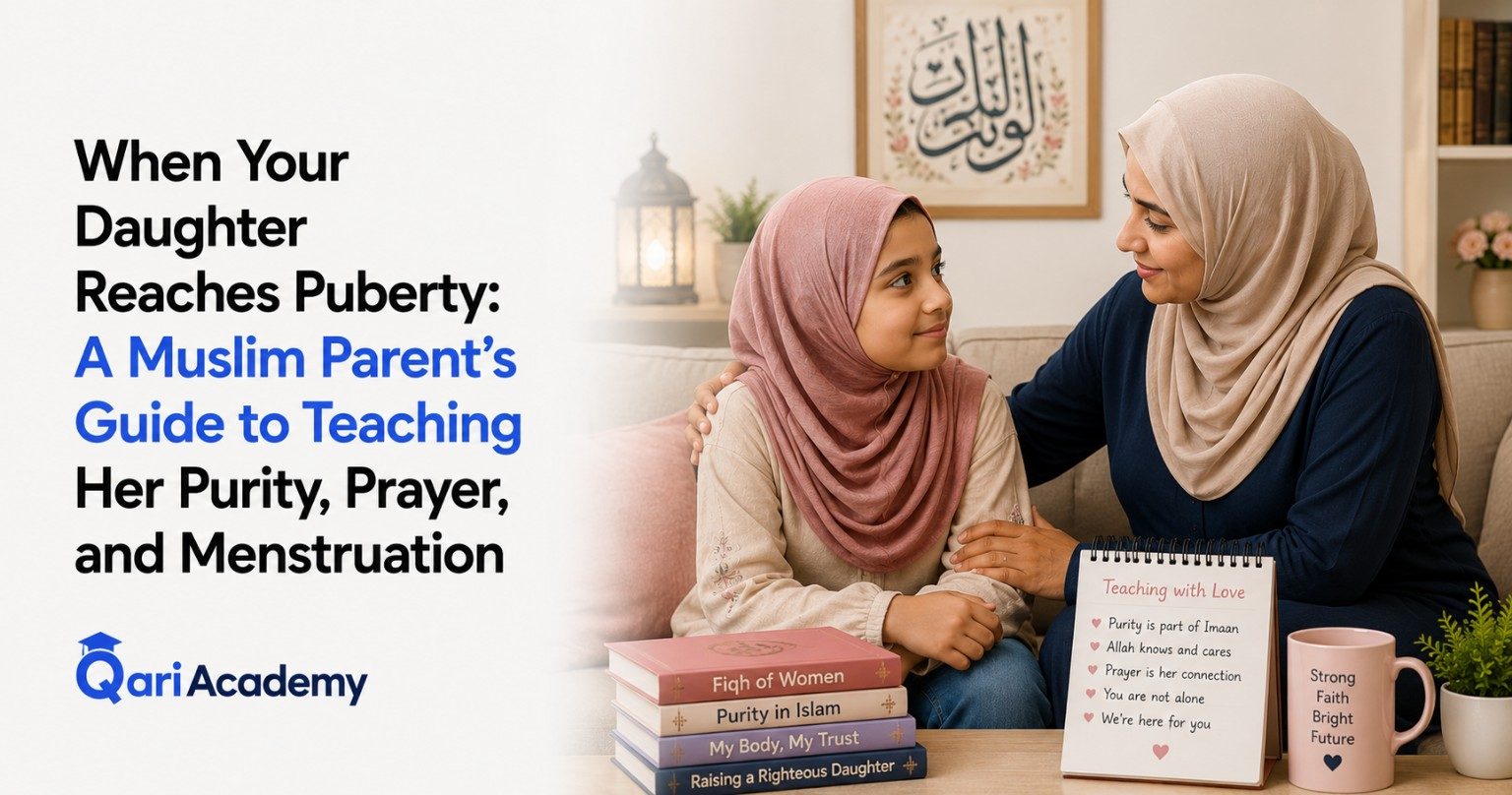
This is why having a Muslim girl puberty guide before puberty begins is so important.
Your daughter shouldn’t have to discover everything by herself.
She shouldn’t learn about menstruation for the first time when she sees blood.
She shouldn’t feel embarrassed to ask about purification.
And she shouldn’t think that menstruation makes her dirty, sinful, or less worthy as a Muslim.
Puberty is a natural stage of development, and Islam provides guidance for the physical and religious changes that accompany maturity.
The challenge for parents is presenting that knowledge in a way that is accurate, age-appropriate, calm, and emotionally supportive.
The goal isn’t simply to teach your daughter what happens to her body.
It is to help her understand:
My body is changing. I am still loved. I am still a Muslim. I can ask questions. I can learn what Allah expects from me. And I don’t have to be ashamed of growing up.
Why Parents Should Start Before the First Period
One of the biggest mistakes parents make is waiting until the first period appears.
Imagine being 10 or 11 years old, going to the bathroom, seeing blood on your underwear, and having absolutely no idea what is happening.
You might think:
“Am I sick?”
“Did I hurt myself?”
“Is something wrong with me?”
That’s why preparation matters.
Your daughter should know beforehand that menstruation is something that can happen as her body matures.
You don’t need to give a five-year-old a detailed biology lesson.
But as she approaches puberty, the conversation should gradually become more specific.
A simple progression works well:
Childhood → body awareness → puberty education → menstruation → purification → religious responsibilities.
What Does Puberty Mean in Islam?
From an Islamic perspective, puberty is particularly important because it marks the transition toward religious responsibility.
A child is not treated exactly like an adult in matters of religious obligation.
As puberty occurs, certain acts of worship and religious responsibilities become applicable according to Islamic jurisprudence.
This is why parents shouldn’t only teach their daughter about the physical side of puberty.
She also needs to learn what changes religiously.
That includes understanding:
- Menstruation
- Ghusl
- Wudu
- Salah
- Fasting
- Modesty
- Privacy
- Hygiene
- Appropriate questions about her body
But don’t try to teach everything in one conversation.
This is a process.
1. Start With Normalizing the Conversation
The first thing your daughter needs to know is:
She can talk to you.
If you become visibly embarrassed every time she asks about her body, she may conclude:
“This is something I shouldn’t talk about.”
That’s dangerous.
Because if she doesn’t ask you, she will eventually ask someone else.
That person might be:
- A friend
- A classmate
- Social media
- YouTube
- An older teenager
Some of those sources may provide inaccurate or inappropriate information.
So make yourself approachable.
You can say:
“Your body will change as you grow, and you can always ask me questions about those changes.”
That single sentence can establish years of trust.
2. Teach Her the Correct Names for Body Parts
Children need accurate vocabulary.
Don’t teach your daughter that parts of her body are “bad” or “dirty.”
Instead, teach appropriate names and explain privacy.
She should understand:
- Which parts of her body are private
- Who can appropriately help her with hygiene
- When she should tell an adult about something unusual
- That nobody should ask to see or touch private areas without an appropriate reason
This is part of body safety as well as Islamic modesty.
Teaching accurate language doesn’t encourage inappropriate behavior.
It gives children the ability to communicate clearly when something is wrong.
3. Explain That Puberty Happens to Everyone
Your daughter may notice that she is changing while her friends are not.
Or she may be one of the first in her class.
Explain:
“People don’t all grow at the same time.”
Some girls begin puberty earlier.
Others begin later.
Both can be normal.
This prevents unnecessary comparison.
She doesn’t need to think:
“Something is wrong with me because I’m different.”
4. Explain Menstruation Before It Happens
Before her first period, your daughter should know what menstruation is.
A simple explanation might be:
“As girls grow up, their bodies go through changes. One of those changes is that the body prepares for the possibility of having a baby in the future. Part of that process is called menstruation, or a period.”
You can explain that menstrual blood comes from the uterus and normally happens periodically.
Keep the first explanation simple.
You can answer additional questions as they arise.
5. Make It Clear: Menstruation Is Not Dirt
This is one of the most important lessons.
Your daughter should never believe:
“I’m dirty because I’m menstruating.”
Menstruation is a natural biological process.
Islam provides specific rulings for menstruation, but those rulings should not be communicated as if the girl herself has become spiritually disgusting.
She is still:
- Loved
- Respected
- A Muslim
- A daughter
- A person worthy of dignity
The physical state has specific rules.
The person is not dirty.
That distinction is essential.
6. Explain Why Salah Changes During Menstruation
As your daughter approaches puberty, she needs to understand that menstruation affects certain acts of worship.
According to established Islamic jurisprudence, a menstruating woman does not perform the obligatory prayers during menstruation and does not make them up afterward.
This is based on Prophetic guidance reported in authentic hadith collections.
For example, Aisha رضي الله عنها explained that women were commanded to make up missed fasts but were not commanded to make up missed prayers. This narration is recorded in Sahih Muslim. Sahih Muslim — Hadith on Making Up Fasts and Not Prayers
This can actually be reassuring for a young Muslim girl.
You can tell her:
“When you have your period, Allah gives you specific rules. You don’t pray during your period, and you don’t have to make up those prayers afterward.”
She isn’t “failing” at Salah.
She is following a different Islamic ruling because of her physical state.
7. Explain That Fasting Is Different
The ruling regarding obligatory fasting is different.
A menstruating woman does not fast during Ramadan and makes up the missed obligatory fasts afterward.
Again, Aisha رضي الله عنها explicitly mentioned this distinction in the hadith referenced above. Sahih Muslim — Hadith 335a
For a girl approaching puberty, this is important preparation.
She may eventually experience Ramadan while menstruating.
Instead of being confused and asking:
“Why can’t I fast?”
she should already understand:
“Allah has given me a specific concession during my period, and I can make up the obligatory fasts later.”
That can transform what might feel like exclusion into an understanding of Islamic mercy and responsibility.
8. Teach Her About Ghusl
One of the most important practical lessons is purification after menstruation.
Your daughter should learn that after menstruation ends, she performs ghusl before returning to acts of worship that require ritual purity, such as Salah.
But don’t overwhelm her.
Teach the practical process calmly and according to the fiqh tradition your family follows.
If your family follows a particular madhhab or has a trusted scholar, use that framework consistently.
This is an area where parents should be comfortable consulting qualified scholars when they aren’t sure about details.
The goal isn’t to turn your daughter into a scholar overnight.
The goal is:
“When my period ends, I know what I need to do.”
9. Teach Her How to Recognize the End of Menstruation
This is one of the areas where a daughter may eventually have detailed questions.
Depending on the girl’s age and the fiqh tradition being followed, discussions can include:
- The duration of menstruation
- Signs that menstruation has ended
- Discharge
- Spotting
- Irregular cycles
- When ghusl is required
Don’t guess if you aren’t sure.
Different schools of Islamic jurisprudence have detailed discussions about menstruation, purity, minimum and maximum durations, and irregular bleeding.
A qualified scholar or knowledgeable female teacher can help your daughter learn the details accurately.
The important thing is to create an environment where she knows:
“It’s okay to ask.”
10. Teach Menstrual Hygiene Practically
Religious education shouldn’t replace practical education.
Your daughter needs to know how to manage her period.
Teach her:
- How to use menstrual products
- How often to change them
- How to dispose of them appropriately
- How to carry emergency supplies
- What to do at school
- How to keep clean
- When to tell a trusted adult that something doesn’t feel right
The NHS explains that periods are a normal part of puberty and provides practical guidance about menstrual hygiene and period problems. NHS — Periods and Menstrual Health
11. Create a “Period Kit”
This can make the first period much less frightening.
Prepare a small pouch containing:
- Menstrual pads
- Spare underwear
- Tissues or wipes
- A small plastic or reusable bag for emergencies
- An extra pair of comfortable clothes if needed
If your daughter attends school, show her where she can keep it discreetly.
Then tell her:
“You don’t need to be embarrassed. This is just something your body does as you grow.”
Preparation creates confidence.
12. Talk About What to Do at School
This is a major concern for girls.
What if her period starts during class?
What if she has no pad?
What if she stains her clothes?
What if she feels embarrassed?
Create a plan.
Tell her:
“If your period starts at school, you can go to the bathroom, use your emergency supplies, and tell a trusted female teacher or school nurse if you need help.”
Also teach her that accidents happen.
A stain doesn’t mean humiliation.
It means:
You’re human.
13. Explain Cramps and Physical Symptoms
Periods can involve symptoms such as:
- Cramps
- Lower back pain
- Headaches
- Bloating
- Tiredness
- Mood changes
Not every girl experiences the same symptoms.
Teach your daughter to notice how her body feels.
If pain is severe, persistent, or interfering significantly with normal activities, parents should seek appropriate medical advice rather than assuming severe pain is simply something girls have to tolerate. The NHS provides guidance on period pain and when medical attention may be appropriate. NHS — Period Pain
14. Talk About Emotions Without Blaming Everything on Hormones
Your daughter may experience emotional changes around puberty.
But don’t tell her:
“You’re only angry because you’re on your period.”
That can teach her to distrust her own emotions.
Instead:
“Your body is changing, and sometimes you may notice changes in how you feel. You can always talk to me.”
Teach emotional skills:
- Name the emotion
- Take a break
- Communicate
- Rest
- Ask for support
- Avoid hurting others
Puberty isn’t an excuse for bad behavior.
But it is a reason for parents to provide more understanding.
15. Explain That Growing Up Doesn’t Mean Losing Your Childhood Overnight
Puberty can feel like a sudden transition.
Your daughter may hear:
“You’re a woman now.”
That statement can be emotionally overwhelming.
Yes, puberty brings new religious responsibilities.
But your daughter is still your child.
She still needs:
- Hugs
- Support
- Play
- Guidance
- Reassurance
- Family time
Don’t suddenly expect adult emotional maturity simply because her body has begun changing.
16. Prepare Her for Modesty Changes
Puberty is also a natural time to deepen conversations about modesty.
This can include:
- Clothing
- Changing clothes privately
- Bathroom privacy
- Personal boundaries
- Interaction with non-mahram people
- Online behavior
- Social media
- Photos
The earlier lessons about body respect now become more relevant.
Teach:
“Your body is yours, and Islam teaches us to treat it with dignity.”
17. Connect Puberty to Hijab Carefully
If your family practices hijab, puberty may be the stage when the conversation becomes more serious.
But don’t suddenly introduce hijab as:
“You’re a woman now. Put it on.”
If you’ve been building an understanding of modesty since childhood, the transition can be much smoother.
Your daughter should already understand:
- Why Muslims value modesty
- That both men and women have responsibilities
- That hijab is an act of worship
- That her body isn’t shameful
- That Islamic identity includes more than clothing
This is why early Islamic education matters.
18. Don’t Use Puberty to Shame Her
Avoid:
“You’re grown now, so stop acting like a child.”
She is still learning.
Instead:
“You’re growing up, and that means you’re learning new responsibilities. I’ll help you.”
That’s a much healthier message.
19. Teach Her About Privacy
Puberty is the perfect time to strengthen personal boundaries.
Teach her:
“You don’t have to answer every question about your body.”
“Your period is private information.”
“You can tell a trusted adult if someone makes inappropriate comments.”
“No one should pressure you to show private parts of your body.”
This is particularly important in the digital age.
Teach her never to send intimate images, even if someone claims to be a friend.
20. Include Digital Safety in Puberty Education
This may sound unrelated.
It isn’t.
Puberty brings increased awareness of bodies, attraction, appearance, and relationships.
At the same time, children increasingly encounter:
- Social media
- Sexualized content
- Pornography
- Influencers
- Direct messages
- Online relationships
Your daughter needs to know that the internet isn’t a safe place to learn everything about sexuality.
Tell her:
“If you have a question about your body or growing up, you can ask me.”
That’s powerful.
You want you to become the trusted source before the algorithm does.
21. Talk About Attraction Without Panic
As children mature, they may begin experiencing attraction.
Don’t treat that as evidence that your daughter has become “bad.”
Attraction is part of growing up.
Islam provides guidance about how Muslims manage relationships and boundaries.
The lesson should be:
“Having feelings doesn’t make you bad. What matters is how you respond to those feelings.”
That creates room for honesty.
If your daughter knows that admitting a feeling will lead to screaming, she may hide it.
If she knows she can discuss it, you have an opportunity to guide her.
22. Teach Her That Puberty Means More Responsibility
This is where the religious conversation becomes important.
As she reaches maturity, she should gradually understand that Islamic obligations become more significant.
That includes:
- Salah
- Fasting
- Modesty
- Purification
- Accountability
But frame responsibility positively.
Instead of:
“Now you’re old enough to get punished.”
say:
“As you grow, Allah gives you more responsibility, and you also become more capable of understanding your worship.”
That is a much healthier introduction to religious adulthood.
23. Don’t Assume She Will Know How to Pray After Menstruation
This sounds obvious, but many girls aren’t sure what to do.
Review the basics:
Before menstruation:
Salah continues normally.
During menstruation:
She follows the Islamic ruling regarding Salah.
After menstruation ends:
She performs ghusl and returns to prayer.
Missed obligatory prayers during menstruation:
They are not made up according to the established ruling reflected in the hadith of Aisha رضي الله عنها. Sahih Muslim — Hadith 335a
For detailed questions, especially around irregular bleeding, consult a qualified scholar.
24. Keep Her Connected to the Quran
A common mistake is allowing puberty education to become entirely about rules.
Your daughter needs a broader Islamic foundation.
Continue:
- Quran reading
- Tajweed
- Islamic stories
- Dua
- Salah
- Character development
- Islamic studies
QariAcademy offers live one-on-one online Quran classes for children, including Quran reading, Tajweed, Hifz, Quranic Arabic, and Islamic studies. QariAcademy — Online Quran Programs
A consistent Quran-learning routine can help your daughter see puberty not as the moment when Islam suddenly becomes a list of restrictions, but as another stage in a lifelong journey of learning and worship.
25. Make Her Feel Supported, Not Watched
There is a difference between guidance and surveillance.
Your daughter needs to know:
“My parents care about me.”
not:
“My parents are waiting for me to make a mistake.”
That distinction becomes increasingly important during adolescence.
The goal is to build enough trust that she comes to you voluntarily.
26. A Simple Puberty Conversation Plan
You don’t have to cover everything in one sitting.
Conversation 1: Body Changes
Explain that puberty is normal.
Conversation 2: Menstruation
Explain what a period is.
Conversation 3: Hygiene
Teach practical management.
Conversation 4: Purification
Explain ghusl and the religious rulings.
Conversation 5: Salah and Fasting
Explain what changes during menstruation.
Conversation 6: Modesty
Discuss clothing and privacy.
Conversation 7: Emotional Changes
Talk about feelings and self-care.
Conversation 8: Digital Safety
Explain sexual content, privacy, and inappropriate messages.
Conversation 9: Questions
Tell her:
“You can ask me anything.”
This gradual approach is much less overwhelming.
27. A Parent’s Puberty Checklist
| Topic | Does She Understand? |
|---|---|
| What puberty is | ☐ |
| What menstruation is | ☐ |
| Basic menstrual hygiene | ☐ |
| What to do at school | ☐ |
| What ghusl is | ☐ |
| When ghusl is required | ☐ |
| What happens to Salah | ☐ |
| What happens to fasting | ☐ |
| Personal privacy | ☐ |
| Body boundaries | ☐ |
| Online safety | ☐ |
| Who she can ask for help | ☐ |
Don’t expect one conversation to complete the list.
28. What If She Is Embarrassed?
Don’t force the conversation aggressively.
You can say:
“I know this might feel awkward, but every girl goes through these changes. You don’t need to feel embarrassed with me.”
If speaking face-to-face is difficult, some parents find it easier to:
- Give their daughter an age-appropriate book
- Talk while driving
- Talk while shopping
- Use a trusted female teacher
- Ask a female doctor
- Have another trusted female family member help
The important thing is that the information comes from a trustworthy source.
29. What If You Don’t Know the Answer?
Say:
“I don’t know. Let’s find out together.”
That’s not weakness.
It’s responsible parenting.
For medical questions, consult a qualified healthcare professional.
For detailed fiqh questions about menstruation and purification, consult a qualified scholar.
Don’t invent an answer because you’re embarrassed to admit uncertainty.
30. When Should Parents Seek Medical Advice?
Parents should speak with a healthcare professional when they are concerned about issues such as:
- Severe or persistent period pain
- Very heavy bleeding
- Fainting
- Significant weakness
- Symptoms that interfere substantially with school or normal activities
- Unusual bleeding patterns
- Other concerning physical symptoms
The NHS provides practical information on periods, period pain, and when medical assessment may be appropriate. NHS — Periods
The goal is not to diagnose your daughter yourself.
It’s to recognize when professional advice is appropriate.
31. The Emotional Message Your Daughter Needs to Hear
At some point during puberty, tell her:
“Growing up doesn’t make you less precious to me.”
Tell her:
“You can always ask me questions.”
Tell her:
“Your body is not something to be ashamed of.”
Tell her:
“Islam gives you guidance because Allah knows what is best for us.”
Tell her:
“You don’t have to figure everything out alone.”
Those messages may stay with her much longer than any technical explanation.
32. What Parents Should Avoid
Avoid embarrassment
Don’t laugh when she asks about menstruation.
Avoid disgust
Don’t describe periods as dirty.
Avoid excessive fear
Don’t make puberty sound terrifying.
Avoid information overload
Give her what she needs at her age.
Avoid internet-only education
Don’t assume she will figure it out safely.
Avoid sudden religious pressure
Prepare her gradually.
Avoid treating her like an adult
Puberty changes responsibilities, but she still needs parenting.
33. The Bigger Picture
Puberty isn’t simply about menstruation.
It is the beginning of a new stage in your daughter’s relationship with herself, her body, her faith, and eventually her responsibilities.
She is learning:
Who am I?
What do I believe?
How should I treat my body?
What does Allah expect from me?
How should I interact with others?
Who can I trust?
How do I make good decisions?
These questions deserve patient answers.
Conclusion
A good Muslim girl puberty guide should do more than explain menstruation.
It should help parents prepare their daughters for a major transition with knowledge, confidence, faith, and emotional support.
Teach your daughter about puberty before her first period.
Explain menstruation without shame.
Teach practical hygiene.
Explain ghusl.
Explain how Salah and fasting are affected.
Teach privacy and body boundaries.
Prepare her for school.
Talk about emotions.
Include digital safety.
And make sure she knows that she can ask you questions without being embarrassed.
From an Islamic perspective, puberty is also an important transition because religious responsibilities become increasingly significant after maturity.
But don’t present this transition as:
“You’re growing up, so now everything is forbidden.”
Present it as:
“You’re growing up, and Allah has given you new responsibilities. We’re going to learn them together.”
That difference matters.
Your daughter doesn’t need a parent who knows every answer immediately.
She needs a parent who is willing to listen, learn, explain, and stay beside her as she grows.
And don’t let puberty become the point where Islamic education suddenly becomes serious.
Build that foundation earlier.
QariAcademy can support your family’s broader Quran and Islamic learning journey through live one-on-one classes in Quran reading, Tajweed, Hifz, Quranic Arabic, and Islamic studies. Explore QariAcademy Programs
The goal is not simply to teach your daughter what to do when her period begins.
The goal is to help her grow into a Muslim woman who understands her body, knows her religion, respects herself, and feels confident asking for guidance.
When that foundation is built early, puberty doesn’t have to be a frightening surprise.
It can become what it should be:
A natural stage of growing up, supported by knowledge, faith, and a family she can trust.
If you’d like to strengthen your daughter’s Quran and Islamic education as she grows, you can explore QariAcademy’s programs and start with a free trial:
Book a Free Trial at QariAcademy
And remember the primary keyword for this article:
Muslim girl puberty guide.