
Introduction
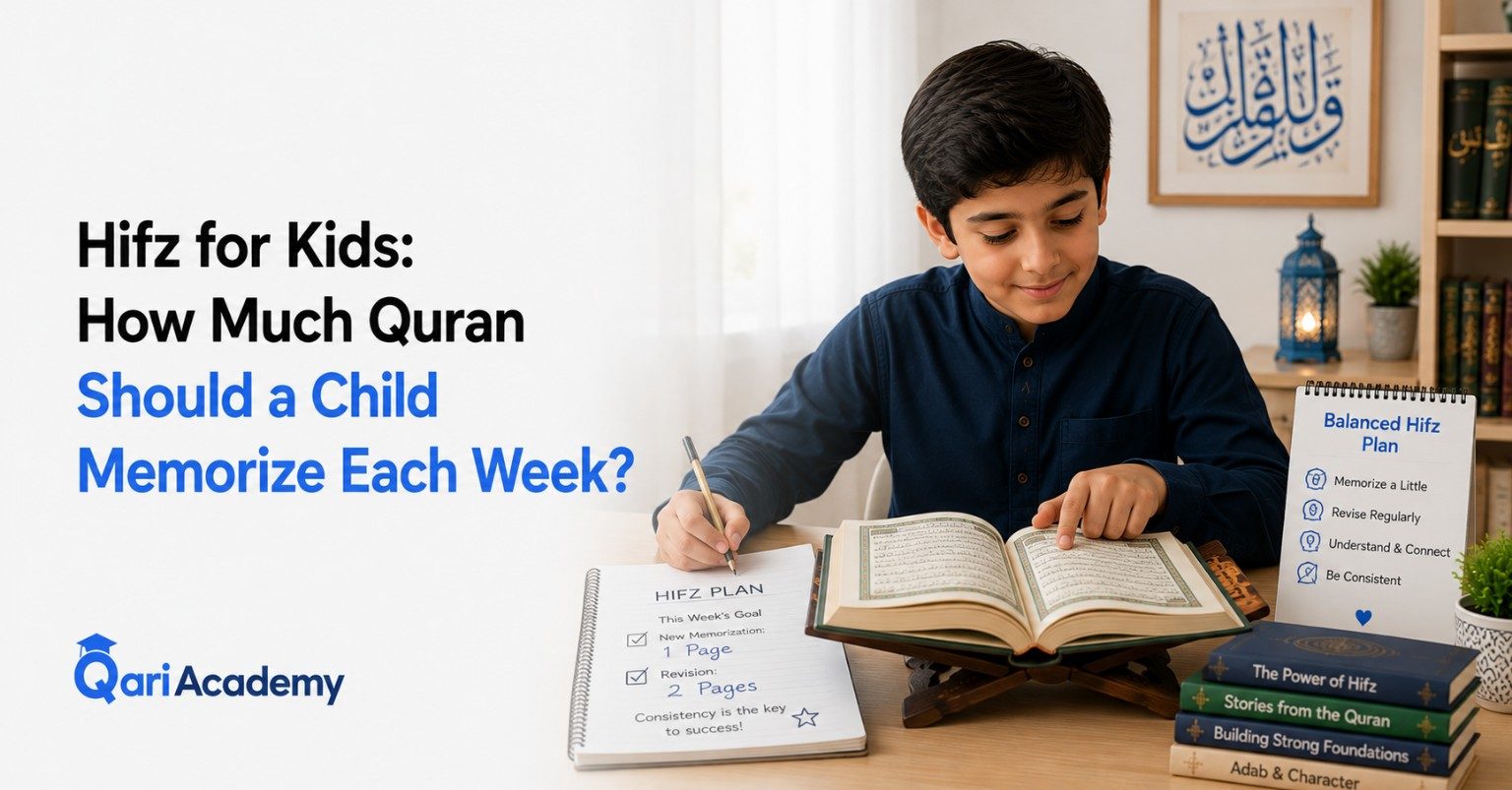
How much Quran should a child memorize each week?
For many Muslim parents, this question seems simple at first. You may hear that one child memorizes half a page every week, another memorizes a page a day, and another is working toward an ambitious Hifz program. Naturally, you may begin wondering whether your own child is memorizing enough.
But there is a problem with measuring Hifz for kids purely by the number of verses or pages memorized.
A child can memorize a large amount of Quran quickly and then struggle to retain it. Another child may memorize only a few lines each week but maintain them accurately for months.
Which child is progressing better?
In sustainable Quran memorization, the answer is not necessarily the child who memorizes more.
The better question is:
How much can this particular child memorize accurately, retain consistently, recite correctly, and review without becoming overwhelmed?
This question is particularly important for Muslim families in the USA, UK, Canada, Australia, and other Western countries. Children growing up in English-speaking environments may have limited daily exposure to Arabic. They may attend full-time English-language schools, participate in sports and extracurricular activities, and have relatively little time available for Quran practice.
Some children may also begin Hifz while they are still developing Quran reading skills.
For these children, an effective Hifz plan may look very different from the schedule of a child who attends an Arabic-speaking school or has extensive Quran practice at home.
The goal of this guide is not to give parents one rigid number and tell every child to memorize the same amount. Instead, it explains how to establish an appropriate weekly target, how to balance new memorization with revision, how age and reading ability affect the workload, and how parents can recognize when the pace is too fast or too slow.
We will also look at practical examples of Hifz for kids, including weekly schedules, home practice routines, age-appropriate considerations, common mistakes, and ways an experienced teacher can personalize the program.
The Quran states that Allah has made the Quran easy for remembrance in Surah Al-Qamar 54:17. Quran.com — Surah Al-Qamar 54:17 At the same time, the Quran instructs believers to recite with measured recitation in Surah Al-Muzzammil 73:4. Quran.com — Surah Al-Muzzammil 73:4
For parents, these verses provide a useful framework: memorization should be approached with confidence and consistency, but recitation should not be rushed.
What Is Hifz for Kids?
Hifz means memorization, and in the Quranic context it commonly refers to memorizing the Quran.
When parents search for Hifz for kids, they are often looking for a structured program that helps their children memorize Quran while developing accurate recitation and revision habits.
However, children’s Hifz should not simply be a smaller version of an adult memorization program.
Children have different:
- Attention spans
- Reading abilities
- Memory capacities
- School schedules
- Motivation levels
- Arabic exposure
- Learning styles
- Emotional needs
A six-year-old and a twelve-year-old should not necessarily have the same weekly memorization target.
Even two children of the same age may require completely different approaches.
Hifz Is More Than Learning New Verses
A common misunderstanding is that Hifz progress equals new material.
In reality, a healthy memorization program has at least three components:
- New memorization
- Recent revision
- Older revision
If new memorization increases while revision remains weak, the child may appear to make impressive progress while their overall retention deteriorates.
That is why an effective weekly target should always include revision.
How Much Quran Should a Child Memorize Each Week?
There is no universal weekly number that is appropriate for every child.
For some beginners, a few lines per week may be enough.
For another child, half a page per week may be realistic.
A stronger and more experienced learner may eventually handle a page or more under appropriate supervision.
The mistake is assuming that one number should apply to every child.
A useful starting framework is:
| Child’s Stage | Possible Weekly New Hifz | Main Priority |
|---|---|---|
| Beginner | A few lines | Accuracy and confidence |
| Early learner | ¼–½ page | New Hifz plus revision |
| Developing learner | ½–1 page | Retention and fluency |
| Experienced learner | 1–3 pages | Structured Hifz and revision |
| Intensive learner | Several pages | Strong teacher supervision |
| Variable schedule | Flexible amount | Consistency over quantity |
These figures are illustrative ranges, not universal rules.
Parents should not interpret them as religious requirements or guaranteed learning rates.
A child’s teacher should determine the actual workload after observing the student’s reading ability, pronunciation, memory, and retention.
Why There Is No “Perfect” Weekly Hifz Target
Imagine two children.
Child A memorizes one page every week but forgets half of it by the following week.
Child B memorizes a quarter-page every week and can recite the entire quarter-page accurately two months later.
If the only measurement is new pages, Child A appears to be progressing four times faster.
But if the measurement is reliable retention, the picture is very different.
This is why parents should avoid turning Hifz into a competition.
The Three Questions Parents Should Ask
Instead of asking:
“How many pages did my child memorize?”
ask:
- How accurately did my child memorize them?
- How much can my child still recite after several days?
- Can my child maintain previous memorization while learning new material?
These questions give you a much more realistic picture.
The Most Important Principle: Retention Before Quantity
A strong Hifz program should protect previously memorized Quran.
New memorization is only one part of the process.
Suppose a child learns five new verses on Monday.
On Tuesday, the child learns five more.
By Friday, the child has learned twenty-five verses.
That sounds excellent.
But what happens if the child cannot remember Monday’s verses?
The solution is not necessarily to work harder.
The solution may be to reduce the amount of new material and increase revision.
A Simple Rule for Parents
Before increasing the weekly target, ask:
“Can my child comfortably maintain the previous target?”
If yes, a gradual increase may be appropriate.
If no, keep the same target or temporarily reduce it.
This makes the program responsive to the child’s actual performance.
How Age Affects Hifz for Kids
Age is relevant, but it should never be the only factor.
Younger children may have strong memorization abilities and excellent imitation skills. However, they may also struggle with:
- Sitting for long periods
- Independent revision
- Reading Arabic
- Understanding instructions
- Managing frustration
Older children may have stronger reading and study skills but face heavier school schedules.
Teenagers may be capable of independent revision but have less free time.
Therefore, age should influence the structure of the program, not dictate a fixed number of pages.
| Age Group | Typical Strengths | Possible Hifz Challenge |
|---|---|---|
| 5–6 | Imitation and repetition | Short attention span |
| 7–8 | Growing memory and reading | Needs frequent encouragement |
| 9–10 | Increasing independence | School workload |
| 11–12 | Stronger study habits | Balancing multiple activities |
| 13–15 | Better self-management | Academic pressure |
| 16+ | Greater independence | Time and motivation |
These are general observations rather than strict developmental rules.
A teacher should always evaluate the individual child.
Hifz for Young Children: Should They Memorize Every Week?
Young children can benefit greatly from memorizing short surahs and selected passages.
But the amount should remain manageable.
For a beginner, even memorizing a few lines accurately can represent meaningful progress.
Parents should resist the temptation to create an adult-style Hifz schedule for a five- or six-year-old.
What Should Young Children Focus On?
For younger learners, the priorities may include:
- Correct pronunciation
- Listening carefully
- Repetition
- Short memorization passages
- Basic Quran reading
- Positive associations with Quran learning
- Regular revision
The child does not need to spend hours every week on Hifz to develop a meaningful relationship with the Quran.
Consistency is more important than creating an impressive weekly number.
Hifz for School-Age Children
Children around elementary and middle-school age may be able to handle a more structured schedule.
However, their workload should still account for:
- School
- Homework
- Sleep
- Sports
- Family time
- Weekends
- Islamic school
- Other extracurricular activities
A realistic Hifz program should fit into the child’s life rather than attempt to replace it.
A Practical Weekly Example
For a child who is ready for structured memorization, a teacher might assign a small amount of new material on several days while reserving time for revision.
For example:
Monday: New memorization + previous lesson
Tuesday: New memorization + Monday revision
Wednesday: New memorization + earlier revision
Thursday: New memorization + weekly review
Friday: Mostly revision
Saturday: New memorization + older review
Sunday: Weekly consolidation or rest
The actual number of verses should depend on the child.
The Role of Reading Ability in Weekly Hifz
A child who reads the Quran fluently may be able to handle more new material than a child who is still learning Qaida or basic Quran reading.
This does not mean the fluent reader is necessarily more intelligent or more capable.
It simply means less lesson time may be needed for decoding the text.
For a child still learning Arabic reading, every new memorization passage may require additional work:
- Reading the words
- Identifying harakat
- Correcting pronunciation
- Understanding difficult letter combinations
- Following the Mushaf
Therefore, the weekly Hifz target should be adjusted.
If Your Child Reads Slowly
Slow reading does not automatically mean your child should not memorize.
If the child can read accurately with support, the teacher may combine Quran reading and memorization.
For example:
Reading: 10 minutes
Tajweed: 5 minutes
New Hifz: 10 minutes
Revision: 5 minutes
This can allow both skills to develop together.
What About Children Who Memorize Through Listening?
Some children have exceptional auditory memory.
They can hear a surah several times and repeat much of it without looking at the Mushaf.
This is a useful ability.
But parents should make sure that memorization does not become completely separated from reading.
Encourage the child to:
- Look at the Quranic text.
- Listen to the recitation.
- Read along.
- Repeat the passage.
- Recite without looking.
- Return to the Mushaf and check accuracy.
This helps connect auditory memory with visual recognition.
New Hifz vs. Revision: The Balance Parents Often Miss
The biggest mistake in children’s Hifz programs is often an imbalance between new memorization and revision.
New material feels productive.
Revision can feel like “doing the same thing again.”
But revision is what protects the work already completed.
A Three-Layer Revision System
A simple system is:
Layer 1: Today’s lesson
Review it several times on the same day.
Layer 2: Recent lessons
Review material from the previous few days.
Layer 3: Older Hifz
Regularly revisit previously memorized surahs or passages.
This creates a stronger memory network than continually adding new verses.
| Revision Layer | Material | Suggested Focus |
|---|---|---|
| Same-day review | Today’s lesson | Accuracy |
| Recent review | Last 3–7 days | Retention |
| Weekly review | Recent week’s work | Fluency |
| Older review | Previous Hifz | Long-term retention |
| Monthly review | Larger memorized portion | Stability |
| Periodic assessment | Selected older passages | Identify weak areas |
The frequency should be adjusted to the child’s level and the amount already memorized.
How to Know If the Weekly Target Is Too High
Parents should watch for warning signs.
Your child’s Hifz target may be too high if:
- Yesterday’s lesson is repeatedly forgotten.
- The child needs excessive prompting.
- Pronunciation deteriorates as the workload increases.
- The child becomes anxious before Quran lessons.
- Revision is constantly skipped.
- The child can only recite with audio assistance.
- Schoolwork begins to suffer.
- The child becomes consistently resistant to practice.
- Previously memorized surahs become weaker.
One difficult day does not mean the target is too high.
Look for patterns.
If the same problems continue for several weeks, discuss the workload with the teacher.
How to Know If the Weekly Target Is Too Low
The opposite can also happen.
A target may be unnecessarily low if:
- The child consistently finishes early.
- Previous material is retained very well.
- The child asks for more.
- Reading is comfortable.
- Revision takes very little time.
- The teacher believes the child can handle more.
- The child remains motivated with the current workload.
In that case, the teacher may gradually increase the target.
The key word is gradually.
A sudden doubling of the workload can disrupt a previously successful routine.
A Practical Hifz Adjustment System
Parents can use a simple traffic-light approach.
Green
The child:
- Memorizes accurately.
- Retains previous work.
- Enjoys lessons.
- Completes revision.
- Reads reasonably well.
Consider maintaining or gradually increasing the workload.
Yellow
The child:
- Sometimes forgets recent material.
- Needs more prompting.
- Struggles on certain days.
- Has inconsistent home practice.
Keep the workload stable and improve revision.
Red
The child:
- Frequently forgets previous material.
- Becomes highly frustrated.
- Shows persistent resistance.
- Has significant pronunciation issues.
- Cannot maintain the current target.
Reduce the workload and discuss the situation with the teacher.
How Much Home Practice Does Hifz Require?
There is no universal number of minutes.
For young children, a short daily routine may be enough.
For older children with larger memorization goals, more time may be necessary.
What matters is the quality and consistency of practice.
A practical home routine could be:
- 5 minutes: Listen
- 5 minutes: Read
- 5–10 minutes: Recite new material
- 5–10 minutes: Review previous material
This is only an example.
Some children may need shorter sessions, while others can handle longer practice.
Parents should avoid turning home practice into a stressful second classroom.
The Best Time for Quran Memorization
The best time varies by child.
Some children concentrate well in the morning.
Others are more comfortable after school.
Some families prefer evenings.
The most important factor is choosing a time when the child is alert enough to learn.
A tired child may appear to have a poor memory when the real problem is simply fatigue.
Consider Your Child’s Daily Rhythm
Ask:
- When is my child most focused?
- When are they usually tired?
- When do they have homework?
- When are they hungry?
- When does the family have fewer distractions?
Then build the Quran routine around that reality.
Should Children Memorize Every Day?
Daily contact with the Quran can be valuable, but that does not necessarily mean every day must include new memorization.
Some days can focus almost entirely on revision.
This may actually improve long-term retention.
For example:
Monday–Thursday: New material plus revision
Friday: Mostly revision
Saturday: New material plus revision
Sunday: Weekly consolidation
This gives the child opportunities to strengthen previous learning.
A Sample Weekly Hifz Schedule for Beginners
Here is one example for a beginner who has basic Quran reading skills.
| Day | New Hifz | Revision | Reading |
|---|---|---|---|
| Monday | Small passage | Previous lesson | 10 min |
| Tuesday | Small passage | Monday + older | 10 min |
| Wednesday | Small passage | Recent lessons | 10 min |
| Thursday | Small passage | Week’s material | 10 min |
| Friday | None or light | Full weekly review | 10 min |
| Saturday | Optional small passage | Older Hifz | 15 min |
| Sunday | Rest/consolidation | Light review | Optional |
The schedule should be adapted to the child’s age, school commitments, and teacher’s recommendations.
A Sample Schedule for a More Experienced Child
A child with stronger reading skills and established memorization habits may handle a larger workload.
For example:
New Hifz: ½–1 page on selected days
Recent revision: Daily
Older revision: Several times per week
Weekly assessment: Once per week
The exact amount should be determined by retention rather than ambition.
A child who can comfortably maintain half a page per week should not automatically be pushed to two pages.
Why Weekly Targets Should Be Flexible
Children are not machines.
Their performance changes.
One week may be excellent.
The next may coincide with:
- School exams
- Family travel
- Illness
- Holidays
- Ramadan routines
- Sports competitions
- Major school projects
- Emotional stress
A good Hifz program can accommodate these fluctuations.
The target may temporarily decrease without meaning the child has failed.
The objective is long-term consistency.
How Parents Can Avoid Comparing Hifz Progress
Comparison is one of the biggest threats to a healthy Quran learning environment.
You may hear:
“That child memorized Juz Amma in three months.”
Another parent may tell you:
“My son memorizes a page every day.”
These stories may be true.
But they tell you almost nothing about your own child’s appropriate target.
You do not know:
- How much time that child practices.
- Their Arabic background.
- Their reading level.
- Their teacher’s method.
- Their revision system.
- Their previous Quran experience.
- How much they actually retain.
Instead, track your child’s own progress.
A Better Progress Journal
Record:
- New material memorized
- Older material reviewed
- Reading accuracy
- Common pronunciation mistakes
- Independent recitation
- Areas requiring extra support
This creates useful information without turning the child into a competitor.
Hifz and Tajweed Should Develop Together
Memorizing incorrect pronunciation and planning to “fix it later” is not a good strategy.
At the same time, demanding advanced Tajweed knowledge from a complete beginner can overwhelm the child.
The better approach is progressive.
Start with:
- Correct letter sounds
- Basic harakat
- Clear pronunciation
- Simple Tajweed concepts
Then gradually add more advanced rules.
The principle of measured recitation in Quran 73:4 reinforces the importance of reciting carefully rather than rushing simply to increase memorization volume.
Should Children Memorize Before They Can Read Fluently?
Not necessarily.
A child does not always need adult-level fluency before beginning short Hifz.
If the child can recognize Arabic letters, read basic words, pronounce most sounds correctly, and work with a teacher, modest memorization may begin while reading continues to develop.
But if the child cannot yet recognize basic letters or understand simple harakat, Quran reading foundations should probably receive greater attention.
The important point is that Hifz should not become a substitute for learning to read.
Hifz for Kids in English-Speaking Families
Children in Western countries face a unique learning environment.
English may be the language of:
- School
- Friends
- Entertainment
- Books
- Sports
- Most family activities
Arabic may appear mainly during:
- Quran lessons
- Salah
- Islamic school
- Mosque
- Family gatherings
That means the child may have less natural Arabic exposure than a child growing up in an Arabic-speaking household.
Parents should take this into account when setting expectations.
A child may need additional time to develop:
- Arabic letter recognition
- Quran reading fluency
- Pronunciation
- Quranic vocabulary
This does not mean the child cannot memorize Quran.
It simply means the path may require more structured support.
How Quranic Arabic Can Support Hifz
Quranic Arabic can complement memorization.
Children do not necessarily need to become fluent Arabic speakers to benefit from learning common Quranic words.
Recognizing recurring vocabulary can make memorization more meaningful.
For example, a teacher may gradually explain the meanings of frequently repeated Quranic words while continuing the memorization program.
This can help the child connect:
Sound → Written Word → Meaning → Memory
That is a richer learning experience than treating every verse as a sequence of sounds.
How a Teacher Should Determine the Weekly Target
A good teacher should not assign the same amount of Hifz to every student automatically.
Before setting a target, the teacher can consider:
- Quran reading ability
- Pronunciation
- Tajweed level
- Current memorization
- Retention
- Age
- Attention span
- Home practice
- School workload
- Motivation
The target can then be adjusted over time.
For example, a teacher may begin with a small amount during the first few weeks.
If the child retains it easily, the amount can increase.
If retention weakens, the teacher can reduce the new material and strengthen revision.
How QariAcademy Can Support Hifz for Kids
QariAcademy provides Online Quran Classes for children, including one-on-one lessons designed around the student’s level.
This can be particularly useful when parents are unsure whether their child should focus primarily on Quran Reading, Tajweed, or Hifz.
A teacher can observe the child’s current ability and help determine an appropriate learning direction.
For one child, the immediate priority may be Arabic alphabet and Qaida.
For another, it may be Quran Reading and Tajweed.
For a child with a stronger foundation, Hifz may become a larger part of the lesson.
QariAcademy can support areas such as:
- Quran Reading
- Tajweed
- Hifz
- Quranic Arabic
The advantage of a one-on-one format is that the child does not have to progress at exactly the same speed as a group of students.
That can be particularly helpful for children in the USA, UK, Canada, Australia, and other Western countries who may have different Arabic exposure and school schedules.
Flexible lesson times can also help families build Quran learning around school and other commitments.
A Free Trial with QariAcademy can provide an opportunity to see how the child responds to the teacher and whether the lesson level is appropriate.
Parents can use the experience to ask practical questions:
- Is the child comfortable with the teacher?
- Is the material too easy or too difficult?
- Does the child need more reading practice?
- How much memorization can realistically be assigned?
- What should the home routine look like?
A 30-Day Hifz Planning Experiment
If you are unsure how much your child should memorize each week, do not guess indefinitely.
Try a four-week observation period.
Week 1: Establish a Small Target
Choose a conservative amount.
The purpose is to establish a baseline.
Week 2: Maintain and Review
Do not immediately increase the target.
See whether the child retains Week 1 material.
Week 3: Test Retention
Ask the child to recite older material without prompts.
This tells you more than a simple daily repetition.
Week 4: Evaluate
Look at:
- Accuracy
- Retention
- Reading
- Pronunciation
- Motivation
- Home consistency
If all six are strong, the teacher may consider a gradual increase.
If several are weak, maintain or reduce the workload.
| Week | Goal | Parent Assessment |
|---|---|---|
| Week 1 | Establish baseline | Can the child manage the target? |
| Week 2 | Build consistency | Is the previous lesson retained? |
| Week 3 | Strengthen revision | Can older material be recited? |
| Week 4 | Evaluate progress | Is the pace sustainable? |
| Month 2 | Adjust carefully | Increase, maintain, or reduce |
| Month 3 | Stabilize routine | Protect long-term retention |
What Should Parents Track?
A simple Hifz tracker can make progress easier to understand.
Track more than pages.
Useful categories include:
- New verses
- Revision completed
- Reading accuracy
- Tajweed corrections
- Memorization retention
- Practice consistency
- Child’s attitude
A child who memorizes fewer verses but steadily improves across these areas may be making excellent progress.
Six Signs You Should Reduce the Hifz Workload
| Warning Sign | Possible Cause | Adjustment |
|---|---|---|
| Frequent forgetting | Too much new material | Reduce new Hifz |
| Pronunciation errors increase | Rushing | Slow down |
| Child becomes anxious | Excessive pressure | Lower expectations |
| Revision is skipped | Schedule is unrealistic | Simplify routine |
| Schoolwork suffers | Poor time balance | Reduce weekly load |
| Child loses motivation | Routine feels overwhelming | Rebuild gradually |
These signs do not mean Hifz should stop permanently.
They indicate that the current system may need adjustment.
Six Signs You May Gradually Increase the Workload
| Positive Sign | What It Shows | Possible Next Step |
|---|---|---|
| Strong retention | Memory is stable | Slight increase |
| Accurate recitation | Quality is protected | Maintain or increase |
| Easy revision | Current load is manageable | Add small amount |
| Independent recitation | Growing confidence | Reduce prompts |
| Consistent practice | Routine is established | Gradual progression |
| Child requests more | Motivation is strong | Discuss increase with teacher |
Again, gradual increases are preferable to dramatic jumps.
The Difference Between a Good Week and a Good Year
This is perhaps the most important mindset shift for parents.
A child may have an amazing week and memorize a large amount.
That is wonderful.
But the real goal is not to maximize one week.
It is to build a sustainable Quran journey over months and years.
A child who memorizes modestly every week may eventually accumulate a substantial amount while maintaining stronger foundations.
Think long term.
Consistency beats occasional intensity.
What Parents Should Say to Encourage Their Children
The language parents use can influence how children experience Quran learning.
Instead of:
“Why did you forget?”
Try:
“Let’s review it together.”
Instead of:
“You only memorized this much?”
Try:
“Let’s make sure you can keep what you learned.”
Instead of:
“Your cousin is ahead of you.”
Try:
“You are improving compared with last month.”
Instead of:
“You have to finish this today.”
Try:
“Let’s work on this part carefully.”
The goal is not to remove expectations.
Children still need structure.
The goal is to combine structure with encouragement.
FAQ: Hifz for Kids
How much Quran should a child memorize each week?
There is no universal amount. A beginner may memorize a few lines, while a more experienced student may manage considerably more. The correct amount depends on reading ability, age, retention, pronunciation, revision, and available practice time.
Is one page a week a good Hifz target for a child?
It can be appropriate for some children, but it may be too much or too little for others. A teacher should assess the child before establishing a specific target.
Should a child memorize Quran every day?
Daily Quran contact can be helpful, but not every day needs to involve new memorization. Some days should focus primarily on revision.
What is more important: memorizing quickly or remembering accurately?
Accurate retention is more important for sustainable Hifz. Fast memorization has limited value if the material is quickly forgotten.
How much time should children spend on Hifz at home?
There is no single correct duration. Younger children may benefit from short focused sessions, while older children may handle longer practice. The routine should be realistic enough to maintain consistently.
Should my child memorize before becoming fluent in Quran reading?
Some children can begin modest memorization while their reading fluency continues to develop. However, basic Quran reading should remain part of the learning plan.
What if my child keeps forgetting old surahs?
Increase revision and consider reducing new memorization temporarily. Forgetting does not necessarily mean your child has poor memory; the revision system may simply need adjustment.
Should children memorize more during school holidays?
School holidays can provide additional opportunities, but parents should not automatically double the workload. Extra free time can also be used for revision, Tajweed, Quran reading, and rest.
Is Hifz suitable for children who primarily speak English?
Yes. English-speaking children can learn Hifz successfully. They may need additional support with Arabic reading, pronunciation, and Quranic vocabulary.
Can Hifz be combined with Tajweed?
Yes. In fact, pronunciation and Tajweed should be developed alongside memorization rather than treated as completely separate goals.
What if my child wants to memorize more than the teacher assigns?
That enthusiasm is valuable. Discuss it with the teacher. The teacher may increase the workload if retention and revision are strong, or may explain why maintaining the current pace is better.
What if my child does not want to memorize?
Do not immediately assume laziness. Look at the workload, teaching style, schedule, fatigue, and motivation. A smaller target or a different lesson structure may help.
Is there a guaranteed number of months in which a child can memorize a Juz?
No responsible program should guarantee a fixed completion time for every child. Learning speed varies significantly, and retention should remain part of the measurement.
Conclusion
When parents ask, “How much Quran should my child memorize each week?”, the most useful answer is not a single number.
The right weekly Hifz target is the amount your child can learn accurately, retain consistently, revise properly, and continue practicing without becoming overwhelmed.
For some children, that may be a few lines.
For others, it may be half a page.
More experienced students may eventually handle a larger amount.
But the number itself is not the most important measurement.
A successful Hifz for kids program balances new memorization with revision, Quran reading, Tajweed, and a realistic home routine. It considers the child’s age, Arabic exposure, school schedule, attention span, motivation, and current reading ability.
Parents should also remember that children develop at different speeds.
A child growing up in the USA, UK, Canada, or Australia may have English as their dominant language and may need more time to develop Arabic reading skills. That does not prevent them from developing a strong relationship with the Quran or making meaningful progress in Hifz.
The best approach is therefore neither to push children toward maximum memorization nor to hold them back unnecessarily.
Start with an achievable target.
Observe retention.
Protect previous memorization.
Correct pronunciation.
Build reading skills.
Then increase the workload gradually when the child is genuinely ready.
Research from the U.S. Institute of Education Sciences also supports the broader learning principle behind this approach: spacing learning over time and actively retrieving previously learned information can improve longer-term retention.
QariAcademy offers one-on-one Online Quran Classes for children, with lessons that can be adapted to a child’s current level. Depending on the student’s needs, learning may focus on Quran Reading, Tajweed, Hifz, or Quranic Arabic. This individualized approach can be especially useful for parents who are unsure how much memorization their child should be doing each week.
A Free Trial with QariAcademy can give your family an opportunity to see the teaching approach, understand your child’s current level, and discuss an appropriate starting point.
The objective is not to make your child memorize the most Quran in the shortest amount of time.
The objective is to help your child build a lifelong relationship with the Quran through accurate recitation, consistent memorization, meaningful revision, patience, and love of learning.
If you are ready to explore an appropriate Quran learning plan for your child:
Book a Free Trial With QariAcademy: QariAcademy Enrollment
Sources and Further Reading
- Quran.com — Surah Al-Qamar 54:17 — The Quran describes itself as made easy for remembrance.
- Quran.com — Surah Al-Muzzammil 73:4 — The verse instructs believers to recite the Quran with measured recitation.
- Institute of Education Sciences — Retrieval Practice and Spacing — Research discussion on retrieval practice and spacing as learning strategies.
- Institute of Education Sciences — Organizing Instruction and Study to Improve Student Learning — Practice guidance addressing spacing learning over time and retrieval through quizzing.