
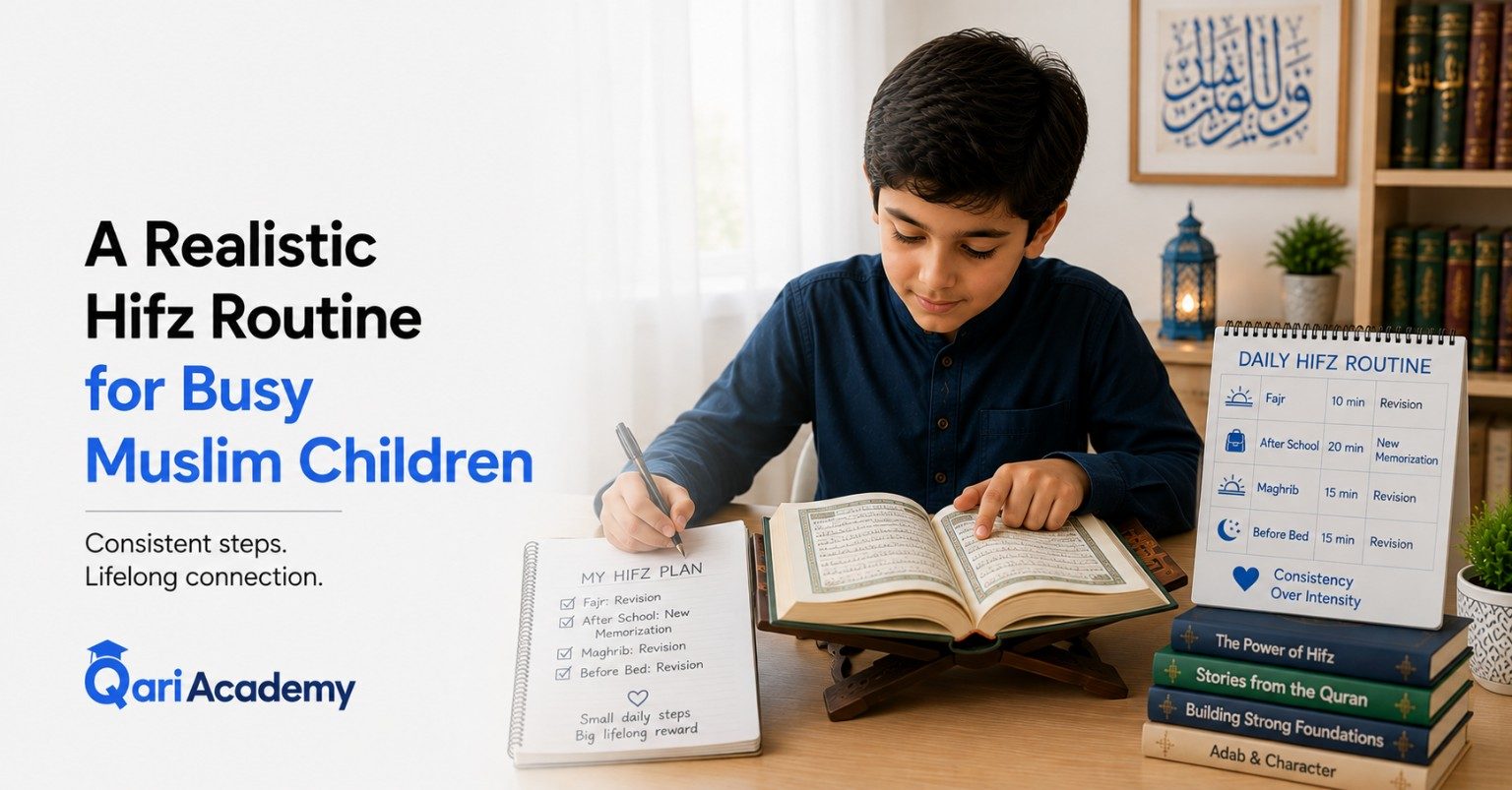
Introduction
How can a busy Muslim child memorize the Quran consistently when school, homework, sports, family commitments, and everyday life already fill most of the week?
This is a challenge many Muslim parents face in the USA, UK, Canada, Australia, and other Western countries.
Parents want their children to develop a strong relationship with the Quran, but they also recognize that children have limited time and energy. A child may spend seven or eight hours at school, come home with homework, attend soccer or swimming practice, participate in Islamic activities, and still need time to eat, rest, play, and sleep.
Then comes the Quran lesson.
The natural question becomes:
Where exactly does Hifz fit into all of this?
The answer is not to fill every available minute with memorization.
A sustainable Hifz routine for kids should fit into the child’s life rather than attempt to take over the child’s life.
This does not mean lowering expectations or treating Quran memorization casually. It means creating a system that respects the child’s age, school schedule, reading ability, attention span, family routine, and current memorization level.
A child who practices for fifteen focused minutes most days may ultimately build a stronger habit than a child who is forced into long sessions that the family cannot maintain.
The goal should be consistency rather than intensity.
The Quran describes itself as made easy for remembrance in Surah Al-Qamar 54:17, while Surah Al-Muzzammil 73:4 instructs believers to recite with measured recitation. Quran.com — Surah Al-Qamar 54:17 Quran.com — Surah Al-Muzzammil 73:4
For parents, these principles can encourage an approach that is hopeful but also careful: help children engage with the Quran regularly while avoiding unnecessary rushing.
This guide will show you how to build a realistic Hifz routine for kids, including daily schedules, weekly planning, revision systems, school-day adjustments, weekend strategies, holiday planning, and practical ways to keep children motivated without making Quran learning another source of stress.
What Makes a Hifz Routine “Realistic”?
A realistic Hifz routine is not necessarily the shortest routine.
It is the routine your family can actually maintain.
This distinction is important.
Many parents create schedules based on an ideal version of their family:
- The child wakes up early every morning.
- Homework is always finished quickly.
- Nobody gets tired.
- There are no appointments.
- Sports never conflict with Quran lessons.
- The child is always motivated.
- Parents always have time to supervise.
Real life does not work that way.
A realistic routine assumes that some days will be difficult.
Your child will occasionally be exhausted.
Homework will sometimes take longer.
Family travel will happen.
Exams will arrive.
The child may get sick.
A good Hifz system needs enough flexibility to survive those situations.
The Four Characteristics of a Sustainable Routine
A realistic routine should be:
Consistent: Quran appears regularly in the child’s week.
Age-appropriate: The workload matches the child’s developmental level.
Flexible: The schedule can adapt during unusually busy periods.
Balanced: New memorization does not completely replace revision, reading, and rest.
The goal is not to create a perfect schedule.
The goal is to create a system that keeps working when life is imperfect.
Hifz Should Not Compete With Everything Else
Parents sometimes make an important mistake when planning Quran memorization.
They treat all available free time as potential Hifz time.
But children need more than academic and religious work.
They need:
- Sleep
- Physical activity
- Family time
- Social interaction
- Play
- Downtime
- Schoolwork
- Personal interests
A healthy Hifz routine should fit within those needs.
This is particularly important for children growing up in Western countries, where school schedules and extracurricular activities can be demanding.
Think in Weekly Hours, Not Just Daily Minutes
Instead of asking:
“How many minutes should my child memorize today?”
also ask:
“How much Quran learning can our family realistically support each week?”
That question produces a more realistic plan.
| Family Situation | Likely Challenge | Better Hifz Approach |
|---|---|---|
| Heavy school workload | Limited weekday energy | Short weekday revision |
| Multiple activities | Schedule conflicts | Protect key Quran sessions |
| Young child | Short attention span | Brief focused practice |
| Older student | More academic pressure | Flexible weekly targets |
| Frequent travel | Interrupted routine | Minimum travel routine |
| Busy parents | Limited supervision | Clear teacher-led assignments |
The right schedule depends on the child’s circumstances.
How Much Time Does a Child Actually Need?
There is no universal number.
A five-year-old may benefit from very short sessions.
An eight-year-old may manage several short practice periods.
A twelve-year-old may be able to handle longer independent revision.
A teenager with an established Hifz foundation may require significantly more time.
The key is to distinguish between lesson time and home practice time.
A child may have a 30-minute online Quran lesson but need only 10–15 minutes of focused home revision afterward.
Another child with a larger Hifz portion may require more.
A Useful Starting Range
For many younger children, a short daily practice period of around 10–15 focused minutes can be a practical starting point.
Older or more advanced students may need longer sessions.
These are not religious requirements or universal prescriptions.
They are planning examples.
The child’s teacher should adjust the workload based on:
- Current Hifz
- Retention
- Reading ability
- Tajweed
- Age
- Attention
- School schedule
- Home consistency
The Three Parts of a Good Hifz Routine
A sustainable Hifz routine should contain three major components.
1. New Memorization
This is the material the child is learning for the first time.
2. Recent Revision
This includes material learned during the previous few days or weeks.
3. Older Revision
This protects memorization that was learned months earlier.
If a child spends all their time on new material, old Hifz can weaken.
If a child spends all their time reviewing old material, they may stop progressing.
The routine needs balance.
| Hifz Component | Main Purpose | Example Activity |
|---|---|---|
| New memorization | Add new Quran | Learn a short passage |
| Same-day review | Strengthen new learning | Recite without looking |
| Recent revision | Protect recent Hifz | Review previous lessons |
| Older revision | Maintain long-term Hifz | Recite an older surah |
| Quran reading | Build reading ability | Read from Mushaf |
| Tajweed | Protect accuracy | Practice teacher corrections |
This balance becomes increasingly important as the child’s memorized portion grows.
Build the Routine Around the Child’s Best Time
Not every child learns best at the same time.
Some children concentrate well in the morning.
Others are more alert after school.
Some children can focus after Maghrib.
Others become exhausted in the evening.
Do not automatically assume that bedtime is the best Quran time simply because the family is finally together.
Observe your child.
Ask:
- When is my child most alert?
- When do they usually become tired?
- When is homework finished?
- When are siblings distracting them?
- When is the house relatively quiet?
Then choose the most realistic practice window.
The Best Time Is the Time You Can Repeat
A theoretically perfect time that happens only twice a week is less useful than a good time that works five days a week.
Consistency matters.
A Simple Weekday Hifz Routine
For a younger child with school, consider something like:
After school: Snack and rest.
Homework: Complete school responsibilities.
Quran lesson: Attend the scheduled online lesson.
Later: 10–15 minutes of focused Hifz review.
Evening: Optional Quran listening or light reading.
The key is not to make every activity happen immediately after school.
Children often need a transition period.
A short break can improve the quality of later Quran practice.
Example: 30-Minute Daily Quran Routine
A child who is already comfortable with basic Quran reading might use:
- 5 minutes: Review older Hifz
- 10 minutes: Review recent material
- 10 minutes: New memorization
- 5 minutes: Final recitation
This is only a model.
The teacher may recommend a different distribution.
The important principle is that new memorization should not consume the entire session.
Example: 15-Minute Routine for a Younger Child
For a younger learner:
- 3 minutes: Listen
- 5 minutes: Recite today’s lesson
- 4 minutes: Review yesterday’s lesson
- 3 minutes: Read from the Mushaf
This shorter structure may be more realistic for a child with a limited attention span.
If the child becomes tired after ten minutes, stop or take a break.
Quality matters.
Example: 45-Minute Routine for an Older Student
An older child with established Hifz may be able to manage:
- 10 minutes: Older revision
- 15 minutes: Recent revision
- 15 minutes: New memorization
- 5 minutes: Final recitation
Again, this should not become a rigid rule.
The larger the memorized portion, the more time may need to be allocated to older revision.
How to Create a Weekly Hifz Schedule
Daily routines are useful, but weekly planning is even more important for busy families.
Look at the entire week.
Which days are busiest?
Which days have sports?
Which days have longer homework?
Which days are relatively free?
Then distribute Quran work accordingly.
For example, if Tuesday is packed with school and soccer, do not assign the same amount of Hifz as Saturday.
| Day | Family Schedule | Hifz Focus |
|---|---|---|
| Monday | Moderate workload | New Hifz + revision |
| Tuesday | Very busy | Short revision only |
| Wednesday | Moderate | New Hifz + recent review |
| Thursday | Busy | Short revision |
| Friday | Flexible | Weekly revision |
| Saturday | More free time | New Hifz + older revision |
| Sunday | Family preparation | Light consolidation |
This approach recognizes reality instead of pretending every day is identical.
The “Heavy Day / Light Day” System
One of the most useful strategies for busy families is to divide the week into heavy and light Quran days.
Heavy Days
Use these for:
- New memorization
- Longer revision
- Reading practice
- Teacher lessons
Light Days
Use these for:
- Short revision
- Listening
- One familiar surah
- Reviewing difficult verses
This prevents a single demanding school day from destroying the entire Hifz routine.
Why Revision Should Not Be Treated as Optional
Children often prefer new memorization.
It feels like progress.
But revision is what makes the progress last.
A child who memorizes a new page every week without revising older material may eventually have a large quantity of weak Hifz.
A child who memorizes more slowly but revises consistently may build stronger long-term retention.
This is why the routine should include revision from the beginning.
Research on learning supports spaced practice and retrieval as effective methods for strengthening long-term memory. The U.S. Institute of Education Sciences provides guidance and research on retrieval and spacing as learning strategies. Institute of Education Sciences
For Quran memorization, the practical sequence is:
Learn → Retrieve → Review → Space → Retrieve Again
A Simple Spaced Revision Pattern
A new passage can be reviewed:
- Same day
- Next day
- Several days later
- At the end of the week
- Two weeks later
- Later as part of older Hifz
This does not need to become complicated.
The child simply needs repeated opportunities to retrieve the passage after time has passed.
| Revision Timing | Main Goal | Example |
|---|---|---|
| Same day | Strengthen new learning | Recite after lesson |
| Next day | Test early retention | Recite without looking |
| Day 3–4 | Reinforce memory | Review weak parts |
| End of week | Consolidate | Full weekly review |
| Week 2 | Test durability | Independent recitation |
| Later | Maintain Hifz | Add to older rotation |
How to Know If the Routine Is Too Heavy
A routine is probably too demanding when several warning signs appear repeatedly.
Your child may:
- Forget yesterday’s lesson constantly.
- Lose older memorization.
- Become anxious before lessons.
- Need excessive prompting.
- Avoid Quran practice.
- Become unusually frustrated.
- Have less time for sleep.
- Struggle with schoolwork.
- Make more pronunciation mistakes because of rushing.
One difficult day does not mean the schedule is wrong.
Look for a pattern over several weeks.
Reduce the Workload Strategically
If the workload is too high, do not necessarily stop Quran completely.
Instead:
- Reduce new memorization.
- Maintain short revision.
- Protect older Hifz.
- Keep the teacher informed.
- Rebuild gradually.
A temporary reduction can protect long-term consistency.
How to Know If the Routine Is Too Light
The opposite problem can occur.
Perhaps your child:
- Consistently finishes the assigned work easily.
- Retains everything well.
- Has plenty of unused practice time.
- Asks to learn more.
- Reads comfortably.
- Needs very little revision time.
In that case, the teacher may recommend a gradual increase.
But do not double the workload overnight.
A small increase gives you information about the child’s actual capacity.
School Exams and Hifz
School exams can temporarily change the child’s priorities.
During exam weeks, parents should not necessarily demand the same Hifz workload.
Instead, use a maintenance plan.
For example:
5–10 minutes of revision
rather than:
30 minutes of new memorization.
The child stays connected to the Quran without creating unnecessary academic pressure.
Once exams finish, the regular schedule can resume.
Homework and Quran: Which Comes First?
There is no universal answer.
The right order depends on the child.
Some children become mentally exhausted after homework.
Others need to complete Quran before starting homework because otherwise they become distracted.
Experiment.
If the child performs significantly better with Quran before homework, schedule it earlier.
If homework needs immediate attention after school, allow the child to rest and complete it before Quran.
The goal is not to follow a rule.
The goal is to identify the routine that works.
Hifz During Sports Seasons
Sports can be one of the biggest schedule challenges.
A child may have:
- Practice
- Games
- Travel
- Weekend tournaments
Instead of abandoning Hifz during sports seasons, adjust the routine.
Practice Days: Use a short revision session.
Game Days: Use a minimum routine.
Free Days: Do more substantial revision or new memorization.
This creates flexibility without losing continuity.
The Minimum Hifz Day
Every busy family should have a “minimum Quran day.”
This is the smallest amount of Quran practice you are willing to maintain even when life becomes difficult.
For example:
Five minutes of revision.
That may seem small.
But its purpose is not to produce huge progress.
Its purpose is to protect the habit.
Once the child has five minutes available, they may naturally continue.
If not, the minimum has still been completed.
This prevents an all-or-nothing mindset.
Hifz During Family Travel
Travel is another reason routines collapse.
Instead of expecting a normal schedule while traveling, create a travel version.
A travel Hifz routine could include:
- Listening to the current passage.
- Reciting one short surah.
- Reviewing recent material.
- Reading from a digital Mushaf where appropriate.
- Practicing during a quiet part of the day.
The target may be smaller.
That is fine.
The goal is continuity.
Hifz During School Holidays
School holidays can provide additional time, but parents should not automatically double the child’s workload.
Extra time can be used for:
- Catching up on weak material
- Older Hifz revision
- Quran reading
- Tajweed
- New memorization
- Listening
A holiday can be an opportunity to strengthen foundations rather than simply accumulate pages.
What About Ramadan?
Ramadan naturally creates more opportunities for Quran engagement.
Children may hear more recitation at home and in the mosque.
Families can use this atmosphere positively.
But avoid turning Ramadan into a memorization competition.
For younger children, focus on:
- Listening
- Reading
- Short surah revision
- Participating in family Quran routines
- Building positive associations
Older children may handle more structured revision.
The exact workload should remain age-appropriate.
How Parents Can Support Without Becoming “Quran Police”
Parents are essential to a child’s Hifz journey.
But parents do not need to monitor every word.
Your role can be:
Create the time.
Provide the environment.
Encourage consistency.
Communicate with the teacher.
Listen when helpful.
Celebrate progress.
Let the teacher handle detailed instruction and assessment.
Let the child gradually develop independence.
A Healthier Parent Question
Instead of:
“How many pages did you memorize?”
ask:
“What did you work on today?”
Instead of:
“Did you practice?”
ask:
“When would be a good time to review?”
Instead of:
“Why did you forget?”
ask:
“Which part needs more practice?”
These small changes can make Quran conversations less confrontational.
Give Children Some Control
Children need age-appropriate autonomy.
For example:
“Would you rather revise before dinner or after dinner?”
“Which of your old surahs would you like to review first?”
“Do you want to recite sitting here or at your desk?”
These are small choices.
But they help the child experience ownership.
For older children, you can ask:
“What do you think needs the most revision this week?”
That is a much more powerful question than simply assigning everything.
Create a Quran-Friendly Environment at Home
You do not need to turn your home into a formal Quran school.
Small environmental cues can help.
Consider:
- Keeping a Mushaf in an accessible place.
- Having a quiet Quran learning area.
- Listening to Quran appropriately during family routines.
- Keeping practice materials organized.
- Making the lesson schedule visible.
- Encouraging family Quran time.
The environment should make Quran accessible rather than making it feel like another punishment.
How Technology Can Help
Children are already surrounded by technology.
Instead of fighting technology constantly, parents can sometimes use it appropriately to support learning.
For example:
- Online Quran lessons
- Audio recitation
- Digital revision trackers
- Calendar reminders
- Teacher communication
- Recorded practice where appropriate
However, technology should remain a tool.
The objective is not to add another screen-based activity without purpose.
For younger children especially, active interaction with a teacher and parent remains important.
The Role of One-on-One Online Quran Lessons
For busy families, one-on-one online learning can provide a predictable Quran lesson without adding travel time.
The child can learn from home while the teacher focuses directly on their level.
This can be especially useful when the child:
- Needs individualized pacing
- Has limited Arabic exposure
- Is balancing school and activities
- Requires specific Tajweed correction
- Needs a personalized Hifz target
The online format itself does not guarantee better learning.
Teacher quality, consistency, lesson structure, and home practice still matter.
How QariAcademy Can Fit Into a Busy Family Schedule
QariAcademy provides Online Quran Classes for children, including one-on-one lessons designed around the student’s level.
For busy Muslim families, this can make Quran learning easier to integrate into an existing weekly schedule because there is no need for the family to travel to a physical learning center for every lesson.
Depending on the child’s needs, the learning plan can include:
- Quran Reading
- Tajweed
- Hifz
- Quranic Arabic
This is important because not every child should spend every lesson doing the same thing.
A child who is still developing Arabic reading may need more Quran Reading.
Another child may need Tajweed correction.
A stronger reader may be ready for a larger Hifz component.
The teacher can help identify the appropriate balance.
Flexible scheduling can also help families coordinate Quran lessons with school, homework, sports, and other commitments.
A Free Trial with QariAcademy can give parents an opportunity to see how their child responds to the teacher and whether the lesson level fits their current ability.
The goal is not simply to add another appointment to the calendar.
The goal is to create a Quran routine that the child and family can realistically maintain.
A Sample Hifz Routine for Ages 5–7
Young children need short, focused sessions.
A possible weekly structure might include:
- 3–4 Quran lessons
- 5–10 minutes of home review
- Short listening periods
- One weekly older-surah review
At this age, parents should prioritize:
- Correct pronunciation
- Basic Quran reading
- Short memorization
- Positive associations
- Consistency
Do not judge success only by the number of verses memorized.
A Sample Hifz Routine for Ages 8–10
Children in this age group may be able to handle:
- 3–5 Quran lessons per week
- 10–20 minutes of home practice
- Daily recent revision
- Several weekly older-Hifz sessions
The exact amount should depend on the child’s school workload and reading ability.
A Sample Hifz Routine for Ages 11–13
Older elementary or middle-school children may be able to take more responsibility.
A routine could include:
- Scheduled online lessons
- 15–30 minutes of independent practice
- Daily recent revision
- Several weekly older-Hifz sessions
- Weekly self-assessment
The child can gradually begin tracking their own weak passages.
A Sample Hifz Routine for Teenagers
Teenagers need more autonomy.
A realistic routine may include:
- Teacher-assigned Hifz
- Independent revision
- Weekly planning
- Older Hifz maintenance
- Flexible adjustment around exams
Instead of monitoring every session, parents can have a weekly conversation:
“What is your Quran goal this week?”
“What part needs the most revision?”
“What is getting in the way?”
This prepares the student for lifelong self-directed Quran learning.
Four Weekly Hifz Models for Different Families
| Family Type | Weekly Pattern | Best Focus |
|---|---|---|
| Very busy | 3 lessons + short daily review | Consistency |
| Moderate schedule | 4 lessons + regular revision | Balanced progress |
| Flexible schedule | 5 lessons + longer review | Structured growth |
| Holiday period | More practice opportunities | Consolidation |
| Exam period | Maintenance routine | Protect existing Hifz |
| Travel period | Minimum routine | Continuity |
These models are starting points rather than fixed programs.
How Much New Quran Should a Busy Child Memorize?
The answer should come from retention rather than ambition.
A child may memorize:
- A few lines per week
- A quarter page
- Half a page
- A page
- More at advanced levels
But none of these numbers is automatically correct.
The better test is:
Can the child maintain the previous material while learning the new material?
If yes, the pace may be sustainable.
If no, reduce the new material and increase revision.
What If the Child Is Memorizing Very Slowly?
Slow progress does not necessarily mean the routine is failing.
Ask:
- Is the child improving?
- Is retention strong?
- Is reading improving?
- Is pronunciation becoming more accurate?
- Is the child becoming more independent?
- Is the routine consistent?
If the answer is yes, slow progress may still represent meaningful progress.
A child should not be rushed simply to produce impressive numbers.
What If the Child Is Memorizing Very Quickly?
Fast memorization can be a strength.
But it creates a temptation to increase the workload dramatically.
Before doing so, check retention.
Can the child still recite the material tomorrow?
Next week?
Can they maintain older Hifz?
If yes, gradual increases may be reasonable.
If no, protect retention before adding more.
Build a “Recovery Plan” for Difficult Weeks
A realistic routine should include a recovery plan.
Suppose your child misses several days because of illness or travel.
Do not try to cram everything into the next weekend.
Instead:
Step 1: Review the most recent material.
Step 2: Identify what was forgotten.
Step 3: Pause or reduce new Hifz temporarily.
Step 4: Rebuild the routine.
Step 5: Return to the normal target gradually.
This avoids turning one interruption into a complete breakdown of the program.
The 80% Rule for Family Routines
You do not need to execute the schedule perfectly.
If your family maintains the routine most weeks, that is already valuable.
A schedule that works 80% of the time is often better than a perfect schedule that collapses after two weeks.
Life will interfere.
The goal is to return to the routine, not punish the family for temporarily leaving it.
A Monthly Hifz Review
Once a month, take ten minutes to review the child’s progress.
Ask:
Memorization: What new material was learned?
Retention: What is still strong?
Revision: Which older portions need work?
Reading: Is Quran reading improving?
Tajweed: Which pronunciation issues remain?
Routine: Is the schedule realistic?
Motivation: How does the child feel about the routine?
| Monthly Review Area | Question to Ask | Possible Action |
|---|---|---|
| New Hifz | Is the pace realistic? | Maintain or adjust |
| Retention | Is old material stable? | Increase revision if needed |
| Reading | Is fluency improving? | Add reading practice |
| Tajweed | Are mistakes decreasing? | Target weak rules |
| Routine | Does the schedule fit? | Rearrange sessions |
| Motivation | Is the child engaged? | Increase ownership |
What a Good Hifz Week Actually Looks Like
A good week does not necessarily mean:
“Memorized two pages.”
It may mean:
- The child attended every lesson.
- They practiced consistently.
- They retained their previous Hifz.
- They corrected a pronunciation problem.
- They reviewed an older surah.
- They handled one difficult passage without giving up.
Those are meaningful achievements.
The Long-Term Goal Is a Habit
The ultimate purpose of a Hifz routine is not the routine itself.
It is to develop a habit that can survive changes in life.
Today, the parent may set the schedule.
Next year, the child may manage it.
Later, the young adult may maintain Quran revision independently.
That is a much more valuable outcome than temporary intensive memorization.
FAQ: Hifz Routine for Kids
How many days a week should a child study Hifz?
There is no universal number. Many families benefit from regular Quran contact throughout the week, but the balance between lessons, new memorization, and revision should depend on the child’s age and level.
How long should a child’s daily Hifz practice be?
It depends on age, attention span, and current memorization. Younger children may need only a few focused minutes, while older or more advanced students may need longer sessions. Start with a manageable amount and adjust based on retention.
Should children memorize Quran every day?
Not necessarily. Daily Quran contact can be useful, but some days can focus entirely on revision, reading, or listening rather than new memorization.
What if my child has too much homework?
Reduce the Hifz workload temporarily rather than abandoning Quran completely. A short maintenance routine can help preserve consistency during particularly busy school periods.
Should Hifz practice happen before or after homework?
There is no universal answer. Some children focus better before homework, while others need to finish school responsibilities first. Test both options and choose the time when your child is most alert.
What if my child is too tired after school?
Give the child time to rest before the Quran session, or move practice to another part of the day. A shorter focused session is often more productive than forcing a tired child through a long lesson.
How much Quran should a busy child memorize each week?
The target should be based on retention rather than a fixed number of pages. A few lines may be appropriate for one child, while another can manage significantly more.
Should children revise old Hifz every week?
Yes, maintaining older memorization is an important part of sustainable Hifz. As the memorized portion grows, older revision becomes increasingly important.
How can parents keep Hifz consistent during vacations?
Create a smaller travel or holiday routine. Focus on maintaining contact with the Quran rather than insisting on the exact same workload used during normal school weeks.
What if my child keeps forgetting what they memorized?
Increase revision, use active recall, and consider reducing new material temporarily. Persistent forgetting may indicate that the current workload is too high or that the revision system needs adjustment.
How can I motivate my child without pressuring them?
Use predictable routines, specific encouragement, realistic goals, and age-appropriate choices. Focus on progress and consistency rather than comparison with other children.
Is online Hifz suitable for busy children?
One-on-one online Quran lessons can be practical for busy families because they eliminate travel time and allow the teacher to focus directly on the child. The effectiveness still depends on teacher quality, lesson structure, and consistent home practice.
Can my child learn Quran Reading and Hifz at the same time?
Yes. Children who are still developing Quran reading skills can sometimes combine reading instruction with modest memorization. The teacher should determine the appropriate balance.
Should teenagers have a different Hifz routine?
Usually, yes. Teenagers can often take more responsibility for planning and revision, but their routines also need to account for school exams, extracurricular activities, and increasing academic demands.
What should parents do when the Hifz routine stops working?
Do not immediately abandon it. Identify what changed, simplify the routine, speak with the teacher, and rebuild gradually. A good Hifz routine should be adjusted when family circumstances change.
Conclusion
A realistic Hifz routine for kids is not the schedule with the most memorization, the longest practice sessions, or the most ambitious weekly targets.
It is the routine that a child can follow consistently while maintaining accurate recitation, healthy revision habits, school responsibilities, family life, and enough time for rest.
For busy Muslim families in the USA, UK, Canada, Australia, and other Western countries, this balance is especially important. Children often have demanding school schedules, limited Arabic exposure, extracurricular activities, and many competing responsibilities.
That does not mean Hifz has to become unrealistic.
It means the approach needs to be smarter.
Build around the child’s best time.
Keep daily practice manageable.
Separate heavy and light days.
Protect revision.
Create a minimum routine for difficult days.
Adjust during exams and travel.
Give children increasing responsibility.
And measure progress by retention and consistency—not simply by pages.
A child who memorizes a modest amount but remembers it accurately is making meaningful progress.
A child who learns to revise independently is developing a skill that will matter far beyond the next lesson.
And a child who grows up seeing Quran as a consistent part of family life—not merely another source of pressure—has a stronger foundation for continuing that relationship as they grow.
QariAcademy offers one-on-one Online Quran Classes for children, with lessons adapted to the student’s level and learning needs. Depending on the child’s stage, lessons can focus on Quran Reading, Tajweed, Hifz, or Quranic Arabic.
For busy families, one-on-one online learning can also make it easier to build Quran lessons around school, homework, sports, and family commitments. The teacher can help identify an appropriate memorization pace instead of assuming every child should follow the same schedule.
A Free Trial can give parents an opportunity to see how their child responds to the teacher and whether the lesson structure fits their current needs.
The objective is not to make your child memorize as much Quran as possible this month.
The objective is to help them build a routine they can continue next month, next year, and eventually on their own.
Consistency today can become independence tomorrow.
Book a Free Trial With QariAcademy: QariAcademy Enrollment
Sources and Further Reading
- Quran.com — Surah Al-Qamar 54:17 — Quranic text and translation.
- Quran.com — Surah Al-Muzzammil 73:4 — Quranic text and translation.
- Institute of Education Sciences — Research and guidance on spacing, retrieval practice, and durable learning.
- PubMed — Research literature on retrieval practice, memory, and children’s learning.