Table of Contents
Introduction
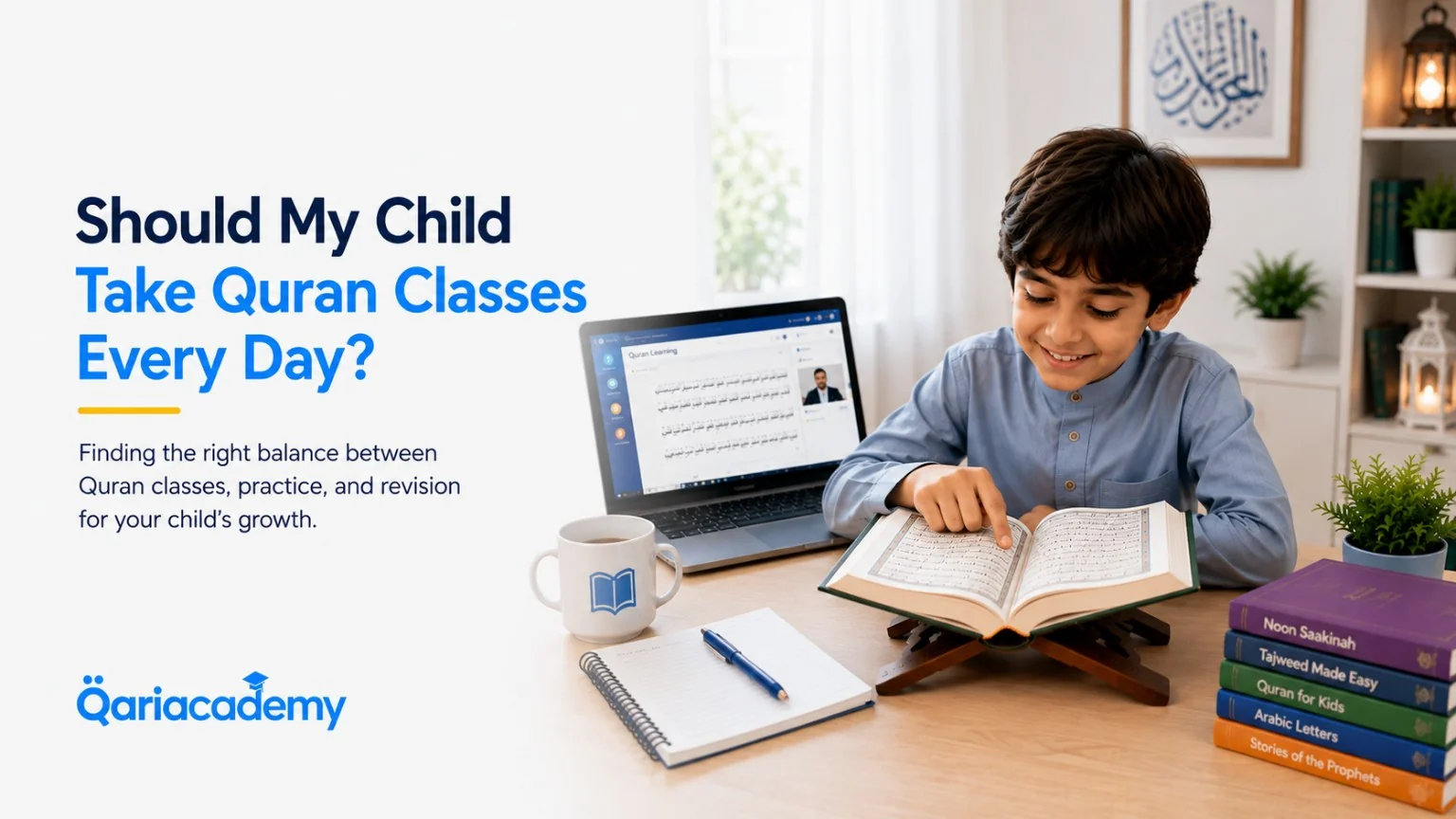
Should My Child Take Quran Classes Every Day? It is a reasonable question, especially when parents see another child progressing quickly and wonder whether more Quran classes would produce faster results.
But there is an important distinction that parents often miss:
Daily contact with the Quran is not the same as daily teacher-led classes.
A child may benefit greatly from interacting with the Quran every day through reading, listening, memorization, or revision. That does not mean they necessarily need a live Quran lesson with a teacher seven days a week.
For many children, two or three focused teacher-led lessons each week, combined with short and consistent home practice, can create a stronger routine than daily classes that leave the child tired or overwhelmed. QariAcademy’s current guidance similarly emphasizes that the appropriate frequency depends on the child’s age, starting level, goals, attention span, family schedule, and home practice.
The real question is therefore not:
“How many Quran classes can my child take?”
It is:
“How much structured instruction and practice can my child benefit from consistently?”
That distinction can prevent parents from confusing intensity with effective Quran education.

Daily Quran Contact vs. Daily Quran Classes
These two ideas should be separated from the beginning.
| Type of Quran Activity | Possible Frequency | Main Purpose |
|---|---|---|
| Teacher-led lesson | 2–4 times weekly | Instruction and correction |
| Quran reading | Most days | Fluency and familiarity |
| Memorization | Several days weekly | New Hifz |
| Revision | Most days | Retention |
| Listening | Regularly | Exposure and pronunciation |
A child may therefore have daily Quran contact without attending a live class every day.
For example, a child could have three teacher-led lessons per week while spending 10–15 minutes on reading or revision on other days.
That may provide a better balance between instruction, practice, school, rest, and family life.
What Does Islam Teach Us About Consistency?
There is a useful principle in the Sunnah here.
The Prophet ﷺ said that the deeds most beloved to Allah are those that are regular and consistent, even if they are few. The same narration also warns against taking on more than one can sustain.
This principle fits Quran education remarkably well.
A child who reads or reviews Quran for a short period every day may develop a stronger long-term habit than a child who studies intensely for several days and then stops because the routine became exhausting.
The Quran also teaches us to seek increase in knowledge: “My Lord, increase me in knowledge.”
The emphasis should therefore be on steady development, not simply maximizing hours.
How Many Quran Classes Does a Child Actually Need?
There is no universal number.
A five-year-old beginner, an eight-year-old learning Quran reading, and a twelve-year-old preparing for Hifz should not automatically receive the same schedule.
| Child’s Situation | Possible Starting Schedule | Priority |
|---|---|---|
| Young beginner | 2–3 lessons weekly | Foundation and familiarity |
| Developing reader | 2–3 lessons weekly | Reading and correction |
| Quran reader | 2–4 lessons weekly | Fluency and Tajweed |
| Hifz student | 3–5 focused sessions | New Hifz + revision |
These are planning examples, not prescriptions.
QariAcademy’s articles on children at different ages consistently make the same point: frequency should be adapted to the child’s ability, goals, school responsibilities, attention, and capacity to practice between lessons.
When Daily Classes May Make Sense
There are situations where more frequent teacher-led Quran lessons can be appropriate.
For example, daily or near-daily sessions may make sense when a child:
- Has a serious Hifz goal.
- Needs intensive reading support.
- Has substantial material requiring frequent correction.
- Is temporarily working toward a specific target.
- Has enough time and energy to handle the schedule.
- Benefits from shorter, more frequent sessions.
Even then, daily does not automatically mean long.
Five short, focused sessions may be easier for a child than three very long sessions.
QariAcademy’s Hifz guidance recommends balancing new memorization with revision rather than simply increasing new material.
When Daily Classes May Be Too Much
More instruction can become counterproductive when the child does not have enough time to absorb what was taught.
Imagine a child attending Quran class every day but:
- Forgetting yesterday’s material.
- Becoming tired before each lesson.
- Doing little independent practice.
- Struggling to concentrate.
- Becoming increasingly resistant to Quran.
- Having no time for revision.
- Already carrying a heavy school workload.
Adding more classes may not solve the underlying problem.
QariAcademy’s discussion of the Quran learning gap makes this point directly: when progress slows, adding more lessons can sometimes mean giving the child more exposure to the same underlying problem rather than fixing the problem itself.
Before increasing frequency, ask:
What exactly is slowing my child down?
The Difference Between Instruction and Practice
This is one of the biggest mistakes parents make.
A teacher-led class and home practice serve different purposes.
The teacher may:
- Introduce a new skill.
- Correct pronunciation.
- Explain Tajweed.
- Listen to memorization.
- Identify weaknesses.
- Adjust the learning plan.
Home practice may:
- Reinforce the lesson.
- Build reading fluency.
- Strengthen memory.
- Review previous material.
- Develop independence.
| Teacher’s Role | Child’s Home Role |
|---|---|
| Teach | Practice |
| Correct | Repeat |
| Explain | Apply |
| Diagnose weaknesses | Strengthen weak areas |
| Set appropriate targets | Build consistency |
The child does not need a teacher present every day to practice every day.
In fact, gradually learning to practice independently is an important part of mature Quran education.
Daily Home Practice Can Be More Valuable Than Daily Classes
For many children, a short daily routine is highly practical.
QariAcademy’s First 90 Days guide gives a simple example of a 10-minute home routine: review previous material, practice a difficult skill, read the assigned material, and finish with something the child already knows well.
A routine might look like:
2 minutes: Previous review
3 minutes: Current lesson
3 minutes: Quran reading
2 minutes: Easy successful reading or memorization
The goal is not to create another full class at home.
The goal is reinforcement.
QariAcademy’s 20-Minute Challenge similarly emphasizes short, structured daily practice rather than exhausting sessions.
What About Hifz?
Hifz is where the question becomes more complicated.
A child memorizing Quran may need more frequent contact with the material than a child whose primary goal is basic reading.
But even for Hifz, new memorization should not be the only daily activity.
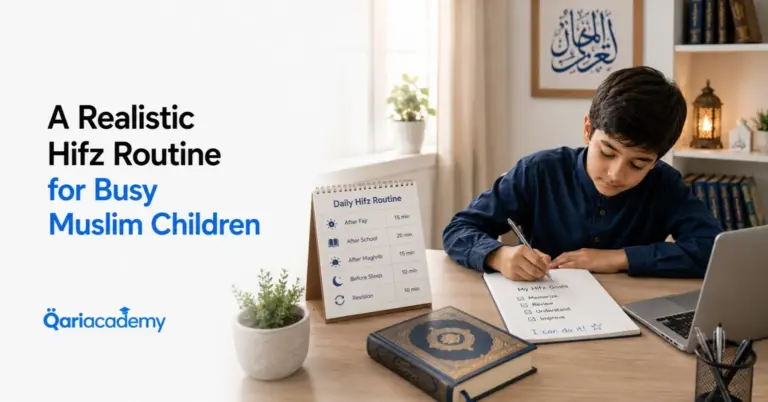
A sustainable Hifz routine includes:
New Memorization → Recent Revision → Older Revision
QariAcademy’s Hifz guidance recommends several days for new memorization while keeping recent revision frequent and older revision recurring throughout the week.
For example:
| Day | Main Hifz Focus |
|---|---|
| Monday | New + recent revision |
| Tuesday | New + revision |
| Wednesday | New + older revision |
| Thursday | New + recent revision |
| Friday | Mostly revision |
| Saturday | New + revision |
| Sunday | Weekly consolidation |
This is only an example.
A child struggling to retain previous Hifz may actually need less new material and more revision.
That is progress management, not failure.
School and Family Life Matter
A Quran schedule should fit the child’s actual life.
Children in the USA, UK, and Canada may already have:
- Full school days.
- Homework.
- Sports.
- Weekend activities.
- Islamic school.
- Family responsibilities.
- Social activities.
- Travel.
- Sleep requirements.
QariAcademy’s realistic Hifz guidance specifically highlights the challenge of fitting Quran learning around school, homework, sports, family commitments, and rest.
A schedule that looks impressive on paper may fail in real life.
A sustainable schedule is more valuable.
What If My Child Is Only Five or Six?
Younger children generally need a different approach.
For a young beginner, daily teacher-led classes may not be necessary.
Short, positive exposure can be more appropriate.
QariAcademy’s guide to Quran learning at age five emphasizes Arabic letters, listening, short Surahs, basic reading, simple Quranic vocabulary, and developing a positive routine rather than pushing large amounts of material.
For young children, the priority should often be:
Short → Focused → Positive → Consistent
not:
Long → Daily → Exhausting
What If My Child Is Older?
Older children may tolerate more structured instruction, especially when they have clear goals.
A tween preparing for Tajweed, Hifz, or Quranic Arabic may benefit from several teacher-led sessions each week.
But they still need time to practice independently.
QariAcademy’s guidance for tweens suggests 2–3 teacher-led lessons weekly alongside 10–20 minutes of focused home practice on most days, with the exact routine individualized according to the child’s goals and schedule.
The older the child becomes, the more important it is to teach them how to learn, not simply give them more lessons.
Signs Your Child May Benefit From More Classes
Consider increasing lesson frequency if:
- The child is motivated.
- Current lessons are productive.
- They retain what they learn.
- There is a clear learning goal.
- The current schedule leaves important gaps.
- The child has sufficient time for revision.
- The teacher recommends increased frequency.
The increase should be gradual.
Do not move from two lessons to seven simply because progress feels slow.
First identify the bottleneck.
Signs Your Child May Need Fewer Classes
Consider reducing frequency or changing the structure if:
- The child is consistently exhausted.
- Retention is declining.
- They have no time for home practice.
- They are becoming resistant to Quran lessons.
- Schoolwork is suffering.
- Lessons are becoming repetitive.
- The teacher is spending most of the lesson correcting the same unresolved foundation.
Sometimes the answer is not fewer hours.
It may be better lesson design.
A Practical Weekly Model
For many families, this type of structure can work well:
| Day | Quran Routine |
|---|---|
| Monday | Teacher lesson + short home review |
| Tuesday | 10–15 min reading/revision |
| Wednesday | Teacher lesson + short review |
| Thursday | 10–15 min reading/revision |
| Friday | Light Quran listening or revision |
| Saturday | Teacher lesson + review |
| Sunday | Optional reading or weekly consolidation |
This creates regular Quran contact without requiring a live class every day.
The exact routine should change according to the child’s goals.
How Parents Should Measure Success
Do not measure success simply by counting classes.
Ask:
- Is my child reading more accurately?
- Is pronunciation improving?
- Is memorization being retained?
- Does the child need fewer prompts?
- Is the child becoming more confident?
- Is Quran becoming a consistent part of the week?
- Can the child maintain the routine without excessive stress?
| Weak Measurement | Better Measurement |
|---|---|
| Number of classes | Quality of learning |
| Pages completed | Pages retained |
| Hours studied | Focused practice |
| Comparison with siblings | Personal improvement |
| Speed | Accuracy + retention |
This approach is much closer to meaningful Quran progress.
The Best Schedule Is the One Your Child Can Sustain
Parents sometimes create a perfect schedule for an imaginary child.
Seven days of Quran.
Long sessions.
Large memorization targets.
Daily testing.
Then reality arrives.
School becomes busy.
The child gets tired.
Homework increases.
The family misses a few sessions.
The routine collapses.
A smaller schedule that survives the entire school year is usually a better investment.
QariAcademy’s article on maintaining consistency for busy parents makes this same distinction: the parent’s role is often better understood as supporting consistency rather than trying to become the child’s full-time Quran teacher.
How QariAcademy Can Help
This is where individualized Quran education becomes useful.
A child who needs three lessons a week should not automatically be placed into a seven-day schedule.
Likewise, a child preparing for Hifz may need a more intensive routine than a beginner learning Arabic letters.
QariAcademy’s one-on-one approach allows the teacher to consider the child’s level, goals, pace, and progress rather than treating every student as if they need the same number of classes. Its published guidance also emphasizes flexible scheduling and adapting lessons to the student’s needs.
Parents can therefore think of the schedule as something that develops with the child, not a fixed number that must remain unchanged.
Conclusion
So, Should My Child Take Quran Classes Every Day?
Usually, the answer should not be an automatic yes or no.
For many children, two or three well-structured Quran lessons each week combined with short, consistent home practice can provide an excellent balance.
Some children may benefit from four or five lessons, particularly when working toward Hifz or another intensive goal.
Others may need fewer teacher-led sessions while they strengthen their foundations.
The key distinction is this:
Daily Quran connection can be excellent. Daily formal classes are not automatically necessary.
The best Quran schedule is one that gives the child enough instruction to progress, enough practice to retain what they learn, enough revision to build strong foundations, and enough space for school, rest, family, and childhood.
In other words:
Don’t maximize lessons. Optimize learning.
That is the approach most likely to help a child continue learning Quran consistently—not just for a few months, but for years.
If you want a Quran schedule based on your child’s current reading level, age, goals, and available time, explore QariAcademy’s one-on-one online Quran learning options and use the initial assessment or trial to determine an appropriate starting schedule.
Frequently Asked Questions
Should children learn Quran every day?
Daily Quran contact can be beneficial, but it does not necessarily require a teacher-led class every day. Short reading, listening, memorization, or revision at home can provide daily reinforcement.
Is three Quran classes a week enough for a child?
For many children, three focused lessons per week can be a practical schedule, especially when combined with consistent home practice. The appropriate frequency depends on age, ability, goals, and retention.
Should a child doing Hifz study Quran every day?
Children working toward Hifz often need frequent Quran practice, but every day does not have to mean new memorization. Revision should remain an important part of the routine.
Can daily Quran classes overwhelm a child?
Yes, if the schedule exceeds the child’s attention, energy, or ability to retain the material. More classes are not automatically better when the underlying issue is fatigue, weak foundations, or poor revision.
How much Quran should a child practice at home?
There is no universal number. For many children, a focused 10–20 minutes on most days can be a practical starting point, with the amount adjusted according to age, goals, and teacher guidance.
What is more important: Quran class frequency or consistency?
Consistency is usually more important than an impressive schedule that cannot be maintained. A sustainable routine allows the child to learn, review, and retain Quran over the long term.
Internal Articles Used — 10 Verified Articles
- Hifz for Kids: How Much Quran Should a Child Memorize Each Week? — Verified live article
- The First 90 Days of Quran Learning: Parent Guide — Verified live article
- The Quran Learning Gap: Why Children Progress Differently — Verified live article
- A Realistic Hifz Routine for Busy Muslim Children — Verified live article
- Quran Learning for Tweens: How to Keep Kids Engaged — Verified live article
- What Should a 5-Year-Old Know About the Quran? — Verified live article
- What Should a 7-Year-Old Know About Quran Reading? — Verified live article
- How Busy Parents Can Keep Their Children Consistent With Quran Learning — Verified live article
- Quran Memorization Revision for Kids: Better Hifz Habits — Verified live article
- The 20-Minute Challenge: How to Memorize a Short Surah with Your Child Daily Without Stress or Boredom — Verified live article
Reliable External Sources
- Sahih al-Bukhari 6464–6465: The Prophet ﷺ emphasized consistent deeds, even when they are small, and advised people to take on what they can sustain. Sunnah.com — Sahih al-Bukhari
- Quran 20:114: The Quran teaches the supplication, “My Lord, increase me in knowledge.” Quran.com — Surah Taha 20:114