Table of Contents
Introduction
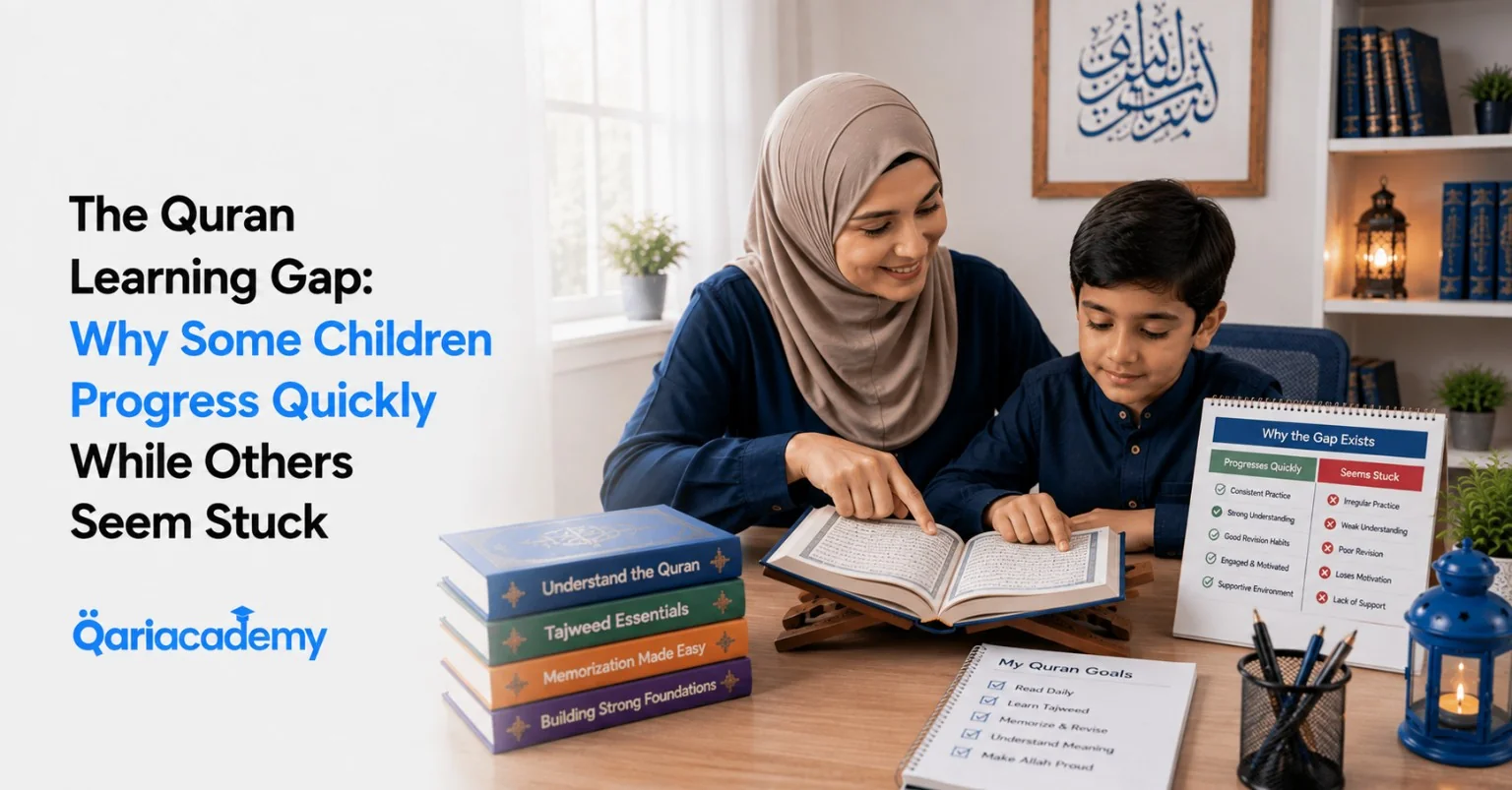
The Quran learning gap can be one of the most confusing experiences for parents.
Two children may attend Quran lessons for the same amount of time, use similar materials, and have qualified teachers, yet one seems to move forward quickly while the other appears stuck.
Parents naturally start asking:
“Why isn’t my child progressing?”
“Should we increase the number of lessons?”
“Does my child need a different teacher?”
“Is my child simply not trying hard enough?”
Sometimes the answer is not more practice.
The deeper issue is that Quran learning is not one skill.
A child may be strong at memorization but weak at reading. Another may read accurately but struggle with fluency. A third may understand well but have difficulty maintaining attention during lessons.
The child who appears “slow at Quran” may actually be progressing normally in one area while facing a specific bottleneck in another.
This is why The Quran Learning Gap should not be treated as a race between children.
The more useful question is:
What is preventing this particular child from moving to the next stage?
What Is the Quran Learning Gap?
The Quran learning gap is the difference between where parents expect a child to be and the child’s actual current ability.
But there is a better way to measure it.
Instead of comparing one child with another, compare the child’s current performance with their own previous performance.
| What Parents See | What May Actually Be Happening |
|---|---|
| Child memorizes slowly | Strong retention may be developing |
| Child reads slowly | Decoding skills may still be developing |
| Child makes repeated mistakes | A specific foundation may be weak |
| Child seems distracted | The lesson may not match attention needs |
| Child progresses quickly | Previous Arabic exposure may be helping |
This shift in perspective matters.
A child who spends several weeks mastering one difficult reading skill may be making more meaningful progress than another child who memorizes several Surahs but quickly forgets them.
QariAcademy’s 5 Smart Ways to Measure Your Child’s Quran and Arabic Progress similarly recommends looking beyond traditional testing and considering consistency, application, observation, and teacher feedback when evaluating development.
Why Do Some Children Progress Faster?
There is rarely one explanation.
Several factors can interact.
Previous Arabic Exposure
A child who hears Arabic at home, attends Islamic school, or has previously learned the Arabic alphabet may start with advantages that another child simply does not have.
This is especially important for children growing up in English-speaking environments.
A child encountering Arabic script for the first time is not starting from the same point as a child who has already spent years hearing or reading Arabic.
QariAcademy’s Learning Arabic for Non-Arabic Speaking Kids discusses how gradual alphabet learning, Quranic vocabulary, listening, pronunciation, and consistent practice can support children who are developing Arabic alongside Quran learning.
Starting Level
Two children can be the same age and require completely different instruction.
| Child | Starting Ability | Likely Priority |
|---|---|---|
| A | Does not recognize Arabic letters | Arabic alphabet |
| B | Knows letters but struggles with Harakat | Reading foundation |
| C | Reads basic Arabic words | Quran reading |
| D | Reads Quran fluently | Tajweed and refinement |
This is why age alone is a poor placement system.
The important question is not:
“How old is the child?”
It is:
“What skill has the child actually mastered?”
Weak Foundations Can Create an Invisible Learning Gap
Sometimes a child appears stuck at an advanced stage because of something that was never properly established earlier.
For example, a child may struggle with Quran reading because they never fully mastered:
- Arabic letter recognition
- Similar-looking letters
- Harakat
- Connected forms
- Basic pronunciation
- Decoding unfamiliar words
Another child may appear weak in Tajweed because their basic pronunciation was never properly established.
In these cases, giving the child increasingly difficult material is unlikely to solve the problem.
The teacher may need to step backward temporarily.
That is not regression.
It is foundation repair.
QariAcademy’s Quran Learning Mistakes Parents Should Avoid with Kids identifies rushing results, neglecting Tajweed, lack of structure, inadequate revision, and overly long sessions among common problems that can interfere with children’s Quran development.
More Quran Lessons Do Not Automatically Mean Faster Progress
This is one assumption parents should challenge.
When progress slows, the instinct is often:
“Let’s add more classes.”
Sometimes additional practice is exactly what a child needs.
But not always.
If the underlying problem is poor lesson structure, weak foundations, lack of home practice, confusion, unsuitable teaching methods, or exhaustion, adding more lessons can simply give the child more exposure to the same problem.
Compare:
Two focused lessons + effective revision
with:
Five lessons + weak retention + exhausted child.
The first may produce stronger long-term progress.
The right question is therefore not:
“How many lessons can we fit into the week?”
It is:
“What learning frequency allows this child to learn, practice, and retain effectively?”
Consistency Often Beats Intensity
Children benefit from repeated contact with the material.
A short routine that happens consistently can be more sustainable than an intense routine that lasts only a few weeks.
Consistency supports:
- Familiarity
- Recall
- Reading fluency
- Memorization
- Confidence
- Learning habits
QariAcademy’s How Busy Parents Can Keep Their Children Consistent With Quran Learning focuses on sustainable routines and encourages parents to support consistency rather than trying to become the child’s primary teacher.
The goal is not maximum effort for a short period.
It is sustainable effort over months and years.
Attention Can Create a False Learning Gap
Sometimes a child knows more than they demonstrate during a lesson.
A child who is tired, hungry, distracted, surrounded by noise, or overwhelmed by a long session may perform below their actual ability.
That does not necessarily mean their learning has stopped.
This is particularly important with younger children.
QariAcademy’s Effective Techniques to Enhance Children’s Focus During Quran Classes recommends distraction-free environments, shorter manageable segments, interactive learning, consistent routines, movement, positive reinforcement, and clear goals.
The learning environment is therefore part of the learning process.
A Child Can Be Slow in One Skill and Fast in Another
This is one of the biggest blind spots in evaluating Quran progress.
Parents may say:
“My child is slow at Quran.”
But which part?
A child may:
- Read slowly but memorize quickly.
- Memorize slowly but retain exceptionally well.
- Read accurately but lack fluency.
- Recite fluently but struggle with Makharij.
- Understand explanations well but dislike memorization.
- Memorize quickly but forget without sufficient revision.
There is no single measurement called “Quran learning speed.”
| Skill | Possible Strength | Possible Challenge |
|---|---|---|
| Reading | Strong recognition | Slow decoding |
| Memorization | Fast recall | Weak retention |
| Tajweed | Good imitation | Inconsistent application |
| Understanding | Strong vocabulary | Slow reading |
| Fluency | Smooth recitation | Recurring pronunciation errors |
A useful assessment should therefore identify the exact skill that is developing slowly.
Memorization Speed Can Be Misleading
Imagine two children.
Child A memorizes one page every week but forgets much of it within a month.
Child B memorizes half a page each week but retains it strongly.
Who is progressing faster?
If you measure only new pages, Child A appears ahead.
If you measure retention, the picture may be completely different.
This is why Hifz should be built around both new memorization and revision.
QariAcademy’s Quran Hifz program emphasizes an appropriate pace, regular revision, pronunciation, and retention rather than treating the accumulation of new Surahs as the only measure of success.
The deeper lesson is:
More material does not automatically mean more learning.
Motivation Can Be the Hidden Variable
A child who appears academically weak may actually be struggling with motivation.
Motivation can decline when:
- Lessons feel repetitive.
- The child is constantly compared with others.
- Goals seem impossible.
- Mistakes are punished.
- Progress is never recognized.
- The teacher’s approach does not fit the child.
- School and extracurricular demands compete for attention.
This does not mean every Quran lesson needs to become entertainment.
Children still need discipline.
But they also need to experience achievable progress.
QariAcademy’s Top Ways to Motivate Your Child to Continue Quran Memorization emphasizes achievable goals, encouragement, visual progress, autonomy, reflection, patience, and consistency.
A child who can see improvement is more likely to believe improvement is possible.
Sometimes the Method Needs to Change, Not the Child
When a child struggles, parents often ask:
“Is my child capable?”
A better first question is:
“Is the current method producing learning?”
A capable teacher should be willing to adjust:
- Lesson pace
- Explanation style
- Practice format
- Revision frequency
- Reading material
- Amount of repetition
- Level of challenge
If one approach repeatedly produces weak results, simply repeating it more intensely is not necessarily good teaching.
The child may not need more pressure.
They may need a better fit.
What Should Parents Do When Progress Stalls?
Start with diagnosis rather than frustration.
Step 1: Identify the Exact Skill
Do not say:
“My child isn’t progressing.”
Ask:
“Is the problem reading, memorization, pronunciation, attention, retention, or motivation?”
Step 2: Review the Routine
Look at:
- Lesson frequency
- Home practice
- Sleep
- School workload
- Distractions
- Consistency
Step 3: Ask the Teacher for Specific Feedback
Ask:
- What is my child’s strongest skill?
- What is their weakest skill?
- What mistake appears most frequently?
- What should we practice at home?
- What should improve during the next month?
Step 4: Give the New Approach Time
Don’t change the teacher, curriculum, schedule, and practice routine simultaneously.
Otherwise, you will not know what actually made the difference.
Measure Progress With Skills, Not Labels
One of the most powerful changes parents can make is replacing vague judgments with measurable observations.
Instead of:
“My child is behind.”
Ask:
“Behind in which skill?”
Instead of:
“My child is slow.”
Ask:
“What specifically is taking longer?”
Instead of:
“They don’t memorize well.”
Ask:
“Can they memorize new material but struggle to retain older material?”
This turns a frustrating problem into a solvable one.
| Weak Statement | Better Question |
|---|---|
| “My child is behind.” | Behind in which skill? |
| “They are slow.” | What specifically is taking longer? |
| “They forget everything.” | Which material is being forgotten? |
| “They hate Quran.” | What part of learning causes resistance? |
| “They aren’t trying.” | What barriers are affecting consistency? |
QariAcademy’s progress guide recommends observing actual recitation, tracking consistency, looking at real-life application, creating meaningful challenges, and using teacher feedback instead of relying only on formal testing.
The Home Environment Can Widen or Close the Gap
Parents sometimes focus almost entirely on the teacher.
But the child spends much more time outside the lesson than inside it.
The home can either reinforce learning or make consistency difficult.
A supportive environment can provide:
- A predictable routine
- A quiet learning space
- Short review sessions
- Positive encouragement
- Reduced pressure
- Communication with the teacher
QariAcademy’s How Parents in the USA, UK, and Canada Can Create a Quran-Friendly Home Environment emphasizes small daily habits, positive reinforcement, consistency, and making Quran feel natural rather than forced.
The parent does not need to become the Quran teacher.
The parent’s role is to make learning sustainable.
Don’t Turn Slow Progress Into Shame
This is one of the most damaging responses to a learning gap.
If a child repeatedly hears:
“Your cousin is ahead.”
“Your younger brother knows more.”
“You have been learning for years.”
the child may eventually stop thinking:
“I have a skill I need to improve.”
and start thinking:
“I am bad at Quran.”
That identity can become harder to change than the original learning difficulty.
A better message is:
“We know what you need to work on, and we’re going to improve it step by step.”
The goal is to create a child who believes progress is possible.
The Quran Learning Gap Also Works in the Opposite Direction
Not every child who seems different is struggling.
Some children are progressing quickly but are being held back by a curriculum that is too easy.
An eight-year-old who already reads Quran independently should not spend every lesson reviewing isolated Arabic letters simply because the program is designed for that age.
They may need:
- More advanced Tajweed
- Fluency work
- Hifz
- Revision
- Quranic Arabic
- Meaning
- Independent reading
QariAcademy’s Quran for Kids describes a program for ages 5–15 that accepts beginners and learners at different levels, with one-on-one instruction, structured progression, feedback, and pacing tailored to the student.
The principle is important:
The child should not have to fit the curriculum. The curriculum should adapt to the child.
A Better Model for Measuring Quran Progress
Think of Quran development as a staircase rather than a race.
Foundation → Accuracy → Fluency → Retention → Understanding → Independence
Each stage supports the next.
| Stage | Main Question | Evidence of Progress |
|---|---|---|
| Foundation | Does the child know the basics? | Stronger recognition |
| Accuracy | Is the reading correct? | Fewer recurring errors |
| Fluency | Can the child read smoothly? | Less hesitation |
| Retention | Can the child remember? | Stronger revision |
| Understanding | Do they know more meaning? | Growing vocabulary |
| Independence | Can they manage learning? | Less prompting |
A child who seems slow at one stage may accelerate considerably once the missing foundation is addressed.
What Does a Three-Month Recovery Plan Look Like?
If your child appears stuck, don’t demand dramatic results immediately.
Use a focused three-month period.
Month 1: Diagnose and Stabilize
Identify the weakest skill.
Improve the routine.
Reduce distractions.
Set one or two measurable goals.
Month 2: Target the Weakness
Focus lessons around the specific problem.
Increase appropriate practice.
Track changes.
Month 3: Apply and Review
Test the skill in actual Quran reading or recitation.
Compare the child with their own starting point.
Then decide whether to continue, advance, or modify the approach.
The purpose is not to manufacture a quick result.
It is to discover:
What actually works for this child?
How One-on-One Learning Can Help
Individualized instruction becomes particularly valuable when children have different starting levels.
One child may need Arabic reading.
Another may need Tajweed.
Another may need Hifz and revision.
Another may need help rebuilding confidence.
A one-size-fits-all curriculum can struggle to address these differences.
One-on-one teaching allows the teacher to adjust the pace and emphasis according to the child’s actual needs.
QariAcademy’s Quran program provides one-on-one lessons, structured progression, regular feedback, and individualized pacing for children at different levels.
This is particularly relevant to the Quran learning gap because the objective is not to make every child progress identically.
It is to help each child progress appropriately.
Frequently Asked Questions
Why is my child progressing more slowly than other children in Quran?
Children begin with different levels of Arabic exposure, reading ability, attention, motivation, and previous learning. Comparing them without considering these differences can create a misleading picture.
Should I increase my child’s Quran lessons if progress is slow?
Not automatically. First identify the reason for the slow progress. Additional practice can help when practice is the missing ingredient, but more lessons will not necessarily fix weak foundations, unsuitable teaching methods, or burnout.
Is slow Quran memorization a sign that my child is struggling?
Not necessarily. Retention matters as much as new material. A slower pace with strong retention may be healthier than rapid memorization followed by significant forgetting.
Should I change my child’s Quran teacher?
Not immediately. First discuss the child’s specific difficulty and ask what adjustments can be made. If the teacher cannot identify the problem or adapt the approach over time, then changing teachers may become reasonable.
How can parents measure Quran progress?
Measure specific skills such as reading independence, pronunciation, Tajweed application, memorization retention, consistency, understanding, and confidence rather than relying only on pages completed or test scores.
What if my child seems completely stuck?
Stop comparing them with other children. Identify the exact skill creating the bottleneck, review the learning routine, discuss the issue with the teacher, and create a focused plan around that weakness.
Conclusion
The Quran Learning Gap does not necessarily mean that one child is more intelligent, more capable, or more committed than another.
Often, it simply means the children are starting from different places and learning under different conditions.
A child who moves slowly may need more time with a foundation.
A child who moves quickly may need a greater challenge.
A child who memorizes quickly may need stronger revision.
A child who reads slowly may need better decoding practice.
And a child who seems unmotivated may need a different learning experience rather than more pressure.
The biggest mistake is treating Quran learning as a race.
Instead, think:
Assess → Identify → Adjust → Practice → Measure → Progress.
That approach changes the parent’s role from comparing children to understanding them.
And that is ultimately what effective Quran education should do.
The goal is not simply a child who appears ahead.
It is a child who is genuinely becoming stronger in reading, recitation, Tajweed, memorization, retention, understanding, confidence, and eventually independent learning.
For families who need help identifying the right starting point or learning approach, QariAcademy’s one-on-one Quran programs can provide individualized instruction, structured progression, and ongoing feedback according to the child’s level.
Explore QariAcademy’s Quran Programs
Internal Articles Used — 10 Verified Articles
- Effective Techniques to Enhance Children’s Focus During Quran Classes — Open Article
- Quran Learning Mistakes Parents Should Avoid with Kids — Open Article
- How Busy Parents Can Keep Their Children Consistent With Quran Learning — Open Article
- 5 Smart Ways to Measure Your Child’s Quran and Arabic Progress Without Traditional Tests — Open Article
- How to Support Your Child’s Quran Learning Online — Open Article
- How Parents in the USA, UK, and Canada Can Create a Quran-Friendly Home Environment — Open Article
- Top Ways to Motivate Your Child to Continue Quran Memorization — Open Article
- Make Quran Learning Fun for Kids Online — Open Article
- Learning Arabic for Non-Arabic Speaking Kids — Open Article
- The 20-Minute Challenge: How to Memorize a Short Surah with Your Child Daily Without Stress or Boredom — Open Article