Introduction
For many Muslim parents living in the USA, UK, Canada, Australia, and other English-speaking countries, one question comes up again and again:
“Why does my child struggle with Quran learning when they seem to learn everything else so easily?”
Your child may speak English fluently, read English books, understand school lessons, use technology confidently, and communicate naturally with friends. Yet when it comes to reading the Quran, Arabic letters, pronunciation, Tajweed, or memorization, the process may suddenly become much harder.
This does not necessarily mean that your child is lazy, inattentive, or uninterested in Islam.
The problem may be that the child is being asked to learn the Quran through a language and learning environment that are different from the ones they experience every day.
English-speaking Muslim children often grow up with English as their dominant language. Arabic may exist mainly in religious contexts: Quran class, salah, Islamic school, or conversations with relatives.
Research on Arabic-English bilingual children supports the idea that language experience matters. One study of Arabic-speaking heritage-language children found differences in linguistic performance associated with their language experience, while another longitudinal study found that Arabic can become vulnerable even among bilingual children as English becomes dominant.
That means parents should not necessarily ask:
“Why can’t my child learn Quran the way I did?”
A better question is:
“What approach will help my child build a strong relationship with the Quran in the environment they actually live in?”
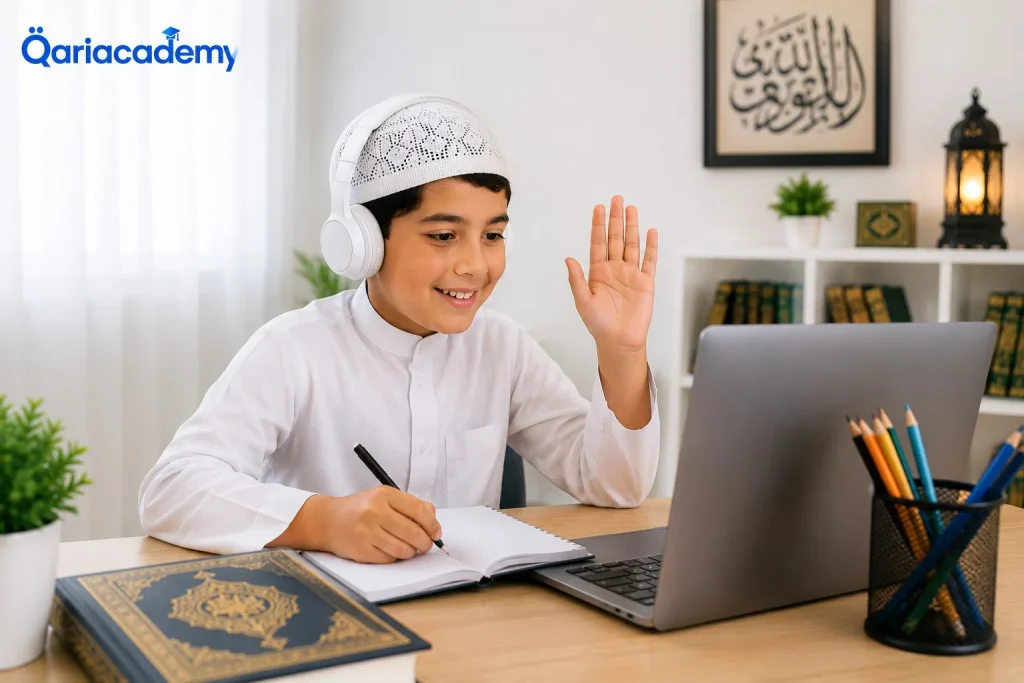
English-Speaking Children Are Not Starting From the Same Place
Imagine two children beginning Quran lessons at age seven.
The first child hears Arabic regularly at home. Their parents speak Arabic, grandparents speak Arabic, and Arabic books and television are part of their environment.
The second child hears English almost all day.
They attend an English-speaking school, communicate with friends in English, consume English-language entertainment, and may only hear Arabic during prayer or Quran lessons.
Both children are Muslim.
Both may have the same desire to learn.
But their linguistic starting points are different.
This distinction matters.
Research involving Arabic-English bilingual children in Canada found that English was the main instructional language for the children studied, while Arabic was used at home; the researchers also examined reading and language skills in both languages.
So expecting every Muslim child to follow exactly the same Quran curriculum can be a mistake.
A Simple Comparison
| Child’s Environment | Likely Experience | Teaching Need |
|---|---|---|
| Arabic dominant | Frequent Arabic exposure | More direct Quran progression |
| English dominant | Limited Arabic exposure | More Arabic foundation |
| Balanced bilingual | Regular exposure to both | Flexible assessment |
The goal isn’t to lower expectations for English-speaking children.
The goal is to start from reality rather than assumption.
Why Arabic Can Feel Difficult to an English-Speaking Child
Arabic and English are different languages with different writing systems and sound systems.
An English-speaking child may already be comfortable with the Latin alphabet, but Arabic introduces an entirely different visual and phonetic system.
The child has to learn things such as:
- Arabic letter shapes
- Letter positions
- Harakat
- Connected letters
- Arabic pronunciation
- Makharij
- Tajweed rules
- Quranic vocabulary
- Reading fluency
- Memorization
Some Arabic sounds may also be unfamiliar.
For example:
ح، خ، ع، غ، ص، ض، ط، ظ، ق
A child who has never needed to pronounce these sounds in everyday English may require considerable practice before producing them accurately.
That is not a character problem.
It is a learning problem that requires appropriate instruction.
QariAcademy’s own guidance for young learners emphasizes gradual listening, watching, repeating, comparing, and practicing unfamiliar Arabic sounds rather than expecting instant perfection.
Quran Reading Is Not the Same as Understanding Arabic
Another common misconception is:
“If my child can read Quran, they know Arabic.”
Not necessarily.
A child can become capable of decoding Quranic Arabic without being conversationally fluent in Arabic.
Similarly, a child can memorize a Surah without understanding every word.
This creates an important opportunity for parents.
Instead of treating Quran reading and Arabic understanding as completely separate worlds, you can gradually connect them.
For example, when a child learns:
رَبّ
you can explain that it relates to their Lord.
When they encounter:
رَحْمَة
they can learn its connection to mercy.
When they hear:
الْحَمْدُ لِلَّهِ
they can begin to understand what they are reciting in prayer.
The objective isn’t to turn every Quran lesson into an Arabic-language class.
The objective is to give the child small windows of meaning.
Research on Qur’anic education has also highlighted the importance of connecting Quranic Arabic with learners’ everyday languages and experiences rather than treating the Arabic text as completely isolated from their lives.
The “Translation Gap” Can Affect Motivation
Consider what Quran memorization can feel like to a child.
They are asked to memorize:
unfamiliar letters
unfamiliar sounds
unfamiliar vocabulary
unfamiliar pronunciation
And then they’re told:
“Memorize this.”
For an English-speaking child, this can become intellectually demanding.
Now imagine that the teacher occasionally explains:
“This verse is talking about Allah’s mercy.”
Suddenly the words have meaning.
The child isn’t simply memorizing sounds anymore.
They’re learning a message.
This is one reason parents should consider combining:
Reading + pronunciation + meaning + connection
rather than treating memorization as the entire objective.
A Different Approach Does Not Mean an Easier Approach
This is an important distinction.
Some parents hear “different approach” and assume it means:
“We should make Quran easier and expect less.”
That’s not what it means.
A better approach should actually help children achieve stronger long-term results.
The difference is in how the child gets there.
For example:
Instead of forcing a child to memorize ten verses before understanding anything, you might focus on three verses with excellent pronunciation and a basic understanding of their meaning.
Instead of spending an entire lesson correcting mistakes, the teacher can prioritize the most important pronunciation issues and revisit them consistently.
Instead of assuming a child is behind, the teacher can identify exactly where the gap exists.
Start With an Assessment, Not an Assumption
Before choosing a Quran curriculum, parents should determine the child’s actual level.
Ask:
- Can my child recognize all Arabic letters?
- Can they identify letters when their shapes change?
- Do they understand basic Harakat?
- Can they connect letters?
- Can they read simple Arabic words?
- Can they read Quranic text?
- Which letters are difficult to pronounce?
- Do they know basic Tajweed?
- Can they memorize short Surahs?
- Do they understand anything they recite?
The answers will tell you far more than the child’s age.
What the Assessment Should Identify
| Area | What to Check | Why It Matters |
|---|---|---|
| Arabic reading | Letters and Harakat | Establishes foundation |
| Pronunciation | Makharij and difficult sounds | Improves recitation |
| Quran skills | Fluency and Tajweed | Determines next level |
A child who is eight years old isn’t automatically ready for the same curriculum as every other eight-year-old.
Age tells you how old the child is. It doesn’t tell you what they know.
Build Arabic Into Quran Lessons Naturally
English-speaking Muslim children don’t necessarily need separate hours of Arabic study before they can begin Quran.
Instead, Arabic can gradually become part of Quran learning.
For example:
Stage 1: Arabic Letters
Learn recognition and pronunciation.
Stage 2: Harakat
Connect letters with short vowel sounds.
Stage 3: Reading
Move from isolated letters to words and short passages.
Stage 4: Quran Reading
Introduce Quranic text progressively.
Stage 5: Tajweed
Develop correct pronunciation and recitation rules.
Stage 6: Meaning
Introduce age-appropriate Quranic vocabulary and meanings.
Stage 7: Independence
Help the child read and practice without constant parental supervision.
This gradual progression is particularly useful when Arabic isn’t the child’s dominant language.
Don’t Make Quran Class “Another School Subject”
This is another major blind spot for parents.
Children already spend much of their day in structured education.
If Quran class feels exactly like another school lesson, the child may begin to associate Quran with:
- Homework
- Tests
- Corrections
- Memorization
- Grades
- Pressure
Instead, Quran learning should also contain:
- Encouragement
- Conversation
- Achievement
- Personal connection
- Appropriate challenges
- Positive teacher-student relationships
Research into Muslim students’ experiences of Quranic supplementary education suggests that children navigate between different educational environments and that meaningful connections between those environments can matter.
The question isn’t whether Quran education should be structured.
It absolutely should be.
The question is whether the structure is designed for the child who is actually sitting in front of the teacher.
One-on-One Learning Can Be Especially Valuable
English-speaking Muslim children can have very different levels of Arabic exposure.
One child may already read Arabic.
Another may know the alphabet but struggle to connect letters.
A third may barely recognize Arabic letters.
Putting all three into the same instructional approach creates unnecessary problems.
One-on-one lessons allow the teacher to identify the child’s specific needs and adjust the pace accordingly.
For example:
Student A: needs pronunciation correction.
Student B: needs reading fluency.
Student C: needs Arabic foundations.
The teacher doesn’t have to spend the lesson teaching material the child has already mastered.
QariAcademy currently describes its children’s Quran program as one-on-one, with step-by-step lessons tailored to the child’s level and pace, focusing on reading, Tajweed, pronunciation, memorization, and regular feedback.
The Teacher’s Role Is More Important Than Many Parents Realize
A child learning Quran in English may need a teacher who understands more than Tajweed.
The teacher should be able to recognize:
“This child isn’t refusing to learn. They don’t understand this Arabic sound yet.”
That’s a major difference.
A strong teacher should be:
- Patient
- Encouraging
- Clear
- Consistent
- Knowledgeable
- Comfortable teaching children
- Able to explain difficult concepts simply
- Sensitive to language differences
- Able to adjust the pace
The teacher should correct mistakes without making the child feel embarrassed.
That’s particularly important for older children.
A child who becomes afraid of making mistakes may eventually stop participating.
Real Parent Experiences
The value of personalization is also reflected in parent feedback published by QariAcademy.
For example, one parent in the USA reported that their son had tried multiple Quran tutors before finding a teacher who connected with him; they specifically highlighted engaging lessons and consistent encouragement.
Another parent in the UK described the importance of maintaining Quran in their home while living in a non-Muslim country, saying the classes provided structure and motivation.
A parent in Australia also described struggling to find enough time for their children’s Quran learning before finding that online classes fit better into their schedule and supported improvements in recitation and confidence.
These are individual parent experiences rather than controlled scientific evidence, so they should not be treated as proof that one teaching model works for every child.
But they illustrate an important point:
The learning environment and relationship with the teacher can influence how a child experiences Quran education.
What Parents Can Do at Home
You don’t need to turn your home into a Quran school.
Small habits can make a significant difference.
1. Read Quran With Your Child
Even five or ten minutes can help normalize Quran as part of family life.
2. Listen to Quran Together
Choose a reciter your child enjoys listening to.
3. Explain Simple Meanings
Don’t try to explain every verse.
Choose one idea.
4. Celebrate Progress
Say:
“Your pronunciation of that letter was much better today.”
rather than:
“You still make too many mistakes.”
5. Create a Consistent Routine
Consistency is generally more useful than occasional intense study.
A recent systematic review of early Quran-reading education also identified parental involvement and continuity of learning at home as important forms of learning support.
6. Avoid Constant Testing
Not every interaction with Quran needs to become an exam.
A Better Weekly Routine
A simple routine could look like this:
| Activity | Suggested Focus | Goal |
|---|---|---|
| Quran lesson | Reading + Tajweed | Skill development |
| Home practice | 10–15 minutes | Reinforcement |
| Family Quran time | Listening + meaning | Connection |
The exact schedule should depend on the child’s age, level, and family circumstances.
The important principle is:
Short, consistent practice beats occasional pressure.
What Parents Should Avoid
Some approaches can unintentionally make Quran learning harder.
Comparing Children
“Your cousin already finished Juz Amma.”
This rarely motivates a child in a healthy way.
Comparing Them With Yourself
“I learned Quran at your age.”
Your childhood environment may have been completely different.
Expecting Immediate Fluency
Learning a new writing system and pronunciation system takes time.
Focusing Only on Memorization
Memorization is valuable, but it shouldn’t be the only measure of success.
Correcting Every Mistake
Prioritize.
A child who is corrected every few seconds may stop wanting to participate.
Treating English as the Enemy
English is the child’s dominant language in many Western families.
Use it strategically.
English can help the child understand the meaning and purpose behind what they are learning in Arabic.
The Goal Is Not to Make Children “More Arabic”
The ultimate goal isn’t linguistic competition.
It’s not:
Arabic vs. English.
It’s:
How can English-speaking Muslim children develop a meaningful relationship with the Quran while gradually developing the Arabic skills needed to read it correctly?
That’s a much more productive question.
A child can be:
- Fluent in English
- Learning Arabic
- Learning Quran
- Growing spiritually
- Developing Muslim identity
All at the same time.
Research on Arabic heritage-language development shows that maintaining meaningful Arabic exposure matters, especially as English becomes dominant.
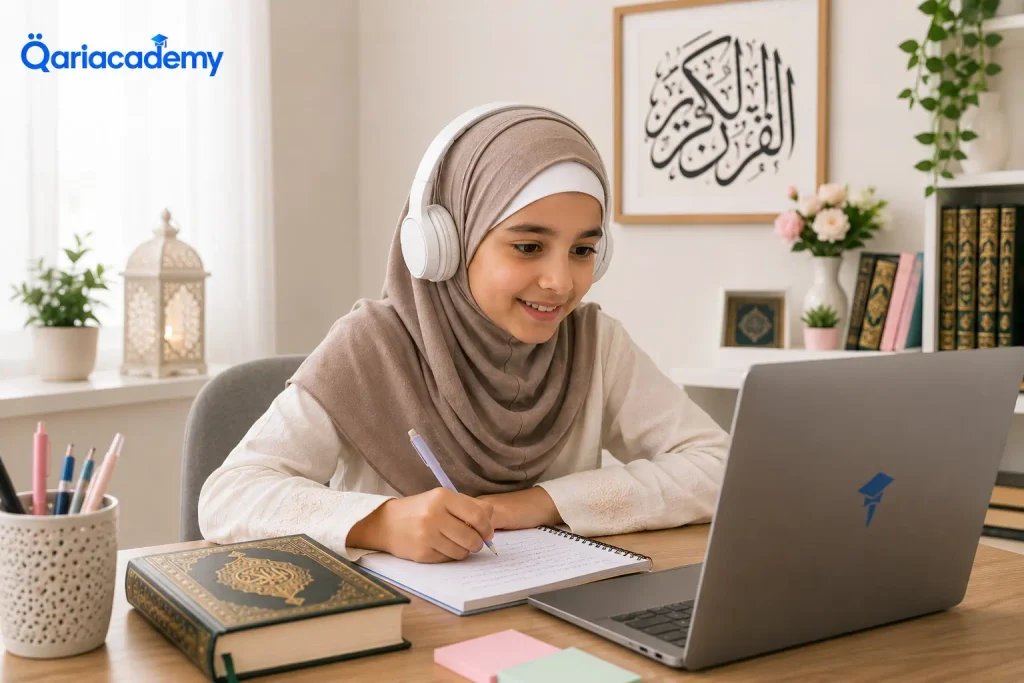
How QariAcademy Can Help
For families looking for Quran learning for English-speaking Muslim children, the learning process should begin with the child’s actual ability rather than a generic assumption about their age.
QariAcademy’s Quran for Kids program offers one-on-one online lessons for children ages 5–15, with instruction covering Quran reading, Tajweed, pronunciation, memorization, and gradual progress.
The academy also allows parents to request a male or female teacher, choose class frequency and duration, and arrange lessons around their availability.
Most importantly, parents can start with a free trial class before committing to a paid plan.
A Practical Checklist for Parents
Before choosing Quran classes for your child, ask:
- Does the teacher assess my child’s current level?
- Can the teacher work with children who have little Arabic exposure?
- Is pronunciation taught gradually?
- Does the teacher explain the meaning of what the child learns?
- Is the lesson interactive?
- Does the teacher encourage the child?
- Is the pace adjusted to the student’s ability?
- Is there regular feedback for parents?
- Can the schedule fit our family’s routine?
- Does my child feel comfortable with the teacher?
If the answer to most of these questions is yes, you’re much more likely to have a sustainable learning experience.
Frequently Asked Questions
Does my child need to speak Arabic before learning Quran?
No. A child can begin learning to read the Quran without being conversationally fluent in Arabic. They may simply need more foundational Arabic instruction.
Should English-speaking Muslim children learn Arabic and Quran separately?
Not necessarily. The two can complement each other. Quran lessons can gradually introduce vocabulary and meanings alongside reading and Tajweed.
Why does my child understand English lessons but struggle with Quran?
Because Quran reading requires learning a different writing system, pronunciation system, and often unfamiliar vocabulary. The difficulty doesn’t necessarily indicate a lack of intelligence or motivation.
Should parents translate every verse?
No. Start with simple, age-appropriate meanings. The objective is to build understanding gradually without overwhelming the child.
How much should my child practice at home?
There is no single amount suitable for every child. Consistent, manageable practice is generally more sustainable than long sessions that create frustration.
Is online Quran learning suitable for English-speaking children?
It can be, particularly when the teacher uses one-on-one interaction, appropriate pacing, feedback, and engaging instruction. The suitability depends on the individual child and teaching quality.
Conclusion
English-speaking Muslim children don’t necessarily need less Quran education.
They need better-adapted Quran education.
Their experience is different because their linguistic environment is different.
They may love Islam while struggling with Arabic.
They may want to learn Quran while finding its writing system difficult.
They may understand the importance of Quran while becoming frustrated with repetitive lessons.
None of these things automatically means that the child doesn’t care.
The solution is to meet the child where they are and then help them move forward.
That means combining:
Arabic foundations + Quran reading + Tajweed + meaning + encouragement + consistency.
And perhaps the most important change parents can make is to stop asking:
“Why isn’t my child learning Quran like I did?”
and start asking:
“What does my child need in order to learn Quran successfully?”
That shift can completely change the way a family approaches Quran education.
Ready to Find the Right Approach for Your Child?
If your child is growing up in an English-speaking environment and you’re unsure where to begin—or you’re concerned that their current Quran classes aren’t working—consider starting with a personalized assessment rather than simply adding more pressure.
Book a Free Quran Trial with QariAcademy and let your child experience a one-on-one lesson before making a decision.
The goal isn’t simply to make your child finish more pages. It’s to help them read the Quran correctly, understand it gradually, and build a relationship with it that can last for life.