Table of Contents
A child who cannot read Arabic yet does not necessarily need more Quran memorization, longer lessons, or more pressure. In many cases, the real need is much simpler: the child has not yet developed the reading foundations required to decode Arabic confidently.
This is especially common among Muslim children growing up in English-speaking environments where Arabic is not part of everyday life.
So, how to teach Quran to a child who cannot read Arabic?
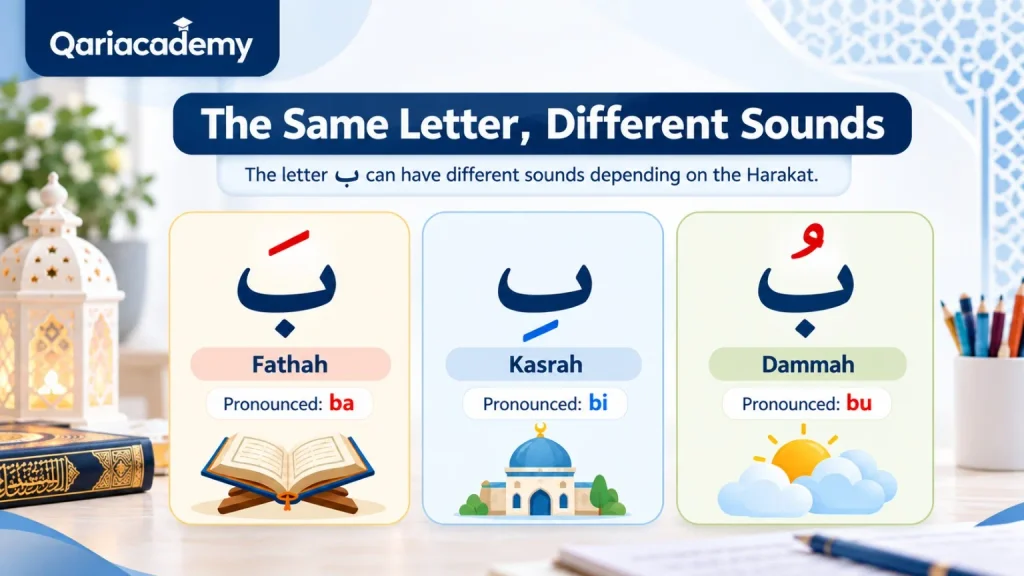
The answer is not to rush directly into Quranic verses. A better approach is to build the skills in sequence: Arabic letter recognition, correct sounds, Harakat, connected letters, basic word reading, and then gradual Quran reading and Tajweed.
The goal is not simply to get a child through the alphabet or Qaida as quickly as possible. The real goal is to help the child become an accurate, confident, and increasingly independent Quran reader.
First, Find Out What the Child Actually Knows
One of the most common mistakes parents make is assuming that a child who knows the Arabic alphabet can already read Arabic.
These are different skills.
A child might be able to recite:
“Alif, Baa, Taa, Thaa…”
but still struggle when shown the letters in a random order.
Another child might recognize individual letters but not know their sounds.
Another might know the letters and Harakat but struggle to combine them into words.
That is why the starting point should be determined by the child’s actual ability rather than simply their age.
QariAcademy’s guide, [Quran Learning by Age: What Should Children Learn at 4, 6, 8, 10, and 12?], explains this principle in greater detail: age can help guide expectations, but the child’s current ability should determine the next learning step.
Does a Child Need to Learn Arabic Before Reading the Quran?
Not necessarily.
A child does not need to speak conversational Arabic before learning to read the Quran.
However, they do need to develop the Arabic literacy skills required for Quran reading.
These include:
- Recognizing Arabic letters
- Knowing their basic sounds
- Understanding Harakat
- Connecting letters
- Reading simple combinations
- Recognizing common Quranic reading patterns
- Developing accurate pronunciation
QariAcademy’s article [Should Children Learn Arabic Before Learning to Read the Quran?] explains the important distinction between learning Arabic as a language and learning the Arabic reading skills needed for Quran recitation.
These two areas can develop together.
For example, a child can learn Quran reading while gradually building Quranic vocabulary and basic Arabic understanding.
| Learning Goal | What the Child Needs First | Does Full Arabic Fluency Come First? |
|---|---|---|
| Read the Quran | Arabic letters, sounds, Harakat | No |
| Recite with basic Tajweed | Reading + pronunciation | No |
| Understand Quranic language | Vocabulary and comprehension | No, but Arabic becomes increasingly useful |
The important thing is not to make the child wait unnecessarily for conversational Arabic before beginning Quran reading.
Step 1: Teach Arabic Letters Through Sound and Recognition
If the child cannot recognize Arabic letters, start there.
But do not limit the lesson to memorizing the alphabet in sequence.
The child needs to recognize letters individually and understand how they sound.
For example:
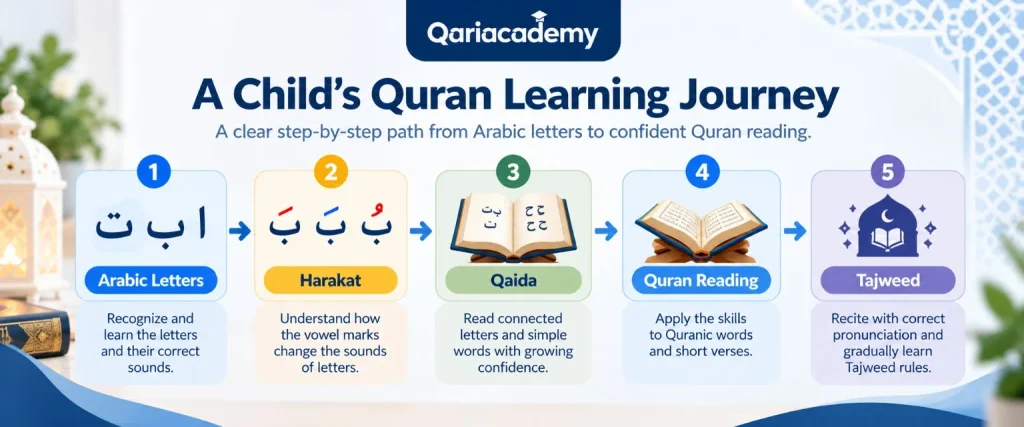
ب → بَ → بِ → بُ
The child gradually learns that the written symbol represents a particular sound and that the vowel mark changes the sound.
This foundation becomes important later when the child begins reading actual Quranic words.
QariAcademy’s [How to Teach Kids the Arabic Letters with Tajweed Precision] provides practical ideas for introducing Arabic letters while paying attention to pronunciation from the beginning.
The important principle is:
Recognition first, decoding next, fluency later.
Do not expect fluency before the child has had enough opportunities to build these underlying skills.
Step 2: Introduce Harakat Gradually
After the child becomes familiar with letters, the next challenge is understanding short vowels.
The child needs to distinguish between:
بَ — بِ — بُ
and eventually apply the same principle to combinations of letters.
This is where many beginners begin to realize that reading Arabic is not simply recognizing letters.
The child is learning a system.
| Skill | Example | Main Objective |
|---|---|---|
| Letter recognition | ب | Identify the letter |
| Harakah recognition | بَ | Connect letter and vowel |
| Combination | بَتَ | Blend sounds |
| Word reading | Quranic words | Apply skills independently |
A structured Qaida can be useful at this stage because it gives the child a progression from simple combinations toward more complex reading.
Step 3: Use a Structured Qaida Before Expecting Fluent Quran Reading
A beginner usually benefits from a gradual bridge between isolated Arabic letters and the Mushaf.
That is one reason structured Qaida-based learning can be valuable.
Instead of asking the child to figure out an unfamiliar Quranic page, the teacher can isolate one reading skill, practice it repeatedly, and then introduce it in increasingly realistic examples.
A useful progression might look like this:
Letters → Harakat → Letter combinations → Words → Short phrases → Quranic passages
The child should not be pushed forward simply because they have completed a certain number of pages.
Mastery matters more than page count.
If the child still struggles with a particular reading pattern, spending additional time on it is not wasted time.
It is foundation building.
Step 4: Focus on Pronunciation Before Speed
Parents sometimes celebrate when their child starts reading quickly.
But speed should not be the first goal.
For a beginner, a better progression is:
Accuracy → Confidence → Fluency → Speed
If a child repeatedly reads a word incorrectly, practicing it quickly does not solve the problem. It may simply give the incorrect pattern more repetition.
QariAcademy’s recent article [When Reading Outpaces Tajweed: Fixing Quran Habits] discusses this issue and explains why pronunciation and Makharij should be developed before speed becomes the main focus.
The child should gradually learn to distinguish sounds that may be difficult for non-Arabic speakers, such as:
- س and ص
- ت and ط
- د and ض
- ك and ق
- ه and ح
This does not mean overwhelming a beginner with advanced Tajweed terminology.
It means giving the child accurate pronunciation from the beginning and correcting errors at an appropriate pace.
Step 5: Keep the Learning Experience Age-Appropriate
A child cannot be expected to learn Quran in exactly the same way as an adult.
A young child may need shorter activities, repetition, visual support, and frequent interaction.
An older child may be able to handle longer reading practice and more detailed explanations.
QariAcademy’s [When Reading Outpaces Tajweed: Fixing Quran Habits] explains why parents should not measure young children’s learning by adult standards of concentration.
The lesson should be challenging enough to produce progress, but not so difficult that the child spends the entire session feeling unsuccessful.
| Child’s Situation | What the Teacher Can Do |
|---|---|
| Easily loses focus | Use shorter activities and frequent changes |
| Knows letters but forgets them | Increase spaced review |
| Reads slowly | Practice short combinations repeatedly |
| Becomes frustrated | Reduce difficulty and create achievable steps |
| Progresses quickly | Increase complexity gradually |
The objective is not to make every child learn at the same speed.
It is to keep each child moving forward.
Step 6: Practice a Little at Home
Parents do not need to recreate the entire Quran lesson at home.
In fact, trying to become the child’s second teacher can sometimes create unnecessary tension.
The parent’s role can be much simpler:
- Provide a consistent practice time.
- Ask the child to review what the teacher assigned.
- Listen patiently.
- Encourage effort.
- Communicate repeated difficulties to the teacher.
QariAcademy’s [How to Support Your Child’s Quran Learning Online] provides additional practical guidance on creating a suitable learning environment, maintaining routines, and supporting children without taking over the teacher’s role.
For many beginners, short and consistent practice is more realistic than occasional long sessions.
| Home Practice | Main Purpose |
|---|---|
| Letter review | Strengthen recognition |
| Reading combinations | Improve decoding |
| Previous lesson review | Improve retention |
| Short Quran reading | Connect skills to the Mushaf |
Consistency matters more than turning every practice session into a test.
Step 7: Do Not Correct Everything at Once
Imagine a child reading a short Quranic word and making several mistakes.
If the parent or teacher immediately corrects pronunciation, Harakah, fluency, stopping, and Tajweed all at once, the child may become overwhelmed.
Instead, prioritize the most important correction.
For example:
First: Help the child recognize the letters.
Then: Correct the vowel.
Then: Improve pronunciation.
Later: Refine the relevant Tajweed rule.
This creates a learning sequence rather than a constant stream of corrections.
Children need to know what they are doing correctly as well as what needs improvement.
Step 8: Understand That Different Children Need Different Starting Points
Two children can be the same age and still require completely different Quran lessons.
A six-year-old who has studied Arabic for two years may be ready to read Quranic passages.
Another six-year-old who has never learned Arabic may need to start with individual letters.
Neither situation automatically means something is wrong.
QariAcademy’s article [What Should a 7-Year-Old Know About Quran Reading?] makes the same point: age alone does not determine a child’s Quran reading level.
The more useful question is:
What can my child do independently today?
Then ask:
What is the next skill they need to master?
That is a much better way to measure progress.
What Should the Learning Journey Look Like?
For a complete beginner, a reasonable long-term roadmap might look like this:
| Stage | Main Focus | Desired Development |
|---|---|---|
| Foundation | Arabic letters | Recognition and basic sounds |
| Early reading | Harakat and combinations | Decoding |
| Qaida | Structured reading practice | Increasing accuracy |
| Quran reading | Short Quranic passages | Independent reading |
| Tajweed | Pronunciation and relevant rules | Better recitation |
| Fluency | Consistent Quran reading | Confidence and independence |
The exact pace will depend on the child.
Some children will move quickly through the early stages.
Others will need considerably more repetition.
There is nothing wrong with that.
The problem is not slow progress by itself.
The bigger problem is progress without a clear learning diagnosis—when nobody knows why the child is struggling or what should happen next.
What About Memorization?
Memorization can be part of a child’s Quran journey even while reading skills are developing.
For example, a young child may memorize Al-Fatihah or short Surahs through listening and repetition before they can read them independently.
That can be valuable.
But parents should distinguish between:
memorizing a Surah and being able to read the Surah independently.
They are not the same skill.
A child may know a Surah perfectly from memory while still struggling to decode its written words.
That is why reading development should continue alongside memorization.
QariAcademy’s [How to Raise a Child Who Loves the Quran—Not Just Memorizes It] discusses this broader view of Quran education and why memorization should not become the only measure of a child’s Quran development.
How Long Does It Take to Learn Quran Reading?
There is no universal number of weeks or months that applies to every child.
The timeline can depend on:
- Age
- Previous exposure to Arabic
- Number of lessons per week
- Home practice
- Letter recognition
- Pronunciation
- Attention and engagement
- Learning differences
- Teacher consistency
QariAcademy’s [How Long Does It Take a Child to Learn to Read the Quran?] explores this question in greater detail and emphasizes the importance of measuring actual mastery rather than rushing through material according to a calendar.
A better question than:
“When will my child finish?”
is:
“What can my child read independently now that they could not read before?”
That gives parents a much more meaningful measure of progress.
How QariAcademy Can Help
For a child who cannot read Arabic yet, one-on-one instruction can be particularly useful because the teacher can identify the child’s exact starting point.
At QariAcademy, children can begin from foundational Quran reading skills and progress toward stronger reading, pronunciation, Tajweed, and memorization according to their individual level.
This is especially relevant for children growing up in the USA, UK, Canada, and other environments where Arabic may not be spoken at home.
Instead of putting every child through exactly the same pace, a personalized lesson can focus on the skill that the individual child needs next.
That might mean spending more time on Arabic letters for one child, while another student may already be ready for Qaida or Quran reading.
QariAcademy’s [Interactive Quran Classes for Kids: The Modern Parent’s Guide to Engaging Quranic Education] also discusses a progressive learning model for children, including the transition from Arabic phonics and Qaida toward Quran reading and Tajweed.
Common Mistakes Parents Should Avoid
When starting Quran education with a non-Arabic-speaking child, avoid:
- Assuming that memorizing the alphabet means the child can read.
- Starting Quran pages before the child has basic decoding skills.
- Focusing on reading speed too early.
- Comparing the child with siblings or classmates.
- Correcting every mistake simultaneously.
- Expecting conversational Arabic before Quran reading.
- Making every home practice session stressful.
- Measuring success only by memorized Surahs.
- Moving to harder material before the child is ready.
- Changing the learning approach without first identifying the actual problem.
The most effective approach is usually more patient and more structured than parents initially expect.
The Real Goal: Build an Independent Quran Reader
The first goal may be recognizing ب.
Then reading بَ.
Then reading combinations.
Then words.
Then Quranic phrases.
Eventually, the child should be able to open the Mushaf and read without depending on someone to pronounce every word first.
That progression is more important than rushing through a curriculum.
Once the reading foundation is strong, the child has a much better base for developing Tajweed, fluency, memorization, revision, understanding, and a lifelong relationship with the Quran.
Conclusion
Teaching Quran to a child who cannot read Arabic yet should not begin with pressure to read full Quranic passages.
It should begin with the right foundation.
The child needs to recognize Arabic letters, connect them with their sounds, understand basic Harakat, combine letters, and gradually transfer those skills into actual Quran reading.
The pace will differ from child to child.
Some children will need more repetition. Others will move quickly. Neither should be forced into the same timetable.
The most important question is not:
“How quickly can my child finish the Qaida?”
It is:
“Is my child becoming a more accurate, confident, and independent Quran reader?”
That is the foundation on which stronger Tajweed, memorization, understanding, and lifelong Quran engagement can be built.
If your child is starting from zero, QariAcademy can provide a structured, one-on-one learning path based on the child’s current level and goals.
Explore QariAcademy’s Quran Programs and choose a learning path that fits your child’s needs.
Frequently Asked Questions
1. Can a child learn Quran without knowing Arabic?
Yes. A child does not need conversational Arabic fluency before learning Quran reading. They can begin with Arabic letters, sounds, Harakat, and structured reading practice while developing Arabic vocabulary and understanding alongside Quran education.
2. What should a child learn first before reading the Quran?
The child should generally begin with Arabic letter recognition and pronunciation, followed by basic Harakat and letter combinations. A structured Qaida can then help bridge these skills into Quran reading.
3. Should my child learn Arabic before learning Quran?
Not necessarily. Quran reading requires specific Arabic reading skills, but a child does not need to speak Arabic fluently before beginning Quran reading.
4. How long does it take for a child to learn Quran reading?
There is no universal timeline. Progress depends on the child’s starting level, age, lesson frequency, home practice, pronunciation, and individual learning needs.
5. Should my child memorize Quran before learning to read?
Memorization can happen alongside reading development, particularly with short Surahs. However, memorization should not replace the development of independent Quran reading skills.
6. What should parents do if their child keeps forgetting Arabic letters?
Increase review rather than simply adding new material. Short, repeated practice can help strengthen recognition. If the difficulty continues, ask the teacher to reassess the child’s learning approach and identify the specific skill causing the problem.