Table of Contents
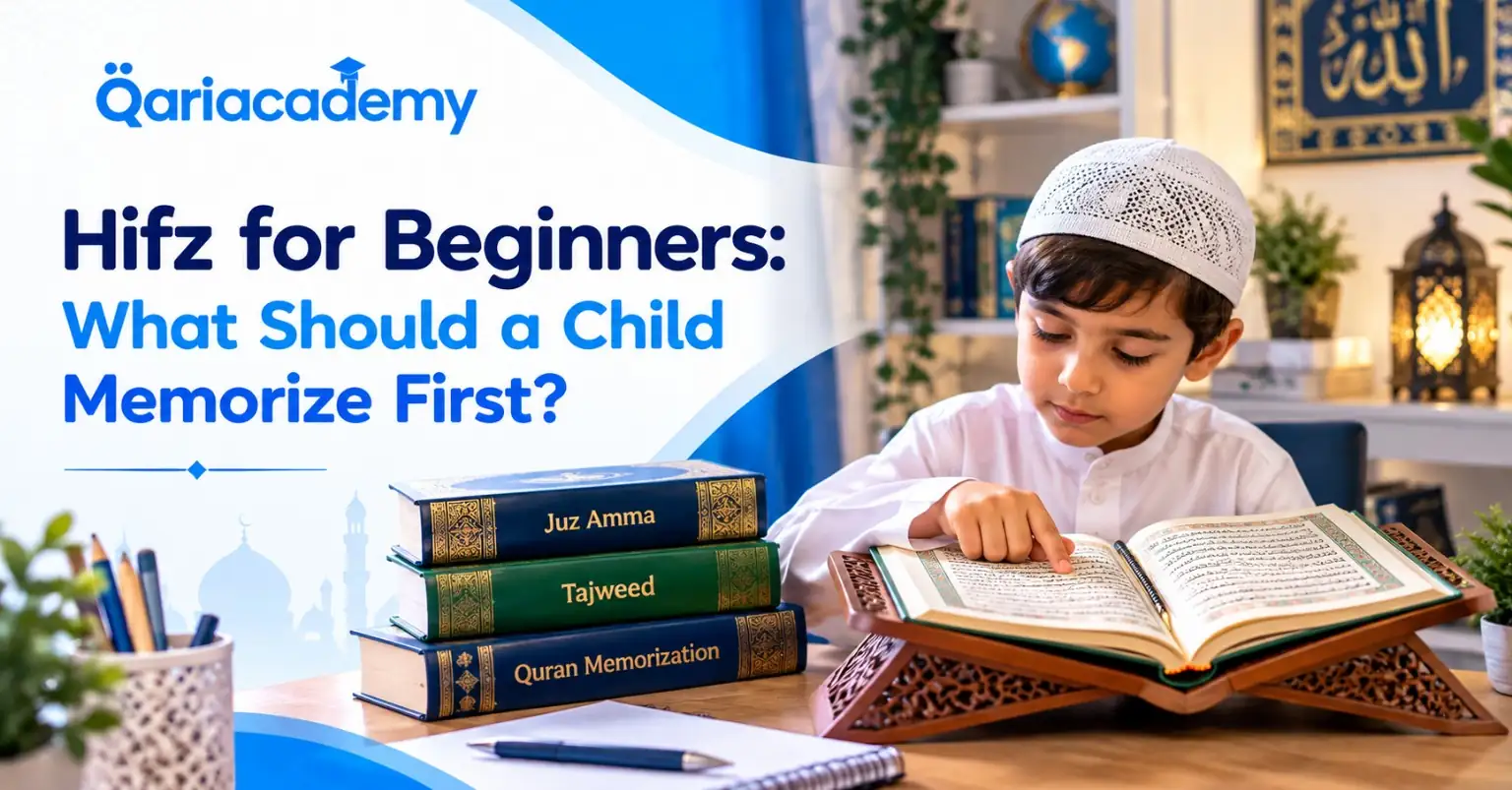
When parents decide to start Quran memorization, one of the first questions is surprisingly difficult:
What should my child memorize first?
Should they begin with Al-Fatihah? Juz Amma? Short surahs such as Al-Ikhlas and An-Nas? Or should the starting point depend on the child’s reading level?
There is no single memorization order that every child must follow.
A good Hifz for beginners curriculum starts with the child’s current ability and then chooses material that is manageable, useful, and appropriate for their stage.
For many children, the best starting point is not simply “the shortest surah.” It is the passage that allows them to experience successful memorization while building accurate recitation and revision habits.
What Does Hifz for Beginners Actually Mean?
Hifz means memorization, and in Quran education it commonly refers to memorizing the Quran.
For a beginner, however, Hifz should not mean immediately memorizing large amounts of Quran.
A child may be a beginner because they:
- Have never memorized Quran before
- Know a few surahs from Salah but have never followed a structured Hifz program
- Can read Quran but have limited memorization
- Are still developing their Arabic reading skills
- Memorize through listening but struggle to read independently
These children need different starting points.
A structured children’s Hifz program should therefore adapt the amount of memorization, revision, Tajweed, and pronunciation to the child’s level rather than giving every student the same target.
QariAcademy’s Quran Hifz for Kids program follows this individualized approach, with one-on-one lessons, structured revision, and memorization paced according to the child.

First Question: Can the Child Read the Quran?
Before choosing the first Hifz target, assess the child’s Quran reading ability.
This is one of the most important curriculum decisions.
A child who reads Arabic confidently can spend more lesson time on memorization.
A child who struggles to recognize letters or decode Quranic words may need more reading instruction alongside a smaller memorization target.
| Child’s Starting Point | Hifz Starting Approach | Main Priority |
|---|---|---|
| Cannot read Quran yet | Very limited memorization | Reading foundation |
| Reads slowly | Short passages + reading practice | Accuracy |
| Reads independently | Regular short-surah Hifz | Memorization + revision |
| Reads confidently | More focused Hifz | Retention + progression |
This does not mean a child must become a fluent Quran reader before memorizing anything.
It means the memorization workload should not become so large that it replaces the development of basic Quran reading and pronunciation.
For some children, Hifz and reading can develop together. The important thing is to maintain the right balance.
Should Al-Fatihah Be the First Surah?
For many children, Al-Fatihah is an excellent early memorization priority.
It is short, familiar, and central to Salah. If the child has not memorized it, it can be a sensible place to begin.
But there is an important distinction:
Al-Fatihah should not automatically be taught as new material if the child already knows it well.
If a child already recites Al-Fatihah accurately in Salah, spending weeks treating it as completely new material would not make sense.
Instead, the teacher can assess:
- Accuracy
- Pronunciation
- Fluency
- Tajweed
- Independence
Then move to the next appropriate target.
A Practical Rule
Do not start with what the child already knows. Start with what they need to learn next.
This principle prevents Hifz from becoming unnecessarily repetitive and allows the curriculum to reflect the child’s actual level.
What About Juz Amma?
For many beginners, Juz Amma is a practical starting section because it contains many relatively short surahs that children commonly hear and recite in Salah.
However, Juz Amma is a curriculum option, not a universal rule.
QariAcademy’s guide, Should Your Child Memorize Juz Amma First?, explains why Juz Amma can be a useful starting point while emphasizing that the child’s reading level, existing memorization, pronunciation, and learning goals should also be considered.
A child might begin with selected short surahs rather than move through Juz Amma strictly from one end to the other.
The goal is not simply to finish a Juz.
The goal is to build strong, lasting Hifz.
A Practical Hifz Starting Sequence
For many young beginners, a curriculum can be organized into stages rather than simply giving the child a list of surahs.
Stage 1: Al-Fatihah
If the child has not already memorized it, establish accurate recitation and comfortable recall.
Stage 2: Short, Familiar Surahs
Introduce manageable surahs according to the child’s level.
Common examples include:
- Al-Ikhlas
- Al-Falaq
- An-Nas
- Al-Kawthar
- Al-Asr
The exact order can vary.
Stage 3: Build a Short-Surah Bank
Once the child can memorize and retain short passages consistently, gradually introduce additional surahs.
Stage 4: Increase Passage Length
The child can eventually move toward longer surahs or longer sections when their reading, retention, and revision skills support it.
| Hifz Stage | Typical Material | Curriculum Goal |
|---|---|---|
| Foundation | Al-Fatihah / very short passages | Accurate recitation |
| Early Hifz | Short surahs | Build confidence |
| Developing Hifz | More short-surah material | Strengthen retention |
| Stronger learner | Longer passages | Increase capacity |
The important point is that the curriculum should expand as the child’s ability expands.
Why Short Surahs Are Useful for Beginners
Short surahs offer an important advantage for beginners.
A child can see the finish line.
If a beginner is given a long passage immediately, the amount of material can feel overwhelming.
A short surah allows the child to experience a complete learning cycle:
Listen → Learn → Recite → Correct → Memorize → Review → Complete
That cycle teaches the child how to memorize, not simply what to memorize.
And that skill becomes increasingly important as the passages become longer.
But Don’t Choose a Surah Only Because It Is Short
Length is useful, but it should not be the only consideration.
A good beginner curriculum also considers:
1. Reading Difficulty
Can the child recognize and read the words?
2. Pronunciation
Does the passage contain sounds the child is still struggling with?
3. Retention
Can the child remember the passage after a day or two?
4. Familiarity
Has the child already heard the surah frequently in Salah or at home?
5. Motivation
Does completing the passage give the child a realistic sense of achievement?
These factors can matter more than simply counting verses.
The First Hifz Lesson Should Not Be a Race
A common mistake is starting with an ambitious memorization target.
For example:
“Let’s memorize a whole surah today.”
That may work for some children.
For others, it creates an unnecessary struggle.
A better first lesson might involve:
- Listening to the passage
- Reading it with the teacher
- Correcting pronunciation
- Breaking it into small sections
- Memorizing the first section
- Testing recall
- Reviewing it before adding more
The teacher can then determine how much new material the child can realistically handle.
The important question is not:
“How much can my child memorize today?”
It is:
“How much can my child memorize accurately and still remember later?”
New Hifz Is Only One Part of the Curriculum
This is where many beginner programs go wrong.
Parents sometimes measure progress by asking:
“How many surahs has my child memorized?”
But Hifz has at least three important components:
New Memorization + Recent Revision + Older Revision
If the child memorizes new material continuously but rarely revises previous surahs, the amount of memorized Quran can grow while retention becomes weaker.
QariAcademy’s guide to how much Quran a child should memorize each week discusses the same principle: weekly targets should be based on the child’s ability to retain and review the material rather than on a fixed number of verses or pages.
| Component | What It Means | Why It Matters |
|---|---|---|
| New Hifz | Learning new verses | Builds the memorized portion |
| Recent Revision | Reviewing recent lessons | Strengthens new material |
| Older Revision | Revisiting previous surahs | Protects long-term retention |
A strong beginner curriculum makes room for all three.
How Much Should a Beginner Memorize?
There is no universal number.
One child may learn two or three lines successfully while another can handle a larger passage.
The correct target is the amount the child can learn accurately and retain.
For example:
Beginner A
Learns five verses but forgets them the following week.
Beginner B
Learns three verses and can still recite them accurately several days later.
The second child may currently have the more sustainable Hifz pace.
That is why increasing the workload should follow successful retention rather than parental pressure.
What If the Child Already Knows Several Surahs?
Then don’t start from zero.
Suppose a child already knows:
- Al-Fatihah
- Al-Ikhlas
- Al-Falaq
- An-Nas
- Al-Kawthar
The teacher should first assess those surahs.
Are they:
- Accurate?
- Stable?
- Recited without prompts?
- Correct in pronunciation?
- Consistent after several days?
If yes, the child can move forward.
If not, the first stage may actually be consolidation, not new memorization.
This is where revision becomes especially important.
QariAcademy’s Quran memorization revision guide focuses on building stronger revision habits so children can retain what they have already learned rather than continually adding new material.
What If the Child Is Very Young?
For younger children, the curriculum should usually be built around short, focused learning periods.
The objective is not to reproduce an adult Hifz schedule on a smaller scale.
A young child may benefit from:
- Short memorization sections
- Frequent repetition
- Listening
- Teacher modeling
- Immediate correction
- Simple revision
- Positive reinforcement
The child should gradually learn that memorization is something they can do.
That confidence becomes valuable when the material becomes more demanding.
What If the Child Is Still Learning Arabic?
This is especially important for Muslim children growing up in English-speaking environments.
A child may want to memorize Quran but still struggle with:
- Arabic letters
- Harakat
- Connected letters
- Pronunciation
- Reading Quranic words
In this situation, Hifz and reading can develop together.
A lesson might look like:
Quran Reading → Pronunciation → New Hifz → Revision
The exact balance depends on the child.
The goal is to prevent memorization from becoming completely detached from the Mushaf.
Should Children Memorize in the Order of the Mushaf?
Not necessarily.
A beginner curriculum does not have to start at the beginning of the Mushaf and proceed sequentially.
A teacher may choose material based on:
- Child’s current level
- Surah length
- Familiarity
- Reading difficulty
- Pronunciation needs
- Memorization capacity
- Revision ability
For a beginner, curriculum order and Mushaf order do not have to be identical.
The priority is creating a sensible learning progression.
When Should a Child Move to Longer Surahs?
Don’t use age alone as the deciding factor.
Look for signs that the child is ready.
The child can:
- Memorize short passages consistently
- Retain previous surahs
- Recite without constant prompting
- Read the material with reasonable accuracy
- Accept correction
- Practice independently for short periods
When these skills are developing reliably, the teacher can gradually increase the length of new material.
| Ready for Progression | Needs More Foundation |
|---|---|
| Retains previous Hifz | Quickly forgets recent Hifz |
| Reads with reasonable accuracy | Struggles to decode words |
| Recites independently | Needs constant prompting |
| Handles short sessions | Becomes overwhelmed quickly |
| Corrects repeated mistakes | Same errors remain unresolved |
This makes progression skill-based rather than age-based.
A Simple Beginner Hifz Curriculum
If you are designing a curriculum for a child starting from the beginning, think in four phases.
Phase 1 — Build the Foundation
Goal: establish accurate Quran reading and comfortable recitation.
Focus on:
- Arabic letters if needed
- Harakat
- Quran reading
- Pronunciation
- Listening
- Al-Fatihah if needed
- Very short memorization passages
Phase 2 — Build Consistency
Goal: make memorization a repeatable process.
Focus on:
- Short surahs
- New Hifz
- Recent revision
- Older revision
- Reading from the Mushaf
Phase 3 — Increase Capacity
Goal: gradually handle longer passages.
Focus on:
- Longer sections
- More independent practice
- Stronger revision
- Tajweed refinement
Phase 4 — Develop Sustainable Hifz
Goal: protect what has already been memorized while continuing forward.
Focus on:
- New material
- Daily revision
- Weekly consolidation
- Older Hifz
- Independent responsibility
The progression should be gradual.
A Beginner’s Weekly Hifz Structure
A simple weekly framework might look like this:
| Day | Main Focus | Home Practice |
|---|---|---|
| Monday | New Hifz | Repeat new passage |
| Wednesday | New Hifz + recent review | Review both sections |
| Thursday | New Hifz | Short repetition |
| Friday | Revision | Mostly previously memorized Quran |
| Saturday | New Hifz + older review | Review weak sections |
This is an example framework, not a required religious schedule.
Some children may need more lessons; others may need fewer.
The teacher should adjust the schedule according to retention and family circumstances.
For families with demanding school and extracurricular schedules, a realistic routine can be more sustainable than an ambitious one. QariAcademy’s Realistic Hifz Routine for Busy Muslim Children offers additional guidance on balancing Hifz with school, revision, family commitments, and daily life.
What Parents Should Watch For
Parents don’t need to become the Hifz teacher.
Instead, watch for a few simple indicators:
Is the child retaining yesterday’s material?
Is pronunciation improving?
Can the child recite without constant prompting?
Is the amount of new material manageable?
Does the child have enough time for revision?
Is the child becoming more independent?
These questions tell you much more than simply counting the number of surahs completed.
The Biggest Beginner Hifz Mistake
The biggest mistake is confusing speed with progress.
A child who memorizes a surah quickly has made progress.
But a child who memorizes it accurately and retains it is building something more durable.
The goal is not:
“How quickly can my child finish?”
It is:
“How can my child build Hifz that lasts?”
This is why a child’s memorization target should be adjusted when retention begins to weaken.
Sometimes the best next step is not more new Quran.
It is more revision.
How QariAcademy Approaches Hifz for Beginners
At QariAcademy, children can begin Hifz without assuming that every student should follow the same starting point.
The academy’s Quran Hifz for Kids program is designed for young learners and describes a one-on-one approach that adapts memorization, revision, Tajweed, and pronunciation to the child’s level.
That approach matters because a child who already knows several short surahs is not starting from the same place as a child who is still learning to read Arabic.
The teacher’s first responsibility is therefore not simply to assign a surah.
It is to answer:
Where is this child now, and what should they learn next?
Frequently Asked Questions
What should a child memorize first in Hifz?
For many beginners, Al-Fatihah is an appropriate early priority if the child does not already know it, followed by manageable short surahs. However, the exact starting point should depend on the child’s existing memorization and reading ability.
Should children memorize Juz Amma first?
Juz Amma can be a practical starting section because it contains many short surahs, but it is not a universal requirement. A teacher can select appropriate surahs based on the child’s level and goals.
Can a child start Hifz before reading Quran fluently?
Yes, in some cases. A child can develop modest memorization alongside reading instruction, provided the Hifz workload does not replace the development of basic Quran reading and pronunciation.
How many verses should a beginner memorize each day?
There is no universal number. The appropriate amount is the amount the child can memorize accurately, retain, and revise without becoming overwhelmed.
Should children memorize new Quran every day?
Not necessarily. Some days can focus mainly on revision. Protecting previous memorization is an essential part of a sustainable Hifz program.
What if my child keeps forgetting?
Reduce the focus on new material temporarily and examine the revision system. Smaller memorization sections, active recall, and more frequent revision may help strengthen retention.
Conclusion
Starting Hifz is not about finding a single “correct” surah and giving it to every child.
It is about finding the right starting point for that particular child.
If Al-Fatihah has not been memorized, it can be an important early priority. If the child already knows it, move forward rather than repeating what they have mastered.
For many beginners, short surahs from Juz Amma provide a practical pathway into structured Hifz. But the sequence should be shaped by reading ability, pronunciation, retention, familiarity, and the child’s capacity for consistent revision.
A strong Hifz for beginners curriculum should therefore follow a simple progression:
Assess → Choose manageable material → Memorize accurately → Revise → Strengthen → Progress
The first goal is not to memorize a large amount.
It is to teach the child how to memorize Quran well.
Once that foundation is strong, the amount of Quran they can carry can gradually grow.
If you are looking for a structured starting point for your child, QariAcademy offers one-on-one online Quran learning that can be adapted to the student’s current level and learning needs.
Book a Free Trial With QariAcademy:
https://qariacademy.com/enroll/