Table of Contents
Summary
Many Muslim parents overlook the early signs of “spiritual burnout” in their children. When Quran learning shifts from a heart-centered activity to a high-pressure chore, the “struggle” begins. This guide explores the psychological roots of this resistance and offers a roadmap to recovery through empathy, creative teaching, and professional support. QariAcademy provides a specialized environment designed to reignite a child’s love for Allah’s words through personalized, stress-free learning.
Introduction: The Illusion of Progress
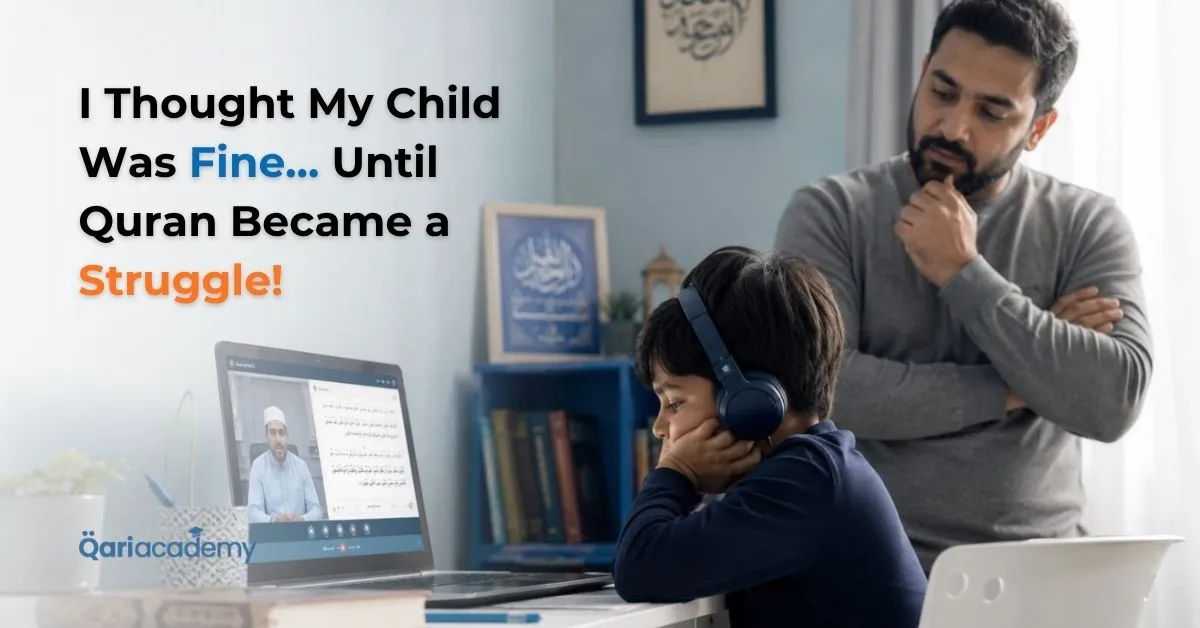
For years, I watched my child sit with their teacher, nodding, repeating, and even finishing Juz’ after Juz’. I was proud. I shared the milestones with family. I truly thought my child was fine.
Then, the resistance started. It began with “I’m tired today,” moved to “Do I have to?” and ended in tears before every session. That’s when I realized: I had focused so much on the progress of the tongue that I neglected the progress of the heart.
If you are experiencing this, you are not failing as a parent. You have simply hit a plateau where traditional methods are no longer enough for your child’s emotional and spiritual needs.
Section 1: The Psychology of the “Quran Struggle”
Why does something so beautiful become a source of tension? Understanding the “Why” is the first step toward healing.
1.1. The Performance Trap
When children feel that their parents’ love or pride is tied to how many verses they memorize, Quran time becomes a high-stakes performance. At QariAcademy, we shift this focus. We teach children that the Quran is a gift for them, not a task to please their parents.
1.2. The “Modern Brain” Conflict
Our children live in a world of instant gratification—YouTube, gaming, and fast-paced school curricula. Quran learning requires “Deep Work” and patience. When these two worlds collide without a bridge, the child feels frustrated.
Section 2: The Silent Red Flags of Spiritual Disconnect
Before the “struggle” becomes an open conflict, there are hidden signs. As a parent, look for these:
- Mechanical Recitation: They read correctly but with zero emotion or curiosity.
- Avoidance Tactics: Suddenly needing the bathroom or water every 5 minutes during Quran time.
- The “When Will I Be Done?” Question: Focusing on the end of the session rather than the content.
Section 3: How QariAcademy Transforms the Struggle into Strength
We created QariAcademy specifically for parents who said, “I thought my child was fine… until Quran became a struggle.” Our methodology is built on three pillars:
Pillar 1: Emotional Safety (The Teacher-Student Bond)
In many traditional settings, the teacher is a figure of fear. At QariAcademy, our teachers are trained in child psychology. They know when to push and, more importantly, when to pause and just talk to the child about their day.
Pillar 2: Contextual Learning (The “Why” Behind the Verse)
Memorizing “Al-Fil” is one thing; understanding the miracle of the elephants and Allah’s protection is another. QariAcademy integrates Tafseer (interpretation) into every lesson, making the Quran a book of stories and lessons, not just words.
Pillar 3: Adaptive Scheduling
We know Muslim families are busy. Forcing a child to study when they are exhausted from school is a recipe for disaster. QariAcademy offers flexible timing to ensure your child meets the Quran when they are at their best.
Section 4: A Step-by-Step Recovery Plan for Parents
If you are currently in the middle of the struggle, follow this QariAcademy recommended “Reset” plan:
- The One-Week Fast: Stop all formal Hifz for one week. Replace it with listening to beautiful recitations or watching Islamic cartoons together.
- Open Dialogue: Ask your child, “What is the hardest part about Quran for you?” Listen without judging.
- Gamify the Experience: Use stickers, digital badges, or “Quran dates” (going to a cafe to read together).
- Delegate to Professionals: Sometimes, the “parent-as-teacher” dynamic creates too much friction. Let QariAcademy take the pressure off your relationship so you can go back to being just the “encouraging parent.”
Section 5: Frequently Asked Questions (FAQ)
Q: At what age does the “struggle” usually start? A: Often around ages 7-9, when academic pressure increases and children start developing a stronger sense of independence.
Q: Is it okay to take a break from Hifz? A: Yes. A short, intentional break is better than a permanent burnout that leads to the child abandoning the Quran in adulthood.
Q: Why choose QariAcademy over a local Masjid teacher? A: While local teachers are a blessing, QariAcademy offers 1-on-1 focused attention, vetted teachers who speak your child’s language fluently, and a curriculum tailored to the specific pace of your child.
Conclusion: Rebuilding the Bridge
“I thought my child was fine… until Quran became a struggle” was the sentence that changed my parenting. It forced me to look deeper, to apologize to my child, and to find a better way.
Your child’s journey with the Quran is a marathon, not a sprint. Don’t let a temporary struggle define their lifelong relationship with Allah. Join the QariAcademy family today and let us help you turn that struggle into a beautiful, lasting connection.
Enroll Now: Book Your Free Evaluation Session at QariAcademy