Table of Contents
Introduction: Why Egyptian Arabic Is the Key to the Arab World
Arabic is one of the most widely spoken languages globally, with over 400 million speakers across North Africa and the Middle East. However, anyone who sets out to learn Arabic quickly encounters a famous linguistic phenomenon: the difference between Modern Standard Arabic (MSA / الفصحى) and Spoken Regional Dialects (العامية).
While MSA is the official language of literature, news broadcasts, formal speeches, and religious texts, it is not spoken in daily life on the streets of any Arab country.
If your goal is to travel, build deep personal relationships, conduct business, understand movies, or simply speak Arabic naturally in everyday conversations, mastering a spoken dialect is essential. And among all regional dialects, Egyptian Arabic (لهجة مصرية / ‘Ammiyya) stands as the undisputed king of spoken Arabic.
Thanks to Egypt’s massive cultural influence—driven by its legendary film industry, music legends like Umm Kulthum and Abdel Halim Hafez, comedy icons, television dramas, and media dominance for over a century—Egyptian Arabic is understood by virtually every Arabic speaker from Morocco to Iraq.
This comprehensive 3,000+ word guide serves as your complete roadmap to learning and speaking Egyptian Arabic naturally, exploring its unique grammar shortcuts, essential vocabulary, cultural nuances, and how private 1-on-1 online instruction makes mastering the dialect effortless.
Part 1: Modern Standard Arabic (MSA) vs. Egyptian Arabic (‘Ammiyya)
Understanding the distinction between MSA and Egyptian Arabic is the first step toward natural fluency.
MSA vs. Egyptian Arabic (‘Ammiyya)
Modern Standard Arabic (MSA)
- Used in news, books, formal speeches, and official documents.
- Complex grammatical case endings (I’rab).
- Understood universally, but sounds artificial in casual daily chat.
Egyptian Arabic (‘Ammiyya)
- The spoken language of daily life, humor, music, and movies.
- Simplified grammar with zero complex case endings.
- Universally understood across the entire Arab world.
The “G” Sound Transformation
The most iconic phonetic hallmark of Egyptian Arabic is how the letter Jim (ج) is pronounced.
- In MSA and most Gulf/Levantine dialects, ج is pronounced as a soft “J” sound (like “journal”).
- In Egyptian Arabic, ج is pronounced as a hard “G” sound (like “gate” or “go”).
Examples:
- Camel: MSA (Jamal) — Egyptian (Gamal)
- Beautiful: MSA (Jameel) — Egyptian (Gameel)
- New: MSA (Jadeed) — Egyptian (Gadeed)
Part 2: Core Phonetic Features of Egyptian Arabic
To speak Egyptian Arabic naturally, you must master the key sound shifts that distinguish it from formal textbook Arabic.
Egyptian Phonetic Transformations
- The Hard “G” (ج): Pronounced as “G” in “go” instead of “J”.
- The Hamza Shift (ق): The letter Qaf (ق) is dropped to a glottal stop “A” sound in urban Cairene speech.
- Tha Shifts (ث & ذ): Softened to “S/T” and “Z/D” sounds.
1. The Glottal Stop for Qaf (ق —> ء)
In Cairene Egyptian Arabic, the deep throat letter Qaf (ق) is transformed into a soft glottal stop (Hamza / ‘A sound), giving the dialect its famous soft, melodic rhythm.
- Heart: MSA (Qalb) — Egyptian (‘Alb)
- Moon: MSA (Qamar) — Egyptian (‘Amar)
- Coffee: MSA (Qahwa) — Egyptian (‘Ahwa)
2. Simplification of Interdental Letters
Egyptian Arabic simplifies hard-to-pronounce interdental letters (ث, ذ, ظ) into accessible “T”, “S”, “D”, or “Z” sounds:
- Three: MSA (Thalatha) — Egyptian (Talata)
- Gold: MSA (Dhahab) — Egyptian (Dahab)
Part 3: Essential Everyday Egyptian Vocabulary & Expressions
To converse naturally in Cairo, Alexandria, or anywhere in Egypt, you need the go-to conversational phrases used in daily life.
Essential Egyptian Phrases
- “Izzayak?” (إزيك؟): How are you? (To a male)
- “Izzayik?” (إزيكِ؟): How are you? (To a female)
- “Ezzay Al-Siha?” (إزاي الصحة؟): How is your health?
- “Aywa” (أيوه): Yes
- “La'” (لأ): No
- “Kwayyis” (كويس): Good / Fine (Male)
- “Kwayyisa” (كويسة): Good / Fine (Female)
- “Eih da?” (إيه ده؟): What is this?
- “Mafiash Mushkila” (مفيش مشكلة): No problem!
The Iconic Egyptian Expression: “Ya ‘Am” & “Miyya Miyya”
- Miyya Miyya (مية مية): Literally “100/100” or “perfect/awesome.”
- Ya ‘Am (يا عم): Literally “Oh uncle,” used casually like “Dude” or “Man” among friends.
- Ya Basha (يا باشا): A respectful, affectionate term meaning “Boss” or “Sir,” commonly used in shops and cafes.
Part 4: Simplified Grammar Mechanics of Egyptian Arabic
One of the greatest benefits of learning Egyptian Arabic is its radically simplified grammar structure compared to MSA.
Egyptian Grammar Shortcuts
- Question Words Placed at the End:
- MSA: “Ayna al-fundoq?” (Where is the hotel?)
- Egyptian: “Al-fundoq feen?” (The hotel is where?)
- The Present Continuous “B-” Prefix:
- Add “B-” (بـ) before a verb to mark active present tense.
- Example: “Ana b-akol” (I am eating).
- The Future “Ha-” Prefix:
- Add “Ha-” (حـ) before a verb to mark future tense.
- Example: “Ana ha-safar” (I will travel).
Word-Order Shift in Questions
In formal MSA, question words always come at the beginning of a sentence. In Egyptian Arabic, question words are placed naturally at the end:
- What is your name?
- MSA: Ma ismuka?
- Egyptian: Ismak eih? (Your name what?)
- Where are you going?
- MSA: Ayna tadhab?
- Egyptian: Raye’h feen? (Going where?)
Part 5: Traditional Self-Study vs. 1-on-1 Online Dialect Coaching
While apps and textbook audio guides offer basic vocabulary, achieving conversational confidence requires active speaking practice with native speakers.
| Learning Dimension | Self-Study Apps / Books | 1-on-1 Native Egyptian Online Coaching |
| Speaking Practice | Passive output; no real-time conversational feedback. | Active, fluid 1-on-1 conversation with native Egyptian tutors. |
| Accent & Nuance | Robotic audio clips; misses cultural slang and humor. | Real-time correction of vocal rhythm, pitch, and colloquial expressions. |
| Personalization | Fixed static linear lessons. | Customized lessons built around your goals (travel, business, family). |
| Cultural Immersion | Limited to basic textbook facts. | Deep cultural understanding of Egyptian humor, etiquette, and life. |
Part 6: Why QariAcademy Is the Premier Choice to Learn Egyptian Arabic
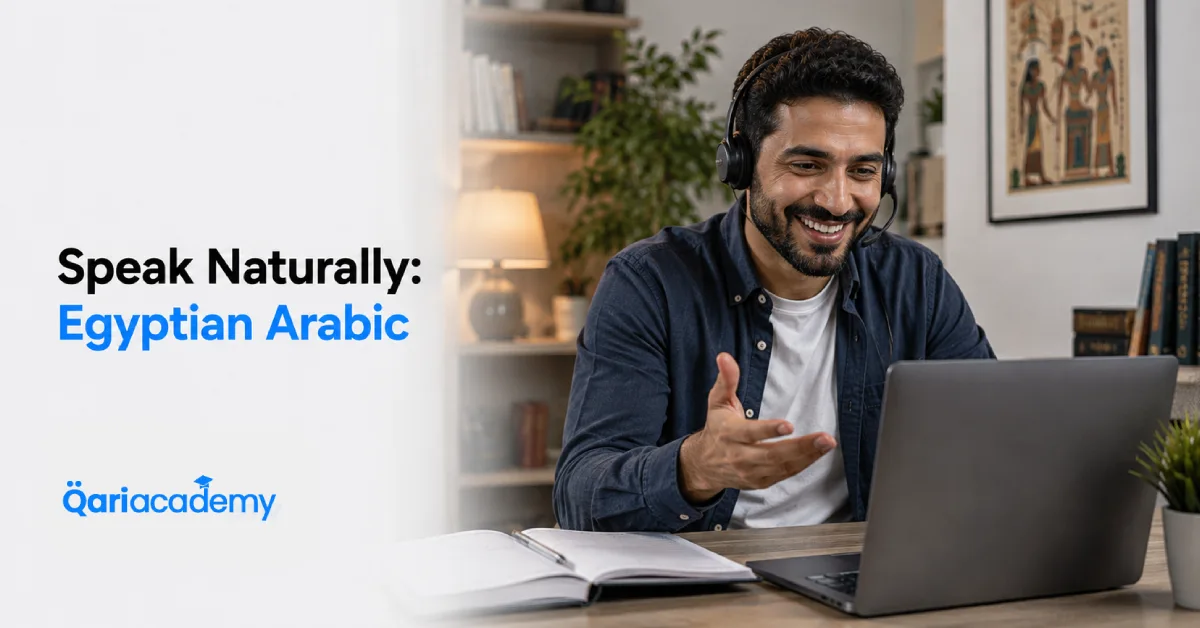
At QariAcademy, we connect students worldwide directly with qualified native Egyptian tutors to help you speak Arabic naturally and confidently.
The QariAcademy Advantage
- Native Egyptian Tutors: Born & educated in Egypt with deep fluency.
- Real Conversational Focus: Practice speaking from Day 1.
- Bilingual Scholars: Clear English explanations for beginners.
- Flexible Scheduling: 24/7 custom booking across all global time zones.
- Tailored Curricula: Travel, business, family, or media tracks.
- Native Egyptian Instructors: Learn directly from native speakers who teach real, living Egyptian Arabic as spoken on the streets of Cairo and Alexandria.
- Conversational Focus: Skip dry, outdated grammar drills and start speaking full sentences from your very first lesson.
- Flexible 1-on-1 Schedule: Book classes around your busy routine across US, UK, and global time zones.
- Dedicated Female Tutors: Qualified female native Egyptian tutors available for adult sisters and children.
Frequently Asked Questions (FAQ)
Q1: Should I learn Modern Standard Arabic (MSA) or Egyptian Arabic first?
Answer: If your goal is to read Quran, classical literature, news, or formal documents, start with MSA. If your goal is to speak to real people, travel, make friends, and understand Arab media, start with Egyptian Arabic.
Q2: Is Egyptian Arabic understood in other Arab countries?
Answer: Yes, universally! Due to Egypt’s century-long leadership in cinema, music, television, and media, almost every Arabic speaker across the Middle East and North Africa understands Egyptian Arabic fluently.
Q3: How long does it take to become conversationally fluent in Egyptian Arabic?
Answer: With consistent 1-on-1 instruction (2–3 classes per week) and active practice, most beginners reach comfortable conversational fluency within 6 to 9 months.
Conclusion: Start Speaking Egyptian Arabic Naturally Today
Mastering Egyptian Arabic opens the doors to an exceptionally rich culture, warm hospitality, and instant connection with millions of Arabic speakers worldwide. Speak with confidence, express yourself naturally, and unlock the world’s most popular Arabic dialect.
Begin Your Egyptian Arabic Journey Today with QariAcademy
Transform your speaking skills under the direct guidance of native Egyptian language coaches.
🎁 Claim Your FREE 1-on-1 Spoken Arabic Assessment & Trial Lesson
Experience our interactive digital classroom, meet your dedicated tutor, and receive a customized conversational roadmap—100% free with zero obligation.
👉 [Click Here to Register for Your Free Trial at QariAcademy]