Table of Contents
Foundations, Neurological Benefits, & Western Dynamics
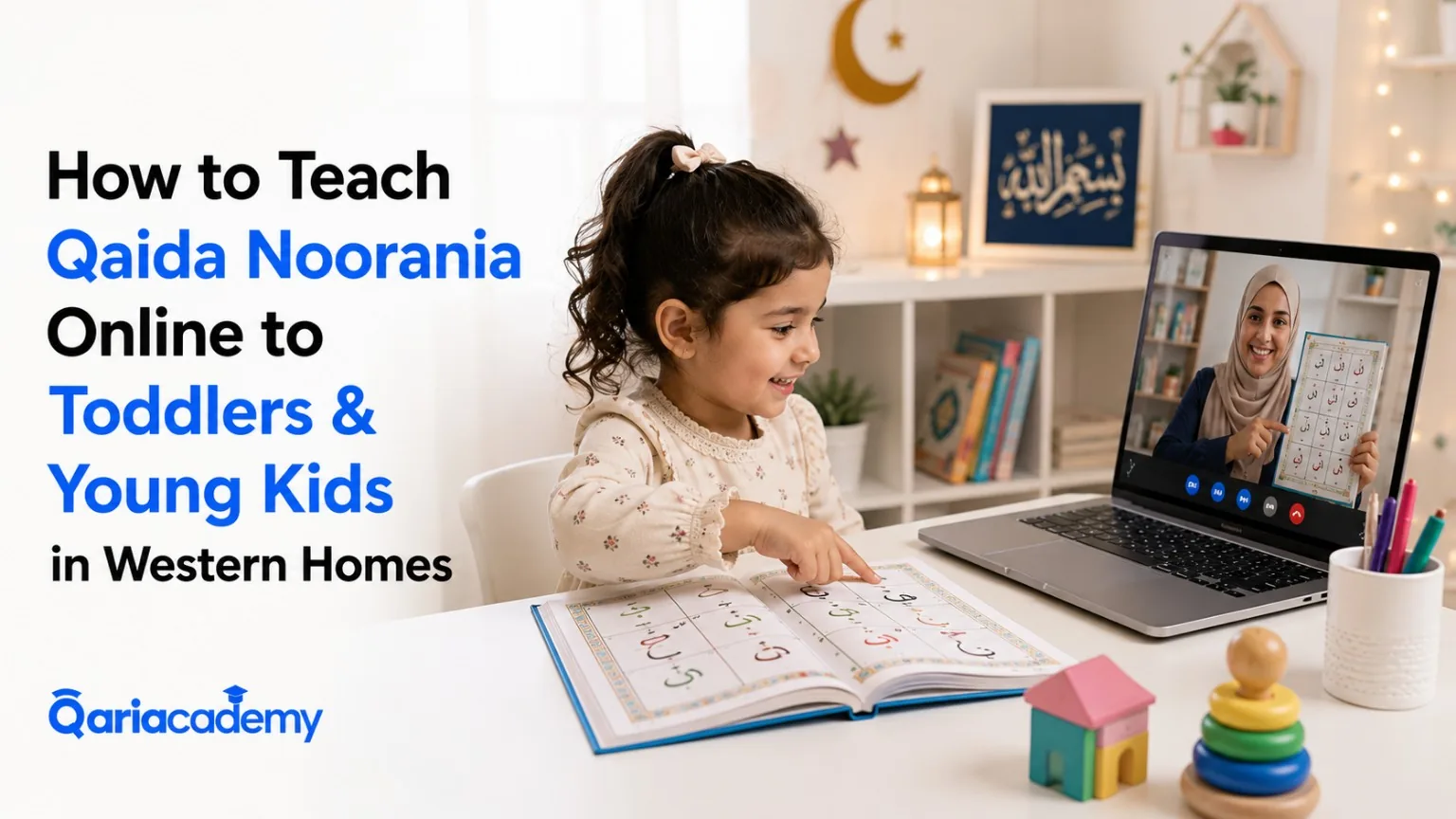
Raising practicing Muslim children in Western societies presents unique cultural and educational dynamics. For parents living in North America, Europe, Australia, or the UK, creating an authentic connection with the Holy Quran during early childhood requires deliberate strategy, structured consistency, and tailored pedagogy. The foundational building block of Arabic phonetic literacy is Qaida Noorania, a globally respected methodology designed to teach non-Arabic speakers the correct pronunciation (Makharij) and recitation rules (Tajweed) from an early age.
When deciding how to teach Qaida Noorania online to toddlers, parents often encounter a central dilemma: young children under five have short attention spans, high movement needs, and limited screen tolerance. Traditional rote-learning methodologies used in physical madrasahs often fail to engage toddlers raised in digital, western environments. To bridge this gap, modern parents require an adaptable framework that blends traditional Islamic scholarship with contemporary early childhood development techniques.
Why Early Qaida Noorania Training Matters for Western-Raised Children
Children growing up in Western environments are immersed in English, French, or other non-Arabic languages throughout their daily lives. The vocal muscles required to produce specific Arabic sounds—such as ع (Ayn), ح (Haa), and خ (Khaa)—naturally adapt to the dominant language spoken in their immediate environment.
Early Phonetic Advantages in Western Environments:
- Vocal Flexibility: Toddlers easily form complex Arabic Makharij before vocal habits rigidify.
- Cognitive Agility: Early dual-alphabet recognition (English and Arabic) strengthens overall linguistic intelligence.
- Identity Anchoring: Early positive exposure provides essential spiritual grounding in a minority cultural context.
When you teach Qaida Noorania online to toddlers during their formative years (ages 3 to 6), you capitalize on their peak window of neuroplasticity. During this stage:
- Phonetic Plasticity is Highest: Toddlers absorb native accents effortlessly without persistent linguistic interference.
- Tajweed Becomes Muscle Memory: Correct vowel lengths (Harakat) and rules like Ghunnah become second nature before habitual mispronunciations set in.
- Spiritual Identity Belongs at Home: Early positive exposure to Quranic sounds builds an emotional attachment to Islam within non-Islamic public environments.
Understanding the Structure of Qaida Noorania
Designed by Sheikh Noor Muhammad Ludhiyanvi, the Qaida Noorania syllabus systematically moves a child from individual letter identification to reading compound Quranic verses. Understanding this progression helps parents track their toddler’s online learning milestones:
| Lesson Stage | Core Focus Area | Toddler Pedagogical Goal |
| Lessons 1–3 | Single Letters (Al-Huroof Al-Mufradah) & Compounds | Visual recognition & physical articulation points (Makharij) |
| Lessons 4–6 | Vowels (Harakat: Fatha, Kasra, Damma) & Tanween | Sound length control and quick phonetic blending |
| Lessons 7–9 | Madd Letters & Leen Letters | Distinguishing short vs. long vowel stretches |
| Lessons 10–13 | Sukoon, Shaddah, and Rules of Nuun Sakinah | Auditory mastery of nasalization and doubled consonants |
| Lessons 14–17 | Advanced Compound Words & Quranic Application | Full fluency in reading directly from the Mushaf |
Part 2: Step-by-Step Pedagogical Methodology & Toddler Engagement Tactics
The 4-Pillar Toddler Engagement Loop:
- Visual Anchoring: Dual-color letter coding and oversized physical flashcards.
- Kinesthetic Motion: Air tracing, tactile sand trays, and bodily Makhraj engagement.
- Auditory Rhythm: Metronomic rhythm tapping for vowel duration (Madd).
- Digital Game Loop: Immediate digital micro-rewards and badge progression.
1. Deconstructing the Qaida Noorania Syllabus for Early Childhood
The original Qaida Noorania syllabus contains 17 distinct lessons designed to systematically elevate an illiterate student to complete Quranic literacy. Applying this syllabus to a 3- or 4-year-old child living in a Western household requires breaking down abstract linguistic concepts into concrete sensory inputs.
- Lessons 1 to 3 (Al-Huroof Al-Mufradah & Al-Murakkabat):For toddlers, the focus shifts toward visual shape recognition and somatic articulation. Tutors isolate individual letters using distinct color codes—for instance, highlighting the three dots of Thaa (ث) in bright red to differentiate it from the single dot beneath Baa (ب). When introducing compound letters, online instructors demonstrate how letters change shapes depending on their position without overwhelming the toddler with dense linguistic jargon.
- Lessons 4 to 6 (Al-Harakat & Al-Tanween):Understanding short vowels is made intuitive by combining physical facial expressions with phonetic sounds. Instructors explain Fatha as a “happy opening of the mouth,” Kasra as a “gentle smile downward,” and Damma as a “rounded parrot beak.”
- Lessons 7 to 9 (Al-Madd & Al-Leen):Distinguishing between short vowels and long extensions (Madd) requires timing precision. Instructors at Qari Academy use visual hand signals—such as expanding an elastic band or holding up finger counts—to visually represent two, four, or six counts of vocal extension.
- Lessons 10 to 17 (Sukoon, Shaddah, & Advanced Tajweed Rules):Mastering the silent mark (Sukoon) and doubled letters (Shaddah) prepares the young learner to read full words directly from the Mushaf. At this stage, micro-lessons incorporate real-world Quranic examples, transitioning the child smoothly from individual phonetic drills to continuous Quranic recitation.
2. The Micro-Lesson Architecture: Structuring a 15-Minute Online Session
Because toddlers have short attention spans, sessions must follow a rapid, highly structured 15-minute micro-lesson model:
- [00:00 – 02:00] Spiritual Warm-Up & Emotional Connection: The tutor greets the child warm-heartedly in English and Arabic, beginning with a short supplication (Du’a) or a friendly check-in.
- [02:00 – 06:00] Core Phonetic Focus: Presenting maximum one or two new concepts using dynamic digital software, color highlighting, and clear vocal modeling.
- [06:00 – 10:00] Kinesthetic & Interactive Application: Tracing letters in the air, tapping desks to rhythm, or pointing to matching wooden blocks at home.
- [10:00 – 13:00] Gamified Review & Digital Micro-Reward: Interactive screen games where the child draws or clicks to match sounds, earning instant stars or badges.
- [13:00 – 15:00] Parent Debrief & Daily Home Assignment: A quick update for observing parents with a single 3-minute physical activity to practice before the next class.
3. Gamification Frameworks for Early Islamic Literacy
Gamification is the strategic application of game mechanics to educational contexts, transforming the process of learning Qaida Noorania online for kids into a self-motivated activity.
| Gamification Element | Traditional Approach | Online Gamified Strategy with Qari Academy |
| Visual Feedback | Verbal corrections | Interactive screen drawing, color highlights, & animated feedback |
| Progress Tracking | Manual checkmarks on physical paper | Digital badge unlocks, level-up milestones, & visual star boards |
| Phonetic Drills | Continuous vocal repetition | Sound-matching puzzles, rhythm tapping, & character quests |
| Home Practice | Mandatory homework drills | Short, interactive “Quran Quests” that reward consistency |
- The “Phonetic Detective” Game: Searching for hidden letters inside colorful digital illustrations to help a digital character complete a quest.
- Tactile Playdough Matching: Molding the target letter using playdough at the desk while viewing the screen to reinforce muscle memory.
- The Rhythm Beat Metronome: Using gentle percussion rhythms during live calls to master the exact duration of short and long vowels.
Part 3: Parental Home Support, Environmental Setup, & Overcoming Western Challenges
The Ideal Home Learning Environment:
- Ergonomic Setup: Feet grounded, eye-level screen, and a distraction-free space.
- Routine Anchoring: Pairing 15-minute practice sessions with existing daily habits.
- Bilingual Bridge: Native-English tutors using culturally relevant metaphors for Arabic phonetics.
- Screen Balancing: Prioritizing active, sensory online learning over passive screen consumption.
1. Setting Up the Physical & Digital Environment for Success
Establishing a dedicated “Sacred Learning Space” in a modern Western home signals to the child’s brain that it is time for focused Quranic connection.
- Ergonomics and Posture: Ensure the child sits at a child-sized desk where their feet touch the floor or a footrest comfortably to prevent agitation.
- Screen Position and Hardware: Place the tablet or computer screen at eye level, roughly an arm’s length away. Use a child-friendly headset if the home has ambient noise.
- Eliminating Visual & Auditory Clutter: Position the desk facing a plain wall, turn off background televisions, and keep siblings engaged in quiet activities nearby.
2. Embedding Qaida Noorania Practice into Western Daily Routines
Consistency is far more critical than session length when you teach Qaida Noorania online to toddlers. Successful Muslim families anchor short practice blocks directly into existing routines:
- Morning Routine: Listen to target Qaida Noorania audio recitations during breakfast.
- Afternoon Routine: Attend a live 15-minute interactive class with Qari Academy.
- Evening Routine: Conduct a 5-minute sensory review using flashcards or playdough before bed.
3. Overcoming Language & Cultural Barriers in Western Homes
Children raised in English-speaking environments process phonetics through their primary language, often substituting English sound equivalents for unique Arabic letters.
The Bilingual Solution:
Trained instructors at Qari Academy use relatable English physical metaphors rather than blunt corrections:
- Explaining Articulation (Makharij): Instructors explain Haa (ح) as making a gentle, warm fogging breath on a cold window, or Khaa (خ) as a soft snoring sound without harshness.
- Validating the Child’s Environment: Tutors acknowledge the child’s dual identity, making them feel proud of learning their faith’s sacred language alongside their daily school subjects.
4. Managing Screen Fatigue: Active vs. Passive Screen Time
It is essential to distinguish between passive screen consumption (watching cartoons) and active, interactive screen engagement (live, two-way educational interaction). When toddlers learn Qaida Noorania online for kids, they respond in real-time, pointing at digital cards, tracing shapes, and articulating sounds directly to an encouraging live instructor.
Part 4: The Long-Term Quranic Trajectory, Milestones, & Final Synthesis
The Road from Qaida Noorania to Full Recitation:
- Stage 1 (Phonetic Foundation): Mastering Makharij & Harakat through Qaida Noorania.
- Stage 2 (Word Synthesis): Connecting individual letters into fluent Quranic words.
- Stage 3 (Direct Mushaf Read): Applying Tajweed rules directly in Juz ‘Amma.
- Stage 4 (Lifelong Connection): Fluent, beautiful recitation built on early childhood confidence.
1. Transitioning from Qaida Noorania to Reading Directly from the Mushaf
Once a child masters the 17 foundational lessons of Qaida Noorania, transitioning to the physical Mushaf (starting with Juz ‘Amma) becomes a natural, friction-free milestone. Because Qaida Noorania uses the exact Uthmani script found in standard Quranic copies, toddlers do not experience a visual shock when opening the Mushaf.
Start with short Surahs like Surah Al-Ikhlas or Surah Al-Kawthar, encouraging the child to track each word with their finger. Celebrating this transition at home reinforces the honor and joy of carrying the Quran in their hearts.
2. Key Milestones: Measuring Progress in Early Childhood Literacy
| Timeline Stage | Target Competency Milestone | Signs of Mastery |
| Months 1–2 | Single Letter Identification & Makharij | Correctly names and articulates isolated letters without mixing similar shapes |
| Months 3–4 | Vowel Blending (Harakat & Tanween) | Transitions smoothly between Fatha, Kasra, and Damma without hesitation |
| Months 5–6 | Vowel Extension (Madd) & Soft Vowels (Leen) | Holds vocal extension for the correct duration using visual hand cues |
| Months 7–9 | Compound Words & Advanced Rules (Sukoon/Shaddah) | Reads complex compound Quranic words accurately with proper Tajweed |
| Months 10–12 | Direct Mushaf Graduation | Recites short Surahs directly from Juz ‘Amma with confidence and joy |
3. Summary of Core Takeaways for Western Muslim Parents
Key Pillars of Early Quranic Success:
- Early Phonetic Precision combined with Gamified Micro-Lessons.
- Consistent Home Routines paired with Expert Online Guidance.
- Result: A lifelong spiritual identity and confident Quranic literacy.
- Capitalize on Early Neuroplasticity: Start early while toddlers naturally absorb native Arabic articulation (Makharij) effortlessly.
- Prioritize Short, High-Frequency Sessions: Keep online lessons between 15 and 20 minutes to match toddler attention spans.
- Blend Technology with Sensory Play: Combine dynamic screen visuals with hands-on physical props like playdough and flashcards.
- Partner with Native, Culturally Fluent Tutors: Work with instructors who understand Western lifestyle dynamics and speak fluent English.
4. Secure Your Child’s Quranic Foundation with Qari Academy
Building an early, unbreakable bond between your child and the Quran requires dedication, patience, and the right educational partners. Qari Academy was created to empower Muslim families in Western homes by providing elite, accessible, and deeply engaging Quranic education tailored specifically for toddlers and young kids.
When you enroll your child in Qari Academy, you are giving them:
- One-on-One Personalized Attention: Tutors adapt every single session to your toddler’s unique learning pace and personality.
- Interactive Digital Learning: A custom, gamified Qaida Noorania curriculum that keeps young minds excited and focused.
- Expert Certified Teachers: Warm, encouraging native Arabic tutors fluent in English and trained in early childhood teaching methods.
- Complete Schedule Flexibility: Class options that fit perfectly around your family’s routine across North America, the UK, Europe, and Australia.
Give your child the lifelong gift of clear, fluent, and beautiful Quran recitation from their earliest years. Enroll in Qari Academy today and book your free trial lesson to experience firsthand how we make learning Qaida Noorania online an inspiring and joyful journey for toddlers in Western homes.