Introduction
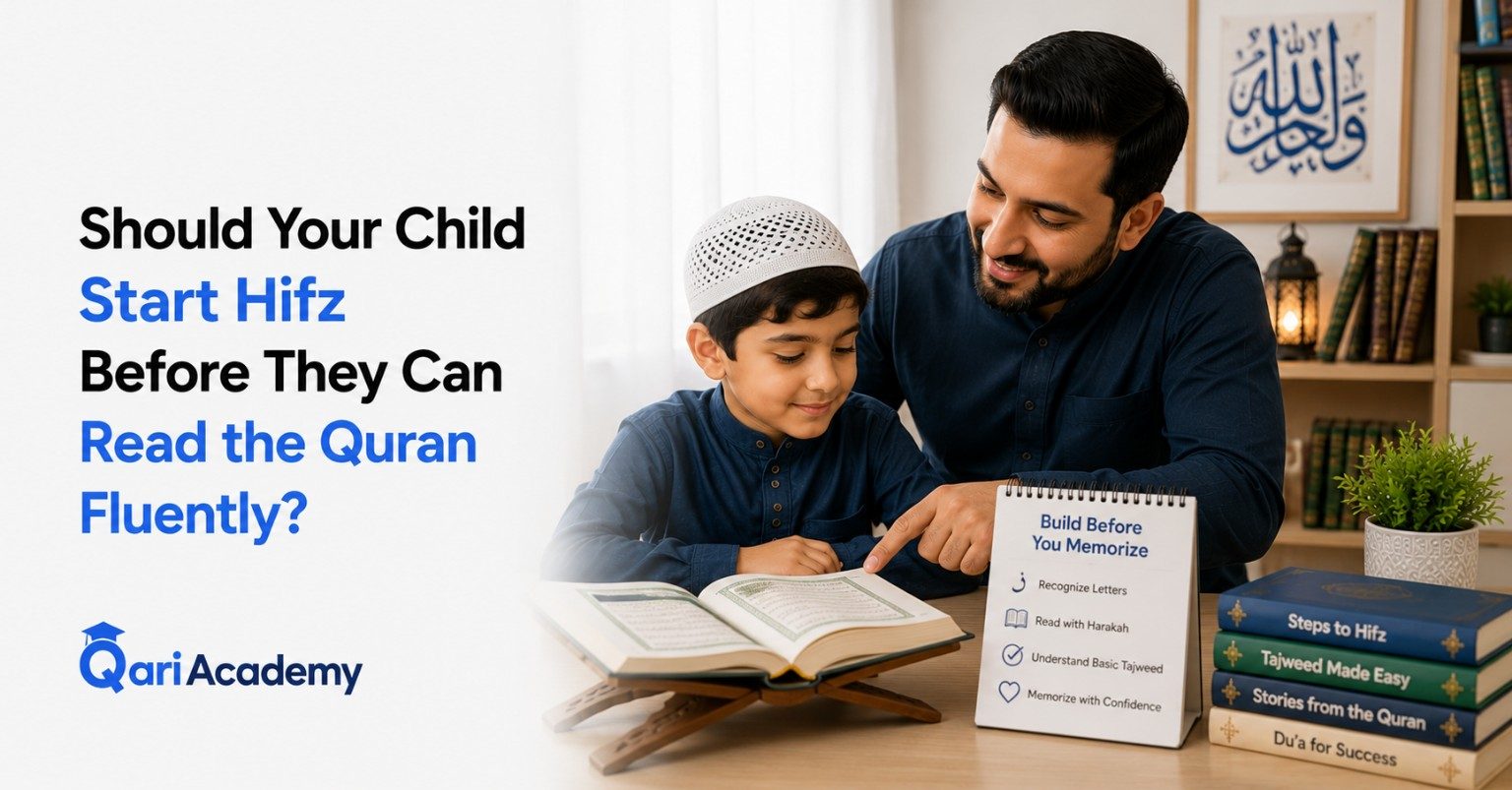
Should your child start Hifz before they can read the Quran fluently? Many Muslim parents in the USA, UK, Canada, and Australia ask this question when their child can memorize short surahs but still reads Arabic slowly.
The answer is not simply yes or no.
A child does not necessarily need perfect Quran reading fluency before beginning memorization. However, there is an important difference between introducing small amounts of Hifz while reading skills are developing and expecting a child with very weak reading foundations to handle an intensive Hifz program.
For children growing up in English-speaking environments, this distinction is especially important. They may speak English all day and encounter Arabic mainly during Quran lessons. As a result, they may need to develop Arabic letters, harakat, word recognition, pronunciation, and Tajweed while also learning to memorize.
The better question is:
What level of Quran reading ability does my child need to begin Hifz successfully, and how can reading and memorization develop together?
The Quran describes itself as easy to remember in Surah Al-Qamar 54:17, while Surah Al-Muzzammil 73:4 emphasizes measured recitation. These verses provide a useful framework: encourage memorization, but do not separate it from careful and accurate recitation.
What Does It Mean to Be Ready for Hifz?
Being ready does not mean reading the Quran as quickly as an adult.
It also does not mean having an exceptional memory.
A child may be ready for small amounts of memorization without being ready for an intensive Hifz schedule.
Useful readiness indicators include:
- Basic Quran reading ability
- Reasonable Arabic pronunciation
- Ability to follow correction
- Age-appropriate concentration
- Ability to retain short passages
- Willingness to practice consistently
A child does not need to be perfect in every area. The important question is whether their current skills can support the next stage.
Reading Fluency Is Not the Same as Reading Accuracy
This distinction is critical.
A child may read slowly but accurately. Another may read quickly while making frequent mistakes.
For Hifz preparation, accurate reading is often more important than speed. If a child repeatedly memorizes incorrect pronunciation, those mistakes may become harder to correct later.
Research on reading development shows that foundational skills such as letter knowledge, word reading, and phonological skills are associated with later reading development.
This does not mean your child must wait for perfect fluency before memorizing.
Instead, identify the actual weakness.
| Child’s Current Ability | What It May Mean | Recommended Focus |
|---|---|---|
| Recognizes letters and harakat | Reading foundation developing | Qaida + short Hifz |
| Reads simple words slowly | Can connect reading and memory | Reading + short surahs |
| Reads with some mistakes | Developing Quran reading | Tajweed + gradual Hifz |
| Reads accurately but slowly | Accuracy is established | Fluency + Hifz |
| Reads independently | Strong foundation | Structured Hifz + revision |
| Struggles with basic letters | Foundation is weak | Alphabet + Qaida first |
The key point is simple:
Slow reading does not automatically mean a child is not ready for Hifz.
Can a Child Start Hifz Before Reading the Quran Fluently?
Yes, in some cases.
If your child can recognize Arabic letters, understand basic harakat, read simple combinations, imitate accurate recitation, and retain short passages, a teacher may introduce modest memorization while reading continues to improve.
This can work particularly well when the child enjoys memorizing short surahs.
However, Hifz should not become a replacement for learning to read.
A child who memorizes everything through listening but cannot recognize the same words in the Mushaf may become dependent on audio or teacher prompts.
A better process is:
Read → Listen → Repeat → Memorize → Review → Read Again
This connects the child’s memory to the written Quran.
When Should Reading Come First?
Parents should prioritize reading foundations when a child:
- Frequently confuses Arabic letters
- Struggles with basic harakat
- Cannot follow the Mushaf
- Has significant pronunciation difficulties
- Memorizes entirely through sound
- Becomes frustrated when reading
- Cannot read even familiar passages
This does not necessarily mean stopping all memorization.
A child may still memorize short surahs for Salah while receiving stronger reading instruction.
The goal is to avoid building a large Hifz portion on a weak reading foundation.
When Early Hifz Can Be Helpful
Starting modest Hifz before full reading fluency may be appropriate when:
- The child enjoys repeating Quran.
- Most Arabic letters can be pronounced reasonably well.
- Basic harakat are understood.
- Short passages can be retained.
- The teacher can correct errors.
- Reading continues alongside memorization.
- The workload is appropriate for the child’s age.
For example, a seven-year-old who reads slowly but can recognize simple Quranic words may be able to memorize short surahs while continuing Qaida and reading practice.
The objective is not rapid completion.
It is developing a healthy connection between seeing, hearing, reading, reciting, and remembering.
Why Reading From the Mushaf Matters During Hifz
Listening is extremely valuable, but it should not be the only method.
Suppose a child memorizes:
“Alhamdu lillahi rabbil ‘alamin”
perfectly by listening but cannot identify the phrase on the page.
The child has developed auditory memorization but not the same level of visual Quran recognition.
A stronger approach is to have the child:
- Look at the verse.
- Listen to accurate recitation.
- Read it aloud.
- Repeat it.
- Recite without looking.
- Check the Mushaf for mistakes.
- Review it later.
This gradually connects sound with written text.
How Much Quran Should a Child Memorize?
There is no universal weekly target.
The better question is:
How much can my child memorize accurately while retaining previous material?
One child may manage several lines.
Another may manage a short surah.
Another may need most of the lesson for reading and revision.
| Practice Area | Example Frequency | Purpose |
|---|---|---|
| New Hifz | 3–5 days | Add manageable material |
| Recent revision | Daily | Strengthen new learning |
| Older revision | 2–4 days | Protect previous Hifz |
| Quran reading | Several days | Build fluency |
| Tajweed | Throughout lessons | Improve accuracy |
| Listening | As appropriate | Reinforce correct recitation |
These are examples, not fixed rules. The teacher should adjust the workload according to age, reading level, retention, and schedule.
What If My Child Memorizes Quickly but Reads Slowly?
This can actually be a strength—if the reading weakness is addressed.
Strong auditory memory may allow a child to memorize a surah after repeated listening. But parents should then ask:
- Can the child find the verse in the Mushaf?
- Can they recognize repeated words?
- Can they follow the text while listening?
- Can they read a familiar memorized passage?
- Can they read unfamiliar words?
If the answer to these questions is mostly no, reading needs more attention.
Do not confuse strong memory with strong Quran literacy.
They are related skills, but they are not identical.
How Tajweed Fits Into Early Hifz
A child does not need advanced Tajweed knowledge before memorizing Quran.
However, important pronunciation problems should be corrected from the beginning.
Early priorities can include:
- Correct Arabic letter sounds
- Basic Makharij
- Harakat
- Clear pronunciation
- Basic Madd
- Appropriate stopping and starting
More advanced Tajweed can develop gradually.
The principle is not perfection before memorization.
It is accuracy throughout memorization.
Surah Al-Muzzammil 73:4 instructs believers to recite the Quran with measured recitation, reinforcing the importance of careful recitation rather than rushing through the material.
Common Parent Mistakes
Parents usually make these mistakes because they want their children to progress quickly.
1. Waiting for Perfect Fluency
A child may be ready for small amounts of Hifz long before becoming a fluent reader.
2. Starting Too Much Hifz Too Soon
A large memorization target can become counterproductive if the child cannot maintain previous material.
3. Using Audio Only
Listening should support reading, not replace it.
4. Ignoring Pronunciation
Repeated errors should be corrected before they become deeply established.
5. Comparing Children
One child may memorize quickly while another needs more reading practice.
6. Measuring Only Pages
A smaller amount of strong, retained Hifz is more meaningful than a larger amount that disappears quickly.
| Mistake | Problem | Better Approach |
|---|---|---|
| Waiting for perfect fluency | Delays useful memorization | Start gradually when foundations allow |
| Too much new material | Weakens retention | Balance Hifz and revision |
| Audio only | Reading develops slowly | Combine audio and Mushaf |
| Ignoring pronunciation | Mistakes become habits | Correct errors early |
| Comparing children | Creates unnecessary pressure | Track individual progress |
| Focusing on quantity | Progress becomes number-driven | Measure accuracy and retention |
A Simple Home Readiness Test
You do not need a formal assessment.
Choose a short passage appropriate for your child’s level.
Ask them to:
- Identify several Arabic letters.
- Read simple words.
- Recognize basic harakat.
- Read a short Quranic phrase.
- Repeat the phrase after you.
- Recite a familiar surah.
- Follow the Mushaf while listening.
- Recite the passage without looking.
- Repeat it again the next day.
The final step is particularly useful.
A child who memorizes quickly but forgets everything the next day may need more revision and a smaller workload.
A child who memorizes slowly but retains the material may be ready for gradual Hifz.
A Practical 30-Day Preparation Plan
If you are unsure, use one month to observe your child’s readiness.
Week 1: Reading Foundation
Focus on:
- Arabic letters
- Harakat
- Simple words
- Short Quranic phrases
Week 2: Reading + Listening
Have the child follow the Mushaf while listening, then read and repeat a short passage.
Week 3: Small Hifz
Introduce a manageable amount of memorization and observe retention.
Week 4: Evaluate
Ask:
- Is reading improving?
- Is pronunciation becoming more accurate?
- Can the child retain previous material?
- Are fewer prompts needed?
- Is the child willing to continue?
| Week | Main Goal | What to Observe |
|---|---|---|
| Week 1 | Reading | Letter and word recognition |
| Week 2 | Reading + listening | Visual tracking |
| Week 3 | Small Hifz | Memory and retention |
| Week 4 | Evaluation | Overall readiness |
This is not a pass-or-fail test. It is a way to understand what your child needs next.
Should Hifz and Quran Reading Be Separate Goals?
Not necessarily.
For many children, they should develop together.
Think of Quran learning as several connected skills:
Reading helps the child recognize the written Quran.
Tajweed helps the child recite accurately.
Hifz helps the child retain what they learn.
Quranic Arabic can help them become more familiar with recurring vocabulary.
A practical progression might look like:
Arabic Alphabet → Qaida → Quran Reading → Basic Tajweed → Short Hifz → Expanded Hifz + Revision
But children do not always follow the same path.
One child may memorize Juz Amma while improving reading fluency. Another may need several months of Qaida first.
The teacher’s job is to determine the most useful next step.
How QariAcademy Can Support the Process
QariAcademy offers one-on-one Online Quran Classes for children, allowing the lesson to be adapted to the student’s current level.
For a child who is not yet fluent, the question should not simply be:
“Can my child start Hifz?”
Instead:
“What does my child need right now?”
That may be:
- Quran Reading
- Arabic Alphabet or Qaida
- Tajweed
- Hifz
- Quranic Arabic
A child with stronger reading skills may spend more time on Hifz. Another may need to strengthen reading and pronunciation before increasing memorization.
This individualized approach is particularly useful for families in the USA, UK, Canada, Australia, and other English-speaking environments.
Research on Quran education for children with different learning needs also highlights the importance of graded activities, appropriate teaching aids, and adapting instruction to the learner’s abilities.
A Free Trial can give parents an opportunity to see how their child responds to the teacher and whether the lesson level is appropriate.
How Parents Can Support Hifz Between Lessons
Parents do not need to become Quran teachers.
Their role can be much simpler:
Keep the routine consistent.
For example:
- 5 minutes reviewing yesterday’s lesson
- 5 minutes reading from the Mushaf
- 5 minutes listening to the assigned passage
- 5 minutes reciting independently
Some children need less. Others need more.
The goal is not to create another school session at home.
The goal is to make Quran practice predictable and manageable.
Specific encouragement can also help.
Instead of:
“Good job.”
try:
“You remembered that verse without any help today.”
This helps children recognize their own progress.
What If My Child Is Older?
It is not too late.
An older child or teenager may actually have advantages such as:
- Better concentration
- Stronger reading ability
- Greater independence
- Better study habits
Their main challenge may be time.
School, exams, sports, and other responsibilities can make consistency difficult.
The answer is not necessarily an intensive program.
A realistic schedule with small, regular goals can still produce meaningful progress.
Final Thoughts: Should Your Child Start Hifz Before They Can Read the Quran Fluently?
So, should your child start Hifz before they can read the Quran fluently?
Sometimes yes—but not without considering their foundations.
A child who reads slowly but accurately, recognizes basic Arabic patterns, can follow correction, and can retain short passages may be ready to begin modest Hifz while continuing to develop reading fluency.
A child who still struggles significantly with Arabic letters, harakat, or pronunciation may benefit from strengthening those foundations before taking on a larger Hifz workload.
The mistake is thinking that parents must choose between two extremes:
Wait for perfect reading
or
Start intensive Hifz immediately.
There is a better option.
Develop reading and Hifz together at a pace the child can sustain.
For children growing up in English-speaking environments, this balanced approach can be particularly valuable. They may need additional Arabic reading support while still having a strong desire to memorize and connect with the Quran.
Do not measure your child’s Quran journey only by pages memorized.
Look at:
- Accuracy
- Retention
- Reading ability
- Pronunciation
- Independence
- Consistency
- Motivation
The Quran describes itself as made easy for remembrance, but that does not mean every child will progress at the same speed.
The goal is not to make your child memorize as much as possible as quickly as possible.
The goal is to help them develop accurate, sustainable, and meaningful Quran learning.
QariAcademy provides one-on-one Online Quran Classes for children, with lessons adapted to the student’s level and needs. Depending on the child’s stage, lessons can focus on Quran Reading, Tajweed, Hifz, or Quranic Arabic.
If you are unsure where your child should begin, a Free Trial can help you understand their current level and identify a suitable learning path.
Book a Free Trial With QariAcademy:
Book a Free Trial With QariAcademy
Sources and Further Reading
- Quran.com — Surah Al-Qamar 54:17 — Quranic guidance concerning ease for remembrance.
- Quran.com — Surah Al-Muzzammil 73:4 — Guidance concerning measured Quranic recitation.
- PubMed — Developmental Profiles of Reading Fluency — Research on reading development and early predictors of reading difficulties.
- PubMed — Quran Learning for Children With Learning Disabilities — Research discussing individualized and graded approaches to Quran education.