Table of Contents
Introduction
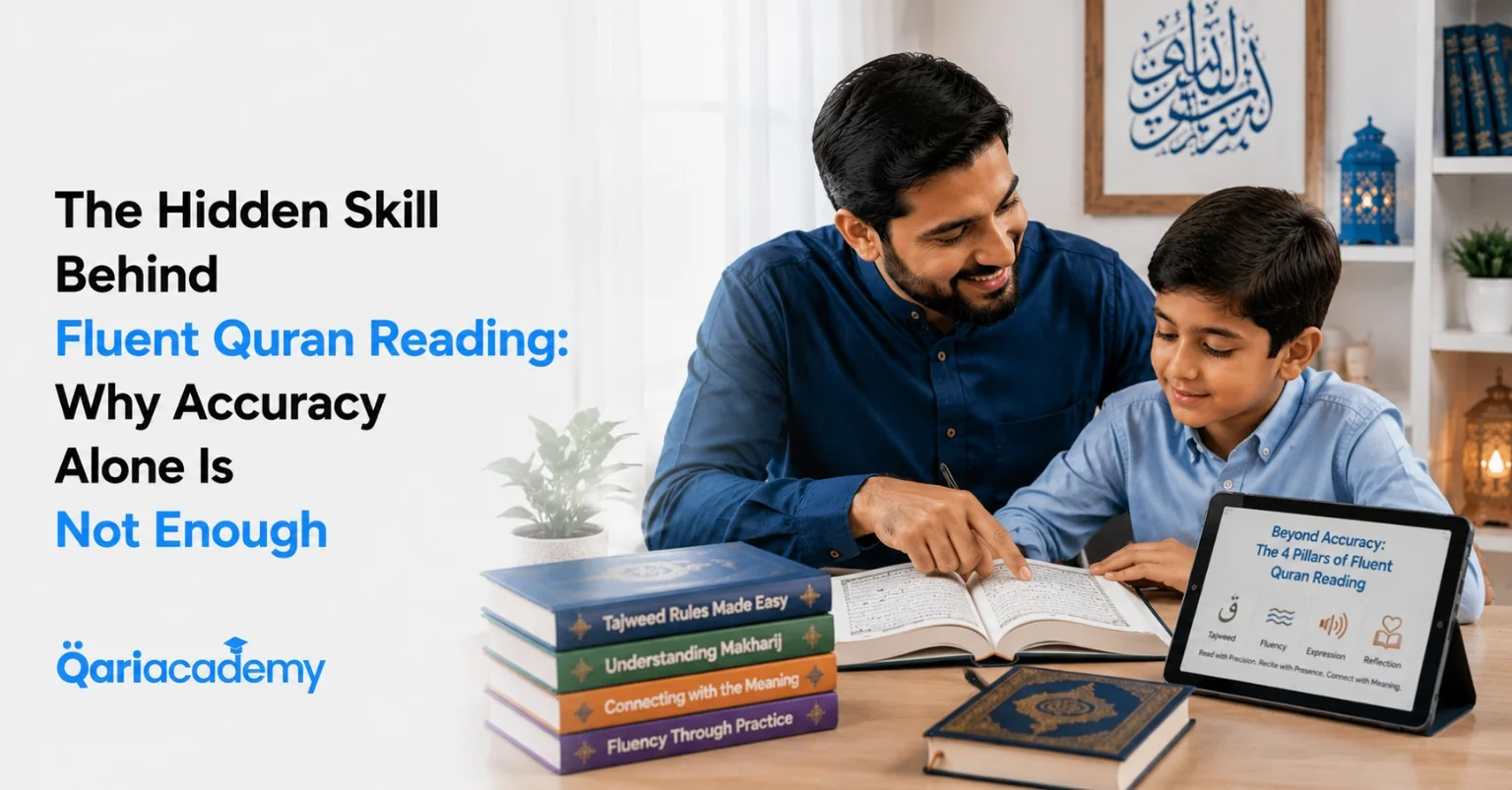
The hidden skill behind fluent Quran reading is not simply memorizing more words or correcting every pronunciation mistake.
It is automaticity: the ability to recognize familiar Arabic patterns, decode words, apply learned Tajweed rules, and continue reading without consciously stopping to analyze every letter.
This is why two children can have similar accuracy but very different levels of fluency.
One child may read a passage correctly, but pause before almost every word and wait for the teacher whenever something looks unfamiliar.
Another child may make an occasional minor mistake, yet continue reading naturally, recognize patterns quickly, and correct themselves when prompted.
Which child is closer to fluent Quran reading?
Usually, the second.
Accuracy matters enormously. A child should not simply read quickly while consistently mispronouncing letters or ignoring Tajweed. But accuracy and fluency are not the same skill.
Strong Quran reading develops when accuracy becomes increasingly automatic.
That requires repeated exposure, meaningful practice, appropriate correction, revision, and gradually reducing dependence on the teacher.
What Is the Difference Between Accuracy and Fluency?
Accuracy answers:
“Did the child read this correctly?”
Fluency asks a broader question:
“Can the child read accurately enough, smoothly enough, and independently enough to maintain the flow of the passage?”
| Skill | What It Looks Like | What the Child Needs |
|---|---|---|
| Accuracy | Correct pronunciation and vowels | Careful instruction |
| Fluency | Smooth, consistent reading | Repeated practice |
| Independence | Less reliance on prompts | Guided-to-independent learning |
| Self-correction | Notices some mistakes | Feedback and reflection |
A child can therefore be accurate without being fluent.
For example, imagine a child reading:
الْحَمْدُ لِلَّهِ رَبِّ الْعَالَمِينَ
The child may pronounce every word correctly but pause dramatically between each one because they are decoding each part from scratch.
That is accurate reading.
Fluency develops when recognition becomes faster and the child no longer needs to consciously process every basic element.
The Hidden Skill: Automatic Recognition
When children first learn Arabic reading, almost everything requires conscious effort.
They may think:
- What letter is that?
- What is its Harakah?
- Does it connect?
- Is there a Shaddah?
- Is this Madd?
- How should I pronounce it?
- What comes next?
That is normal for beginners.
But if the child still processes every familiar word this way months or years later, reading will remain slow and mentally exhausting.
The brain needs repeated exposure to develop increasingly automatic recognition.
The child eventually sees a familiar Quranic pattern and recognizes it as a whole rather than rebuilding it letter by letter.
This is one reason repetition matters so much.
It is not merely about remembering yesterday’s lesson.
It is about making previously learned skills easier to retrieve.
Why a Child Can Read Correctly but Still Struggle
Several factors can produce this situation.
1. The Child Is Still Decoding Every Word
They know the letters but have not developed enough automatic recognition.
2. Practice Is Too Inconsistent
Skills that are learned but rarely used remain slow.
3. The Child Relies on Teacher Prompts
If someone always supplies the answer, the child has fewer opportunities to develop independent retrieval.
4. The Child Has Weak Reading Foundations
Problems with Harakat, connected letters, or pronunciation can slow everything that comes afterward.
5. The Child Is Focused on Avoiding Mistakes
Excessive fear of being wrong can make the child hesitate before every word.
QariAcademy’s article Quran Learning Mistakes Parents Should Avoid with Kids identifies several issues that can slow children’s development, including neglecting Tajweed, teaching without structure, insufficient revision, excessive strictness, and overly long sessions.
Fluency Is Built Through Repeated Retrieval
A child does not become fluent simply because a teacher explained a reading rule correctly.
They need to retrieve that rule repeatedly.
A useful progression is:
Learn → Practice → Repeat → Apply → Retrieve Automatically
For example, the child learns a particular Tajweed pattern.
At first, the teacher reminds them.
Later, the teacher asks:
“Which rule is this?”
Eventually, the child applies it without thinking consciously about the terminology.
That is a sign that learning is becoming more automatic.
Revision Is Not Just for Hifz
Many parents associate revision primarily with memorization.
But revision is equally important for reading fluency.
Repeated reading helps strengthen:
- Word recognition
- Pronunciation
- Tajweed application
- Reading rhythm
- Confidence
- Speed of retrieval
This does not mean racing through the Quran.
The goal is smooth and accurate reading, not maximum speed.
QariAcademy’s 5 Smart Ways to Measure Your Childs Quran and Arabic Progress Without Traditional Tests specifically emphasizes tracking consistency rather than looking only at accuracy and using regular teacher feedback to understand real progress.
Why Repeating the Same Passage Can Be Useful
Parents sometimes worry:
“My child already read this page. Why read it again?”
Because the second reading may serve a different purpose.
The first reading may develop:
Decoding
The second may strengthen:
Accuracy
The third may improve:
Fluency
Later readings can help with:
Tajweed and confidence
The objective is not to make the child memorize the page accidentally.
It is to reduce the mental effort required to read it.
Accuracy Still Comes First
There is an important warning here.
Fluency should not become an excuse for rushing.
A child who reads quickly but consistently confuses:
س and ص
or:
ت and ط
has not achieved strong Quran reading fluency.
Likewise, ignoring Madd, Ghunnah, Qalqalah, or other relevant Tajweed principles simply to increase speed is the wrong trade-off.
A better model is:
Accuracy → Repetition → Automaticity → Fluency
QariAcademy’s Quran Tajweed for Kids program describes its goals as helping children recognize and apply Tajweed rules, read Quranic verses accurately and fluently, and recite with confidence and independence.
The Role of Tajweed in Fluent Reading
Tajweed is not only about theoretical rules.
For a developing reader, Tajweed provides a framework for consistent pronunciation.
Children gradually learn how to recognize and apply things such as:
- Makharij
- Sifat al-Huroof
- Madd
- Ghunnah
- Qalqalah
- Noon Sakinah
- Tanween
- Meem Sakinah
- Waqf and Ibtida
But the child should not be forced to consciously analyze every rule while reading every word.
The long-term goal is application.
Know the rule → Practice the rule → Apply the rule → Internalize the pattern
QariAcademy’s The Secret to Teaching Kids Makharij Al-Huroof focuses on developing correct articulation through repetition, gentle correction, and practical activities.
Fluent Reading Requires Independence
Another hidden component of fluency is independence.
A child who waits for the teacher before attempting every difficult word may have reasonable accuracy but limited reading independence.
A stronger progression is:
| Stage | Child’s Behavior | Teacher’s Support |
|---|---|---|
| Beginner | Waits for the model | High |
| Developing | Attempts with prompts | Moderate |
| Growing fluency | Reads independently | Targeted |
| Strong reader | Self-corrects some mistakes | Occasional |
| Advanced learner | Monitors own reading | Coaching |
This is why correcting every single word immediately can sometimes become counterproductive.
The child needs opportunities to think before receiving the answer.
Instead of immediately saying the correct word, a teacher can ask:
“Try it.”
“Look at the Harakah.”
“Check the letter.”
“Read it again.”
That small pause creates an opportunity for independent retrieval.
What Parents Should Listen For
Parents do not need to become Tajweed experts to recognize signs of developing fluency.
Listen for:
- Fewer unnecessary pauses
- Less dependence on prompts
- Faster recognition of familiar words
- More consistent pronunciation
- Better application of learned rules
- Ability to continue after a mistake
- Occasional self-correction
- Greater confidence with unfamiliar passages
| Weak Indicator | Stronger Indicator |
|---|---|
| Pages completed | Reading ability improved |
| Fast recitation | Smooth and accurate recitation |
| Teacher says every word | Child attempts independently |
| New material only | New material + revision |
| Memorized passages | Independent reading |
| Few mistakes with heavy prompting | Fewer mistakes with less support |
This is a much better way to evaluate development than simply counting pages.
How Parents Can Help Without Becoming the Teacher
Parents have an important role, but they do not need to correct every technical detail.
A healthier routine is:
- Give the child a short passage to read.
- Let them attempt it independently.
- Avoid interrupting every few seconds.
- Notice recurring difficulties.
- Share those difficulties with the teacher.
- Encourage the child to practice the assigned material.
QariAcademy’s How to Support Your Child’s Quran Learning Online recommends creating a consistent routine, encouraging children, communicating with tutors, and supporting the learning environment at home.
The parent’s job is primarily to support consistency and motivation, while the teacher handles detailed instruction and correction.
Focus Also Affects Fluency
A child cannot develop smooth reading if they spend most of the lesson distracted.
But the answer is not necessarily to demand longer concentration.
Sometimes the lesson itself needs better structure.
QariAcademy’s Effective Techniques to Enhance Children’s Focus During Quran Classes recommends manageable lesson segments, interactive techniques, consistent routines, clear goals, and positive reinforcement.
For younger learners, the same principle appears in Make Quran Learning Fun for Kids Online, which discusses active participation, short focused sessions, repetition, and positive reinforcement.
The lesson should create enough focused practice for fluency to develop.
Don’t Chase Speed
This is one of the biggest misconceptions about fluent Quran reading.
Fast reading is not automatically fluent reading.
A child who races through a passage while making repeated pronunciation errors has not necessarily developed stronger Quran reading skills.
Fluency is better understood as:
Accuracy + Smoothness + Appropriate Pace + Independence + Consistency
The appropriate pace will differ between children and between different levels of reading.
A beginner should naturally be slower.
As skills become more automatic, the child can become smoother without deliberately forcing speed.
How One-on-One Lessons Can Help
Individualized teaching can be particularly useful because not every child has the same bottleneck.
One child may need:
More reading repetition
Another may need:
Makharij correction
Another may need:
Tajweed reinforcement
Another may need:
Confidence and independent attempts
A group curriculum may not always have enough flexibility to address the specific reason a child is struggling.
QariAcademy’s online Quran classes provide one-on-one instruction tailored to the student’s level and pace, with teachers focusing on areas such as Tajweed, Hifz, and Quranic Arabic.
A Practical Fluency-Building Routine
A short practice routine can be structured around four stages:
1. Review
Read a previously learned passage.
2. Accuracy Practice
Focus on one or two recurring pronunciation or Tajweed issues.
3. Fluency Reading
Read the passage again without unnecessary interruption.
4. Reflection
Ask the child:
“What was easier this time?”
“What word was difficult?”
“Did you notice any mistake yourself?”
This final step is particularly valuable because it turns the child into an active participant in their learning.
What Progress Should Look Like Over Time
Progress is rarely linear.
A child may spend several weeks appearing to make little improvement and then suddenly become noticeably smoother.
Look for gradual changes.
| Earlier Stage | Developing Stage | Stronger Stage |
|---|---|---|
| Decodes letter by letter | Recognizes familiar patterns | Recognizes many words quickly |
| Frequent pauses | Fewer pauses | Natural reading flow |
| Constant prompts | Occasional prompts | Mostly independent |
| Teacher corrects mistakes | Child responds to correction | Child self-corrects some errors |
| Focuses on individual sounds | Applies patterns | Reads passages more naturally |
The important question is not:
“Is my child reading as fast as another child?”
It is:
“Is my child becoming more accurate, more automatic, and more independent than they were before?”
When Should Parents Consider Changing the Approach?
If a child has been studying for a long period but remains heavily dependent on prompts, investigate the process before blaming the child.
Ask:
- Is the child getting enough practice?
- Is the material at the right level?
- Is the teacher allowing independent attempts?
- Is revision consistent?
- Are pronunciation problems being addressed?
- Is the child anxious about making mistakes?
- Are lessons too long or repetitive?
- Does the child understand what they are practicing?
Sometimes the child needs more repetition.
Sometimes the curriculum needs adjustment.
Sometimes the teacher needs to change the level of support.
Sometimes the child simply needs time.
Frequently Asked Questions
Is reading fast the same as Quran reading fluency?
No. Fluency includes accuracy, smoothness, appropriate pacing, independence, and consistent application of learned reading and Tajweed skills.
Why does my child read correctly with the teacher but struggle alone?
The child may still depend on teacher prompts. They need opportunities to attempt passages independently and gradually develop automatic recognition.
Should I correct every mistake immediately?
Not always. Some mistakes should be corrected immediately, particularly important pronunciation errors, but allowing the child to attempt and self-correct can help develop independence.
How can I improve my child’s Quran reading fluency?
Use regular reading practice, revision, targeted Tajweed correction, repeated exposure to familiar passages, and gradually reduce teacher prompting.
Does Tajweed make Quran reading slower?
Initially, learning Tajweed may require more attention. With practice, correct application can become increasingly automatic and support more confident, accurate recitation.
How do I know whether my child is actually improving?
Look beyond pages completed. Track accuracy, fluency, independence, self-correction, consistency, pronunciation, and retention over time.
Conclusion
The hidden skill behind fluent Quran reading is not simply accuracy.
It is the gradual development of automatic, independent reading.
A child first learns to recognize letters.
Then they learn to decode them.
Then they learn to apply Tajweed.
Then, through repeated and meaningful practice, those skills become increasingly automatic.
Eventually, the child can look at Quranic text without consciously analyzing every basic element.
That is when reading begins to feel natural.
The path is:
Learn → Practice → Repeat → Apply → Internalize → Read Independently
Parents should therefore resist two extremes.
Do not sacrifice accuracy in pursuit of speed.
But do not mistake constant correction for successful learning either.
The real objective is to build a child who can read accurately and increasingly without depending on someone else to tell them what to do.
That is why progress should be measured not only by how many pages a child completes, but by whether they are becoming more accurate, more fluent, more confident, and more independent.
For families looking for individualized support, QariAcademy’s one-on-one Quran programs are designed to develop Quran reading, Tajweed, confidence, and fluency according to the student’s level and pace.
Explore QariAcademy’s Online Quran Programs
Internal Articles Used — 10 Verified QariAcademy Articles
- Quran Learning Mistakes Parents Should Avoid with Kids
Open Article - 5 Smart Ways to Measure Your Childs Quran and Arabic Progress Without Traditional Tests
Open Article - Effective Techniques to Enhance Children’s Focus During Quran Classes
Open Article - Make Quran Learning Fun for Kids Online
Open Article - How to Support Your Child’s Quran Learning Online
Open Article - The Secret to Teaching Kids Makharij Al-Huroof (Articulation Points) Easily
Open Article - Tajweed for Kids: A Parent’s Guide
Open Article - Quran Tajweed Step-by-Step: 30-Day Plan for Kids
Open Article - How Busy Parents Can Keep Their Children Consistent With Quran Learning
Open Article - Top 5 Mistakes Parents Make Teaching Surah Al-Ikhlas
Open Article
Reliable External Sources
- Quran 73:4 — Quran.com — relevant to measured and deliberate Quran recitation.
- Quran 75:16–19 — Quran.com — relevant to listening, recitation, and the process of learning the revelation.