Table of Contents
Introduction: Navigating Islamic Education in Modern Britain
Raising children with strong Islamic values, fluent Arabic reading skills, and an authentic connection to the Holy Quran is one of the most sacred and cherished aspirations for British Muslim families.
United Kingdom cities—from vibrant hubs like London, Birmingham, and Manchester to Bradford, Leicester, and Leeds—house rich, diverse Muslim communities. British Muslims contribute significantly to academic, medical, corporate, and civic spheres across the UK. Children attend high-performing state or independent primary and secondary schools, engage in competitive sports leagues, and participate in local community activities.
However, balancing rigorous UK academic commitments (Key Stages 1 through 4, GCSEs, and A-Levels) with traditional evening religious education presents a growing challenge for modern parents.
Historically, the primary avenue for Islamic education in Britain was the local Madrasah—a traditional evening school held at the local mosque between 5:00 PM and 7:00 PM on weekdays or during weekend mornings. While local masjids continue to serve as essential spiritual anchors for the Ummah, many parents find that traditional madrasah structures struggle to accommodate the fast-paced realities of modern British life.
Commuting through heavy UK traffic after a long school day, navigating unpredictable British weather, dealing with high student-to-teacher ratios in crowded classrooms, and managing fatigue before school homework often leads to burnout for young children.
This structural gap has fueled the rapid rise of Online Quran Classes UK.
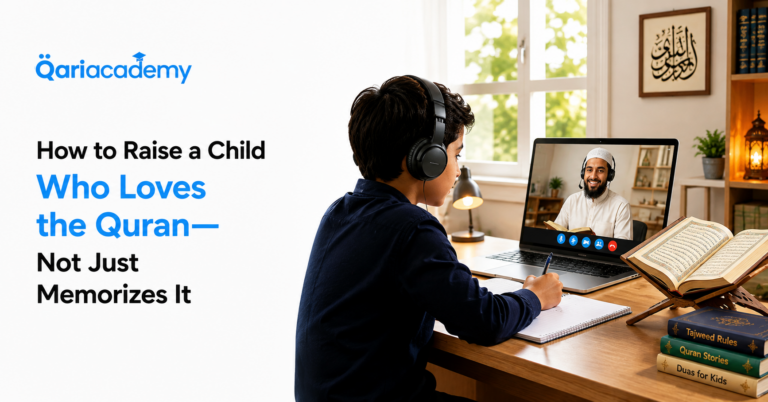
Far from being a simple alternative, modern online learning has established itself as the gold standard in Quranic pedagogy for UK households. Through structured, one-on-one virtual classrooms, children and adults across England, Scotland, Wales, and Northern Ireland can connect directly with highly qualified, English-fluent, certified Quran scholars from the comfort and safety of home.
This ultimate guide explores everything British Muslim parents need to know about structuring a high-yield, stress-free Quranic education that harmonizes perfectly with the UK school system, British Summer Time (BST) / Greenwich Mean Time (GMT) schedules, and long-term academic excellence.
Part 1: Why British Muslim Families Are Transitioning from Local Madrasahs to Online Learning
To understand why thousands of households across the United Kingdom are making the shift to learn Quran online UK, we must objectively examine the daily operational realities facing British parents.
Traditional UK Madrasah vs. Online 1-on-1 Learning
| Metric | Traditional UK Madrasah | Online 1-on-1 Class |
| Student-to-Teacher | 15 – 25 Students | 1 Student (100% Focus) |
| Weekly Commute Time | 3 – 5 Hours in Traffic | 0 Hours (At Home) |
| Lesson Personalization | Fixed, Uniform Pace | Fully Customized |
| Time-Zone Adaptability | Fixed (e.g., 5-7 PM) | Flexible Booking |
| Progress Accountability | Oral / Yearly Report | Digital Reports |
1. High Student-to-Teacher Ratios vs. 1-on-1 Focus
In a typical UK local madrasah, a single teacher or volunteer often oversees a classroom of 15 to 25 children across varying age groups and reading levels. In a two-hour evening session:
- An individual child may sit quietly for 115 minutes waiting for their turn.
- Direct, one-on-one reading time with the teacher often lasts less than 3 to 5 minutes per child.
- Subtle pronunciation mistakes in Tajweed (Makharij al-Huroof) are easily overlooked due to noise and time constraints.
Conversely, private Online Quran Classes UK utilize a dedicated 1-on-1 format. For the entire 30, 45, or 60-minute duration, 100% of the teacher’s attention is focused exclusively on your child. Articulation errors are caught instantly, questions are answered thoroughly, and lesson plans adapt dynamically to the child’s learning pace.
2. Eliminating After-School Commuting and Transit Stress
For working parents in major metropolitan areas such as London (with congested routes along the M25 or A40), Birmingham, or Manchester, driving children to a local mosque during peak rush hour (4:30 PM to 6:30 PM) adds immense physical and mental strain.
During dark, rainy winter months under Greenwich Mean Time (GMT), dragging exhausted primary school children out into cold weather after a full school day creates unnecessary stress. Transitioning to online classes allows children to learn in a warm, comfortable, and safe home environment immediately after enjoying an after-school snack.
3. Adapting to UK Academic Demands (GCSEs & A-Levels)
British school children face rigorous academic milestones:
- Key Stage 1 & 2 (Ages 5–11): SATs preparation and foundational literacy/numeracy.
- Key Stage 3 & 4 (Ages 11–16): Preparation for GCSE examinations.
- Key Stage 5 (Ages 16–18): Intensive A-Level coursework for university admissions.
During exam seasons, traditional evening madrasahs often offer little scheduling flexibility, forcing parents to choose between academic study and Quranic attendance. Structured online platforms allow parents to adjust class frequencies, pause schedules, or shift lesson times around school exam timetables seamlessly.
Part 2: Essential Pedagogical Pillars for UK Native Students
Teaching Quran to children growing up in the United Kingdom requires a nuanced educational approach. British children are native English speakers whose primary mode of thinking, reading, and communicating is rooted in the British National Curriculum.
Pillar 1: English Fluency with Authentic Arabic Phonetics
One of the greatest challenges British parents face when hiring local or unvetted tutors is the language barrier. A scholar may possess deep classical knowledge, but if they speak limited English or struggle with British cultural context, young children feel disconnected.
Premier academies supplying a Quran teacher UK recruit scholars who combine native Arabic articulation with fluent English. They explain complex Tajweed concepts (such as rules of prolongation, heavy letters, or nasalization) using terminology that aligns naturally with how British children learn phonics in UK primary schools.
Pillar 2: Mastery of Articulation Points (Makharij al-Huroof)
The Arabic language contains distinct guttural and heavy letters that do not exist in the English alphabet:
- Ayn (ع) and Ghayn (غ) originating from the middle and upper throat.
- Heavy letters like Taa (ط), Dhad (ض), Saad (ص), and Qaf (ق).
- Soft vs. heavy variations of Raa (ر) and Lām (ل).
Without direct, individualized guidance through foundational texts like Norani Qaida, native English-speaking children tend to substitute English approximate sounds (e.g., pronouncing Haa (ح) as a soft English ‘H’, or Ayn (ع) as a simple ‘A’). 1-on-1 virtual instruction trains the child’s vocal tract through visual diagrams and active repetition until pronunciation becomes flawless.
Pillar 3: Interactive Visual Learning Technology
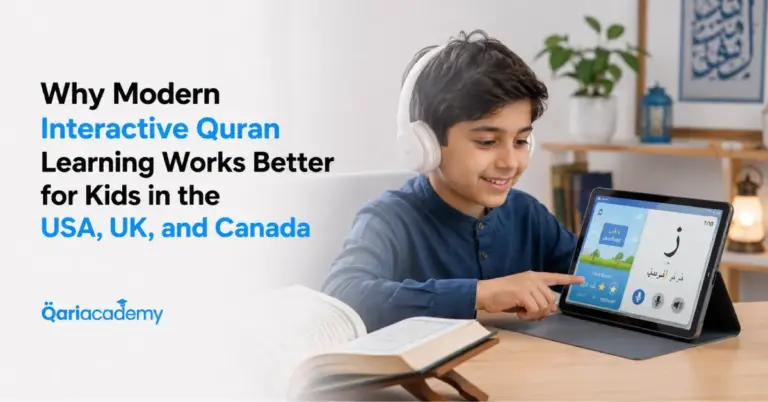
Modern UK school classrooms heavily integrate interactive digital technology (smartboards, visual apps, educational software). Expecting a British child to sit passively staring at a static physical book for an hour without engagement leads to rapid loss of focus.
Leading online platforms utilize color-coded digital Mus-haf interfaces, interactive whiteboards, screen-sharing tools, and digital reward badges to transform Tajweed and Hifz study into an engaging experience.
Part 3: Structuring Quran Education Around UK School Schedules
To establish long-term consistency without overwhelming your child, Quranic study must be integrated smoothly into your family’s weekly routine.
The 3 Optimal UK Time-Slot Models
- Model A: The Post-School Transition (4:30 PM – 6:00 PM BST/GMT)
- Best for: Primary School students (KS1 & KS2). Allows study right after an after-school snack, leaving evenings free for homework.
- Model B: The Early Morning Weekend Routine (8:30 AM – 10:30 AM)
- Best for: High School students (GCSE/A-Levels). Capitalizes on a fresh mind on Saturday/Sunday before weekend activities begin.
- Model C: The Late Evening Focus (7:00 PM – 8:30 PM)
- Best for: Secondary students balancing school sports and homework.
Comparative Analysis: Micro-Lessons vs. Weekly Cramming
Many parents assume that longer lessons yield faster results. However, cognitive science in language acquisition demonstrates that short, frequent touchpoints are exponentially more effective than long, infrequent sessions.
| Learning Dimension | Single Weekly Session (2 Hours) | Micro-Routine Model (30 Mins / 4x Week) |
| Total Weekly Time | 120 Minutes | 120 Minutes |
| Child Focus Level | High for first 20 mins; drops sharply after. | 100% High Focus throughout every session. |
| Memory Retention | Low (7-day gap causes significant loss). | High (Continuous reinforcement every 48 hours). |
| Mental Fatigue | High (Feels like a long chore). | Low (Feels brief, manageable, and natural). |
| Tajweed Muscle Memory | Slow development due to long gaps. | Fast development due to regular muscle activation. |
Part 4: Comprehensive Curriculum Pathways at QariAcademy UK
At QariAcademy, we offer structured, age-appropriate educational tracks designed to guide students from absolute beginners to master reciters and Huffaz.
- LEVEL 1: Norani Qaida & Arabic Phonetics (Foundational Decoding) ↓
- LEVEL 2: Quran Recitation & Applied Tajweed Rules ↓
- LEVEL 3: Systematic Online Hifz Program (Memorization & Revision) ↓
- LEVEL 4: Integrated Islamic Studies & Youth Mentorship
Level 1: Norani Qaida & Basic Phonetics Course
Designed for young children (ages 4 to 8) or adult beginners:
- Alphabet Recognition: Learning individual letter forms, compound shapes (Murakkabat), and joinery rules.
- Vowels & Signs: Mastering short vowels (Fatha, Kasra, Damma), long vowels (Madd), silent letters (Sukoon), doubled letters (Shaddah), and Tanween.
- Phonetic Precision: Training the vocal cords to produce correct classical Arabic articulation (Makharij) from day one.
- Average Duration: 3 to 6 months (based on frequency).
Level 2: Fluent Quran Recitation & Applied Tajweed
Designed for students who can read basic Arabic script but need fluency, speed, and rule application:
- Core Tajweed Rules: Comprehensive application of Noon Sakinah & Tanween (Izh-har, Idgham, Iqlab, Ikhfa), Meem Sakinah rules, and rules of Raa and Lām.
- Proportionate Elongation (Madd): Distinguishing between 2, 4, and 6-vowel elongations accurately.
- Rules of Stopping (Waqf): Understanding Quranic punctuation marks to pause and resume recitation correctly without altering sacred meanings.
- Target Outcome: Smooth, melodious, and error-free reading directly from any page of the Mus-haf.
Level 3: Structured Online Hifz Program (Quran Memorization)
For British students aspiring to memorize portions or the entirety of the Quran, our Online Hifz Program employs a disciplined three-part system:
| Hifz Component | Classical Term | Purpose and Execution |
| 1. New Lesson | Sabaq | New verses assigned daily or weekly, memorized and recited directly to the teacher. |
| 2. Recent Review | Sabqi | Reciting verses memorized over the last 10 to 14 days to lock them into medium-term memory. |
| 3. Old Retention | Manzil / Muraaja’ah | Systematic revision of older chapters memorized months prior to ensure lifelong retention. |
Level 4: Islamic Studies & Character Building for UK Youth
In addition to Quranic recitation, British Muslim youth benefit from understanding their faith in an actionable, inspiring way:
- Prophetic History (Seerah): Lessons from the life of Prophet Muhammad (PBUH) highlighting leadership, mercy, and wisdom.
- Essential Supplications (Duas & Adhkar): Daily prayers for waking up, eating, leaving home, seeking knowledge, and sleeping.
- Pillars of Worship: Practical guidance on performing Wudu (ablution) and Salah correctly according to authentic Sunnah.
- Islamic Character (Akhlaq): Cultivating truthfulness, respect for parents, kindness to neighbors, and resilience in Western academic environments.
Part 5: Specialized Female Quran Tutors for Sisters and Young Girls
A crucial requirement for many British Muslim households is access to qualified, certified female Quran tutors.
Why UK Families Choose Female Instructors at QariAcademy
- Cultural Comfort and Modesty: Many young girls (ages 8 and above), teenage students, and adult sisters feel significantly more comfortable, relaxed, and confident reciting one-on-one with a female educator.
- Sisterly Mentorship: Our female tutors serve as positive spiritual role models, offering guidance on navigating life as a confident Muslim woman in modern Britain.
- Certified Expertise: All female scholars at QariAcademy hold formal Ijazah credentials from respected Islamic institutions (such as Al-Azhar University), ensuring uncompromised educational rigor.
Part 6: Overcoming Common Technical and At-Home Challenges
While virtual learning offers convenience, establishing a clean, structured setup at home ensures your child derives maximum benefit from every session.
1. Creating a Dedicated “Quran Corner”
Studying on a bed, lounging on a sofa, or sitting near a television creates subconscious passivity and invites distraction.
- Recommended Setup: Set up a quiet desk corner equipped with a comfortable chair, adequate lighting, a laptop or tablet at eye level, a physical copy of the Quran (Mus-haf), and a wooden stand (Rehal).
- Psychological Impact: Entering a clean, dedicated space signals academic focus and reverence for the Holy Quran.
2. Audio Optimization for Tajweed Precision
Because Tajweed relies on subtle vocal variations—such as breath control, nasal echo (Ghunnah), and throat resonance—relying on low-quality built-in laptop speakers can mask student errors.
- Actionable Tip: Equip your child with a basic USB or 3.5mm headset featuring an integrated microphone. Headsets eliminate room noise, prevent audio feedback, and allow the tutor to hear every vocal detail with total clarity.
3. Adapting to Seasonal Time Shifts (BST vs. GMT)
In the United Kingdom, clocks change twice a year:
- British Summer Time (BST): Clocks move forward by 1 hour in late March (UTC+1).
- Greenwich Mean Time (GMT): Clocks move back by 1 hour in late October (UTC+0).
Unvetted freelance tutors working from overseas often forget UK seasonal time changes, causing missed classes and scheduling confusion. At QariAcademy, our automated student management system automatically adjusts class schedules to match UK local time year-round.
Comprehensive Frequently Asked Questions (FAQ)
Q1: How do online Quran classes compare in cost to local UK madrasahs?
Answer: While local UK masjids usually charge a nominal monthly fee subsidized by community donations, they involve hidden time and financial costs—including travel expenses, fuel, parking, and lost parental work hours during peak traffic. Online Quran Classes UK offer individual 1-on-1 private tuition with certified scholars at highly competitive rates, providing exceptional value per minute of direct instruction.
Q2: What if my child attends a UK primary school and has no prior Arabic knowledge?
Answer: This is completely normal! The vast majority of our British students do not speak Arabic at home. Our foundational curriculum (Norani Qaida Course) is specifically engineered for native English speakers. Tutors explain concepts clearly in English, building the child’s reading confidence step-by-step from letter identification to fluent Quranic reading.
Q3: Can we choose class times that fit around UK school term times and holidays?
Answer: Yes. Our platform operates 24/7, allowing you to select class slots that suit your family’s routine—whether after school (4:00 PM – 7:00 PM UK time), early mornings, or weekends. During UK school holidays (Half-Terms, Easter, Christmas, and Summer holidays), you can easily adjust or increase lesson frequency through our student portal.
Q4: Are the tutors at QariAcademy background-checked for child safety?
Answer: Yes. Child safety and security are paramount. All tutors at QariAcademy undergo thorough background screening, document verification, and child protection training. Additionally, session logs and administrative quality audits are conducted regularly to maintain strict educational standards.
Q5: What equipment do we need at home to start?
Answer: You only need three basic items:
- A laptop, desktop computer, or tablet (iPad/Android) with a working webcam.
- A stable broadband internet connection.
- A headset with a built-in microphone for clear audio articulation.
Conclusion: Investing in Your Child’s Eternal Success in the UK
As British Muslim parents, you work tirelessly to secure your children’s future in this world—investing in top school catchments, extracurricular tutoring, sporting development, and university savings.
While academic and career success are important, nurturing your child’s relationship with the Quran is the ultimate investment that yields blessings in both this life and the Hereafter. The verses your child memorizes, the Tajweed they perfect, and the Islamic character they build today will serve as an unshakeable moral compass throughout their adult life in Western society.
Online Quran Classes UK provide the modern, flexible, and highly effective bridge connecting your family’s busy British lifestyle with timeless Quranic guidance.
Take the First Step Today with QariAcademy UK
Give your child the lifelong gift of clear, beautiful, and confident Quranic recitation.
Partner with QariAcademy today and experience how our personalized 1-on-1 online classes, English-fluent scholars, and UK-friendly schedules can transform your family’s spiritual journey.
🎁 Claim Your FREE 1-on-1 Trial Lesson Today
Experience our interactive online classroom firsthand with no obligation or credit card required.
👉 [Click Here to Register for Your Free Trial at QariAcademy]