Table of Contents
Your child can recite several surahs from memory. They remember the verses, follow the teacher’s corrections, and may even be making excellent progress in Hifz. But when you ask, “What does this ayah mean?” they look at you and say, “I don’t know.”
If your family speaks English or another language more often than Arabic, this situation may be especially familiar. Your child can memorize Quran accurately without understanding much of the Arabic vocabulary they are reciting.
Is that a problem? Not necessarily—but it is worth paying attention to.
Memorization and understanding are different learning skills. A child may develop one faster than the other, and not understanding every verse does not mean their memorization has been wasted. However, Quran education can become more meaningful when children gradually learn what familiar words and passages mean, at a level suitable for their age and Arabic ability.
The goal is not to make every memorization session a translation lesson. It is to help your child progress from remembering the words to developing a growing understanding of the message.
Is It a Problem If a Child Memorizes Quran Without Understanding It?
It depends on the child’s age, learning stage, and overall Quran education.
A young child who has memorized short surahs but cannot explain their meanings may simply be at an early stage of learning. A child who is still learning Arabic letters or basic Quran reading may need to concentrate on pronunciation, accuracy, and memorization before studying detailed meanings.
On the other hand, if a child has been memorizing for years and has little opportunity to explore the meanings of what they recite, parents may want to discuss how understanding can become a more consistent part of their learning.
The Quran itself encourages reflection. In Surah Sad, Allah describes the Quran as a blessed Book revealed so that people may reflect upon its verses and take heed (Quran 38:29). This highlights the value of engaging with the Quran beyond recitation alone.
That does not mean children must understand every word before they are allowed to memorize it. Recitation, memorization, learning to read Arabic, and understanding meaning can develop alongside one another, with different levels of emphasis at different stages.
Memorization and Understanding Are Not the Same Skill
Consider two children.
- Child A can recite Surah Al-Fil from memory but cannot explain what happened in the surah.
- Child B can recite the same surah and explain, in simple language, the main events it describes.
Both children have achieved something valuable. Child B has also developed an additional layer of understanding.
The purpose is not to label Child A as unsuccessful. It is to identify a possible next learning goal.
| Skill | What it involves | How parents might recognize it |
|---|---|---|
| Recitation | Pronouncing the Quranic text accurately | The child reads with improving accuracy and applies learned pronunciation rules |
| Memorization (Hifz) | Remembering verses and reciting them without looking | The child can recall previously learned passages |
| Quranic Arabic | Recognizing Arabic words and expressions | The child recognizes familiar words in different verses |
| Understanding | Grasping the meaning of words, verses, or a surah’s main message | The child can answer simple, age-appropriate questions about what they recited |
| Reflection and application | Thinking about lessons and connecting them to life | The child can discuss a lesson from a story or identify a relevant good action |
These skills support one another, but they do not automatically develop at the same speed.
Why Can Children Memorize Quran Without Understanding Its Meaning?
There are several common reasons, particularly for children growing up in non-Arabic-speaking households.
1. They Learn Through Listening and Repetition
Children can memorize a passage by listening to a teacher, repeating after them, and practicing it regularly. With enough repetition, they may remember the sequence of sounds and words without knowing the meaning of each word.
This can be a useful part of memorization. It simply means that remembering the passage has not necessarily taught the child its vocabulary.
2. Arabic May Not Be Their Everyday Language
A child who speaks English at school and at home may encounter Quranic Arabic mainly during Quran lessons.
They might recognize Arabic letters and pronounce words correctly while not understanding the vocabulary or sentence structure. Reading and memorizing Arabic text does not automatically produce the same comprehension that comes from learning a language through conversation and explanation.
For this reason, parents should not assume that a child who reads Quran fluently can also understand Arabic fluently.
3. Lessons May Focus Mainly on Completing New Memorization
Some learning plans give most of the available lesson time to new Hifz, correction, and revision. These are important activities, but there may be little time left for explaining vocabulary or discussing meaning.
The answer is not necessarily to stop memorization. The teacher and parent can review the child’s current goals and consider adding short, manageable meaning-focused activities.
4. The Explanations May Be Too Advanced
A detailed tafsir explanation may be difficult for a young child, especially when it uses unfamiliar terminology or assumes knowledge the child has not yet developed.
Children usually benefit from explanations that begin with the main idea, use language they understand, and introduce more detail as they mature.
A child does not need to understand every grammatical structure or scholarly discussion to begin learning what a familiar surah is about.
5. Parents May Not Know How to Teach Meaning at Home
Parents who do not speak Arabic may feel unable to help with Quran understanding. They may be comfortable encouraging recitation but uncertain about explaining vocabulary or answering questions about a verse.
They do not have to become Arabic teachers or tafsir specialists. They can use a reliable translation, age-appropriate explanations, and guidance from a qualified teacher, while referring more complex questions to knowledgeable scholars.
Should You Reduce Memorization and Focus on Understanding Instead?
Not automatically. A better approach is to look at the child’s current level and decide how to balance the different learning goals.
If your child is still building basic reading skills, those foundations may need significant attention. If they already memorize confidently, it may be appropriate to introduce more vocabulary and simple explanations. If memorization is becoming stressful, the overall workload may need adjustment for reasons beyond understanding alone.
| Your child’s current situation | A sensible next step |
|---|---|
| Learning Arabic letters and basic reading | Prioritize reading foundations while keeping memorization manageable |
| Memorizing short surahs successfully | Add a simple explanation of the surah’s main message |
| Memorizing regularly but understanding very little Arabic | Introduce a small amount of Quranic vocabulary alongside Hifz |
| Memorizing quickly but forgetting earlier passages | Strengthen revision before increasing new memorization |
| Becoming frustrated by too many learning goals | Reduce the workload and coordinate priorities with the teacher |
| Already reading, memorizing, and understanding simple passages | Gradually deepen vocabulary, meaning, and reflection |
A balanced Quran learning plan does not need to give equal time to every skill in every lesson. It should make sure that the child’s important needs are not overlooked over the longer term.
For further guidance, read My Child Can Memorize Surahs but Doesn’t Understand Their Meaning. Am I Focusing Too Much on Memorization?.
How Can You Help Your Child Understand What They Memorize?
You can start with a small change: choose a short surah your child already knows and explore its meaning together.
Do not try to turn every recitation into a test. The aim is to connect familiar words with meaning and encourage curiosity.
1. Begin With Surahs Your Child Already Knows
Choose a short surah that your child can recite comfortably. Familiarity with the recitation allows you to focus on understanding without asking the child to learn too many new things at once.
For example, if your child knows Surah Al-Ikhlas, explore its central message about the oneness and uniqueness of Allah. Use a reliable translation and an explanation appropriate for the child’s age.
Ask a simple question such as, “What does this surah teach us about Allah?” Accept an answer that reflects the child’s current level, and add clarification gently if needed.
2. Teach a Few Useful Quranic Words at a Time
You do not need to teach long vocabulary lists. Start with a few words that appear in the surah or verses your child is learning.
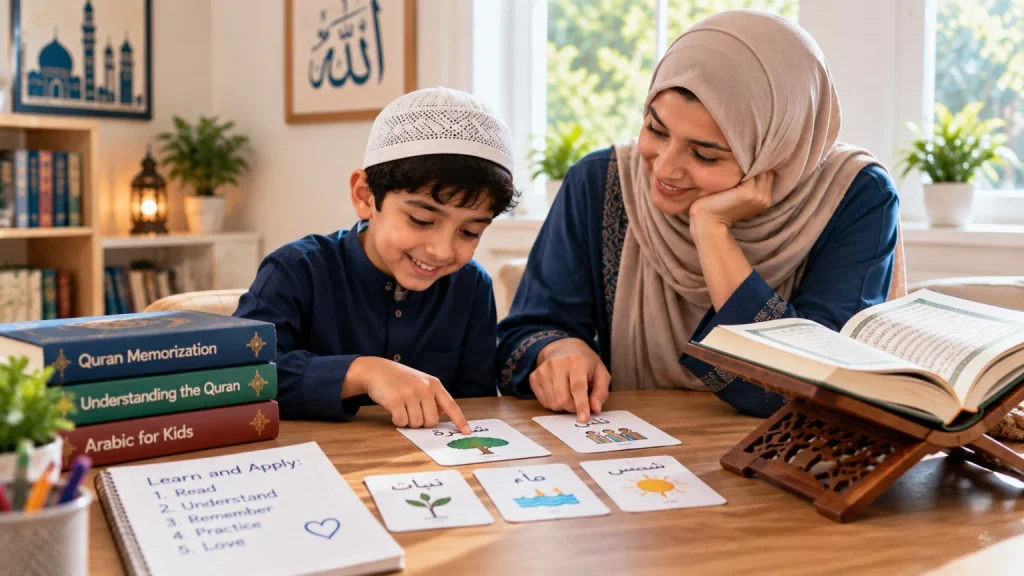
Write the Arabic word, give its meaning in the child’s strongest language, and find it in the Quranic text. Revisit it in later lessons so the child can recognize it again.
| Activity | Example | Learning goal |
|---|---|---|
| Word recognition | Identify a familiar word in a verse | Connect written Arabic with meaning |
| Matching | Match a word with its simple translation | Strengthen vocabulary recall |
| Recitation and meaning | Recite a familiar verse, then discuss its main idea | Connect memorized words with meaning |
| Picture or story prompt | Use an age-appropriate visual to discuss a Quranic story | Support comprehension and recall |
| Review | Find a word learned in an earlier lesson | Build retention over time |
Keep the activity short enough that the child can remain engaged. A few words understood well may be more useful than a long list quickly forgotten.
3. Explain the Main Message Before the Details
Children do not always need a word-by-word explanation as their first step.
Start by explaining the general meaning of a short surah or passage. Then introduce important words or details that help the child understand it better.
For example, when discussing a surah that tells a story, first establish who the story is about and what happened. After that, explore the lesson or meaning in greater depth, using a reliable explanation.
Be careful not to invent details or present a personal interpretation as the definitive meaning of a verse. If a question requires detailed tafsir or scholarly explanation, consult a qualified teacher or trusted tafsir source.
4. Ask Questions That Encourage Thinking
Instead of asking only, “Do you understand?”, try questions that let your child show what they have understood.
- “What is this surah mainly about?”
- “Can you tell me one thing you learned from it?”
- “Do you recognize any words in this verse?”
- “What happened in the story we discussed?”
- “Which part would you like me to explain again?”
A child may understand more than they can express in a full sentence. Give them time, allow them to answer in the language they know best, and avoid making the conversation feel like an exam.
5. Connect the Lesson to Everyday Life When Appropriate
Some Quranic lessons can be discussed through familiar situations, such as telling the truth, showing gratitude, being patient, or treating people fairly.
The connection should be accurate and appropriate to the passage. Do not force a moral lesson onto a verse that does not support it, and do not imply that every verse has an easy one-sentence application.
The aim is to help children see that understanding the Quran can inform how they think and behave, while respecting the meaning and context of the text.
What If You Do Not Speak Arabic Yourself?
You can still support your child’s learning. You do not have to speak Arabic fluently to encourage understanding, ask thoughtful questions, or build a positive routine around Quran study.
Consider these practical options:
- Use a reliable translation. Read the meaning of a short passage together in a language your child understands.
- Ask the teacher for a simple explanation. Request one or two key points from the surah or passage your child is learning.
- Learn alongside your child. It is fine to say, “Let’s look that up together,” instead of pretending to know an answer.
- Keep a small vocabulary notebook. Write down a few familiar words and revisit them each week.
- Use suitable learning materials. Choose resources that identify their sources and explain Quranic meanings carefully.
Avoid relying on random social media posts for religious explanations, particularly when a question involves a ruling, a disputed interpretation, or a complex verse.
If you are considering Arabic lessons as well, remember that learning to read Arabic and learning to understand Quranic Arabic are related but distinct goals. Your child may benefit from developing both gradually, without making the overall schedule overwhelming.
You may find these guides useful:
- My Child Doesn’t Understand Quranic Arabic. Should They Learn It?
- Should My Child Learn Quranic Arabic?
How Should a Quran Teacher Include Understanding in Hifz Lessons?
Parents do not need to redesign the entire learning plan on their own. A conversation with the Quran teacher can help establish what is realistic for the child’s current level.
You could ask the teacher:
- Does my child understand the general meaning of the surahs they have memorized?
- Can we introduce a few age-appropriate Quranic words each week?
- Which short surah would be suitable for discussing meaning?
- How can we add understanding without weakening reading practice or revision?
- What can we do at home to reinforce what is taught in lessons?
A teacher may be able to explain a key word, give a short overview of a surah, or ask one comprehension question during a lesson. The right approach will depend on the child’s age, Arabic skills, memorization goals, and lesson time.
| Lesson component | Possible approach | Why it matters |
|---|---|---|
| New memorization | Learn a manageable portion with accurate recitation | Builds Hifz steadily |
| Revision | Revisit previously memorized passages | Supports long-term retention |
| Reading and Tajweed | Correct pronunciation and reading errors | Develops accurate recitation |
| Meaning | Discuss a few words or the main message of a familiar passage | Builds understanding gradually |
| Progress review | Share strengths and next steps with parents | Keeps the learning plan realistic |
Not every lesson needs to contain a long explanation. Consistency over time is more important than adding so many tasks that the child becomes overwhelmed.
For ideas on assessing progress beyond the number of memorized surahs, see How Can I Tell If My Child Is Making Progress in Quran?.
How Much Quran Understanding Should You Expect at Different Ages?
There is no single age at which every child should understand the same amount. Children’s language backgrounds, learning opportunities, reading skills, and maturity vary.
The following table is a general guide, not a strict developmental standard.
| Stage | A reasonable learning focus | What understanding might look like |
|---|---|---|
| Early learners | Enjoying Quran, learning sounds and short surahs | Recognizing a few familiar words and simple ideas |
| Primary school years | Building reading, memorization, and basic vocabulary | Explaining a short surah’s main message in simple language |
| Preteen years | Expanding vocabulary and discussing themes | Answering more detailed questions about familiar passages |
| Teenagers | Developing deeper reading and reflection skills | Exploring context, themes, and reliable explanations with appropriate guidance |
Do not compare your child with another student who may have a different language background or learning history. Look for steady progress from your child’s own starting point.
Signs Your Child May Need More Support With Understanding
Not understanding every word is not, by itself, a reason for concern. However, the following signs may indicate that the learning plan deserves a closer look:
- Your child has been memorizing for a long time but has had almost no opportunity to discuss meaning.
- They cannot explain even the main idea of a familiar short surah at a level appropriate for their age.
- They are learning new material continuously, but the teacher and parent have not discussed how understanding will develop.
- They seem to believe that Quran learning is only about repeating sounds and finishing a target.
- They have questions about words or passages but do not know whom to ask.
These signs do not mean the child has failed. They are reasons to review the learning approach and identify a realistic next step.
A helpful first action is to ask the teacher for a clear assessment: what does the child already understand, what is appropriate for their age, and what could be added over the next few weeks?
Frequently Asked Questions
Should children understand the meaning of every verse they memorize?
No. Children do not need to understand every word or verse before memorizing it. Their understanding can develop gradually as their language skills, knowledge, and maturity grow. The goal is to make room for age-appropriate meaning and reflection alongside accurate recitation, memorization, and revision.
Should my child stop Hifz until they learn Arabic?
Not necessarily. Memorization and learning Arabic can often continue together. The appropriate balance depends on your child’s reading foundation, current memorization goals, available lesson time, and level of understanding. Discuss the options with the teacher rather than assuming one skill must stop completely.
Is translating the Quran enough to understand it?
A reliable translation can be a useful starting point, but it does not replace all the nuances of the Arabic text or the need for context and tafsir. For children, translations and explanations should be age-appropriate. More complex questions should be addressed with qualified teachers or trusted scholarly resources.
How can I help if I do not know Arabic?
Read a reliable translation of a short passage together, ask your child’s teacher for a simple explanation, and help your child review a few important words. You can support learning without being fluent in Arabic, while referring difficult religious questions to someone qualified.
What if my child is too young to understand abstract explanations?
Keep explanations concrete, short, and suited to the child’s age. Focus on a simple main idea, familiar vocabulary, and questions they can answer. As they grow, you can gradually introduce more detail. Avoid expecting young children to explain complex theological or linguistic concepts.
Does understanding the Quran matter more than memorization?
They serve different purposes and should not always be treated as competing goals. Memorization can be valuable, and understanding helps children connect with what they recite. The most suitable learning plan develops these skills in a balanced way over time, according to the child’s needs and stage.
Conclusion: Help Your Child Move From Memorizing Words to Understanding Their Meaning
If your child memorizes Quran but does not understand what they are reciting, it does not automatically mean something is wrong. Memorization and comprehension develop through different learning experiences, and children growing up in non-Arabic-speaking homes may need deliberate support with Quranic vocabulary and meaning.
You do not have to abandon Hifz or turn every lesson into a translation exercise. Start with familiar surahs, introduce a few important words, discuss the main message, and ask simple questions that encourage curiosity. Work with the Quran teacher to build understanding into the child’s learning plan without overwhelming them.
Over time, the aim is for your child to develop accurate recitation, strong retention, and a growing ability to understand the words they know by heart.
Help Your Child Build a Deeper Connection With the Quran
At QariAcademy, children can receive personalized one-to-one online Quran lessons suited to their level and learning needs. If you would like to discuss your child’s Quran reading, memorization, or understanding, explore the available learning options.
Explore Quran for Kids or register your child with QariAcademy.