Key takeaways
- Choose your Arabic first: Modern Standard, Quranic or a spoken dialect.
- Learn the letters and their sounds, then the vowel marks and reading.
- Build vocabulary through three-letter roots and learn a few sentence patterns.
- Listen and speak a little every day, with a teacher to correct your pronunciation.
Table of Contents
Introduction
Arabic is spoken by hundreds of millions of people, it is the language of the Quran, and it opens a door to family, culture and faith for many Muslims raised in English-speaking countries. It also has a reputation for being hard. The truth is in between: Arabic takes time, but it is very regular, and a beginner who learns things in the right order makes steady progress.
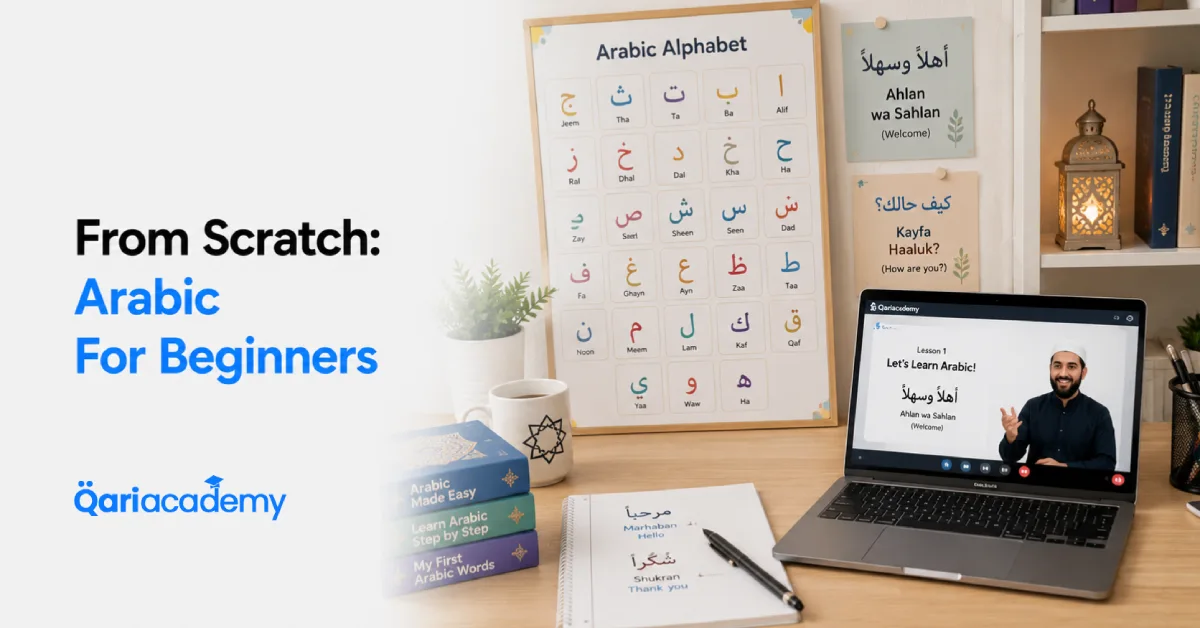
This guide shows that order, step by step: which Arabic to choose, the alphabet and its sounds, vowels and reading, vocabulary through roots, first grammar, and listening and speaking – with a realistic timeline and advice for adults and children.
Quick answer – how should a beginner learn Arabic? Decide which Arabic you need (Modern Standard, Quranic or a spoken dialect), then learn the 28 letters and their sounds, the vowel marks, and reading simple words. Build vocabulary through word roots, learn a few basic sentence patterns, and listen and speak a little every day – ideally with a teacher who corrects your pronunciation.
Which Arabic Should You Learn First?
“Arabic” covers more than one variety. Choosing the right one for your goal saves months.
| Variety | What it is | Where you meet it | Start here if you want to… |
|---|---|---|---|
| Modern Standard Arabic (Fusha) | The shared formal language of the Arab world | News, books, signs, formal speeches, most courses | Read and write Arabic and be understood across countries |
| Quranic (Classical) Arabic | The Arabic of the Quran and early Islamic texts | The Quran, hadith, prayers and supplications | Understand the Quran and your prayers |
| Spoken dialects (e.g. Egyptian, Levantine, Gulf) | Everyday spoken Arabic, different by region | Family conversations, films, TV, social media | Talk with relatives or people from one region |
Modern Standard and Quranic Arabic share the same alphabet, grammar and most of their vocabulary, so starting with either one helps with the other. Dialects differ more in everyday words and pronunciation. For a closer comparison, read Modern Standard Arabic vs Quranic Arabic and, for parents, Quranic Arabic vs conversational Arabic. If your family speaks Egyptian Arabic, see speaking Egyptian Arabic naturally and Egyptian Arabic for Western-born Muslims.
Tip: Not sure? Start with Modern Standard Arabic. Its alphabet, grammar and core words carry over to Quranic Arabic and help with any dialect later.
If your main goal is the Quran, follow our step-by-step guide on how to understand the Quran in Arabic.
The 5-Step Path for Beginners
Step 1: The Alphabet and Its Sounds
Arabic has 28 letters, written from right to left. Most letters join the next letter in a word, so a letter can look a little different at the start, middle or end of a word:
| Position | Start | Middle | End | Alone |
|---|---|---|---|---|
| Letter Ba | بـ | ـبـ | ـب | ب |
The letters themselves are not the hard part – the sounds are. Several Arabic sounds do not exist in English, for example ح ع ق ض ط ظ ص غ خ. Learn each letter with its sound from the start, by listening and repeating. Where each sound comes from in the mouth and throat is explained in What Is Makharij?, and for children see teaching kids the Arabic letters.
Common mistake: Learning the letters by their names only. Knowing that ع is called “Ain” does not help you read; knowing the sound it makes does.
Step 2: Vowel Marks and Reading Words
Short vowels are small marks above or below a letter. Beginners’ books show them on every letter; everyday texts usually leave them out once readers know the words.
| Mark | Name | Sound | Example |
|---|---|---|---|
| بَ | Fatha | short “a” | بَ “ba” |
| بِ | Kasra | short “i” | بِ “bi” |
| بُ | Dhamma | short “u” | بُ “bu” |
| بْ | Sukoon | no vowel | أَبْ “ab” |
| بّ | Shaddah | the letter is doubled | مُدَرِّس “mudarris” (teacher) |
| بَا بِي بُو | Long vowels | “aa”, “ee”, “oo” | بَاب “baab” (door) |
Once you can read the vowel marks, join letters into short words and read them aloud. Children can practise with Fatha, Kasra and Dhamma made simple. If your first aim is reading the Quran, follow our guide how to read the Quran for beginners.
Tip: Read aloud for 10–15 minutes every day. Short daily reading builds speed far better than one long session a week.
Step 3: Vocabulary Through Roots
Most Arabic words are built from a root of three letters that carries a basic meaning. Learn the pattern once and new words become easier to guess and remember. The root ك ت ب is about writing:
| Arabic | Meaning |
|---|---|
| كَتَبَ | he wrote |
| كِتَاب | book |
| كَاتِب | writer |
| مَكْتَب | desk, office |
| مَكْتَبَة | library, bookshop |
Aim first for the few hundred words you use every day: greetings, family, numbers, food, time, places, common verbs. You may already know some – English borrowed words such as algebra (الْجَبْر), sugar (سُكَّر) and coffee (قَهْوَة) from Arabic, and many Muslims use phrases like إِنْ شَاءَ الله every day. See Arabic words and phrases you hear in everyday English.
Step 4: First Grammar
A beginner needs only a few patterns to start making sentences:
- “The” is الـ. With some letters (“sun letters”) the L is not pronounced: الشَّمْس “ash-shams” (the sun). With others (“moon letters”) it is: الْقَمَر “al-qamar” (the moon).
- Masculine and feminine. Many feminine words end in ة: مُعَلِّم (male teacher), مُعَلِّمَة (female teacher).
- No “is” in the present. الْبَيْتُ كَبِيرٌ means “The house is big” – literally “the house big”.
- Verb-first sentences. كَتَبَ الطَّالِبُ الدَّرْسَ – “The student wrote the lesson” – often starts with the verb.
Leave the rest of the grammar for later. It makes much more sense once you can read and already know some words.
Step 5: Listening and Speaking
Listen to a little Arabic every day – a short dialogue, a children’s programme, a recitation you love – and repeat it out loud (“shadowing”). Then use it: greet someone with السَّلَامُ عَلَيْكُمْ, introduce yourself, ask simple questions. Speaking with someone who corrects you is the fastest way to fix your pronunciation.
Common mistake: Waiting until your grammar is “finished” before you speak. Start with simple sentences from the first weeks; accuracy grows with use.
How Long Does It Take to Learn Arabic?
The US Foreign Service Institute places Arabic among the hardest languages for English speakers: it estimates about 2,200 class hours – roughly 88 weeks of full-time study – to reach professional working proficiency. That is the level of a diplomat working in Arabic, studying full time; most learners need far less for their own goals.
Rough ranges for an adult with two or three lessons a week and a little daily practice (every learner is different):
| Milestone | Typical time |
|---|---|
| Read the letters and vowelled words | 1–3 months |
| Greet, introduce yourself, ask simple questions | 2–4 months |
| Hold short, simple conversations about daily life | 6–12 months |
| Read short simple texts (children’s stories, simple articles) | 1–2 years |
Children often pick up pronunciation faster; adults usually progress faster with grammar and reading because they can study deliberately.
Apps, Self-Study, Classes or a Teacher?
| Apps | Books / self-study | Group classes | 1-on-1 teacher | |
|---|---|---|---|---|
| Cost | Free to low | Low | Medium | Medium to higher |
| Pronunciation correction | None or automatic | None | Some | Every word |
| Speaking practice | Very little | None | Shared with the group | Most of the lesson |
| Pace | Your own | Your own | The group’s | Yours |
| Best for | Vocabulary on the go | Disciplined learners | Learners who like a class | Beginners, pronunciation, busy schedules |
Many learners combine them: an app for vocabulary, a book for reading practice, and a teacher who listens and corrects.
Learning Arabic as a Child
Children can start with sounds, letters and songs as early as 4 or 5, and build reading and vocabulary from there. Learning Arabic alongside Quran reading helps both: letters and sounds are shared, and words from daily prayers become meaningful. For parents:
- Why every Muslim child should learn Arabic
- Should children learn Arabic before learning to read the Quran?
- How Arabic can help your child understand the Quran
- Why children struggle with Arabic even when they hear it at home
- My child doesn’t know how to read Arabic – where to begin
Learn Arabic with a Teacher
Arabic is learned by listening, speaking and being corrected. At Qari Academy, lessons are live, 1-on-1 and 30 minutes long, with male and female teachers, at a pace that suits you. Plans start from $36 per 28 days, and your first class is a free trial.
Courses: Modern Standard Arabic · Arabic for Adults · Arabic for Kids · Quranic Arabic
FAQ
Is Arabic hard for English speakers?
It takes longer than languages like Spanish or French, mainly because of the new script, new sounds and different grammar. But the script is regular and words follow clear root patterns, so steady daily practice brings visible progress.
Should I learn Modern Standard Arabic or a dialect first?
If you want to read, write and understand the Quran or formal Arabic, start with Modern Standard Arabic. If your main goal is talking with family from one country, a dialect such as Egyptian may suit you better. Many learners start with Modern Standard Arabic and add a dialect later.
Can I learn Arabic just to understand the Quran?
Yes. Quranic Arabic courses focus on the vocabulary and grammar of the Quran and your daily prayers. Modern Standard Arabic shares most of that grammar and vocabulary, so either path helps.
Do I need to read Arabic before I start?
No. A beginner course starts with the alphabet and sounds. If you can already read the Quran, you will move faster through the first steps.
How many hours a week should I study?
Consistency matters more than long sessions. Two or three lessons a week plus 10–15 minutes of daily reading and listening is a good rhythm for most beginners.
Can I learn Arabic online?
Yes. Live online lessons let a teacher hear you and correct your pronunciation straight away, and they fit around work and school.
Am I too old to learn Arabic?
No. Adults of every age learn Arabic. Adults often find grammar and reading easier than children do; pronunciation simply needs a little more listening and correction.
Conclusion
Learning Arabic is a long journey, but every step is clear: choose your Arabic, master the letters and sounds, read with the vowel marks, grow your vocabulary through roots, learn a few sentence patterns, and listen and speak a little every day. Keep it regular, get your pronunciation checked, and you will be surprised how much you understand within months.
Arabic Guides in This Series
Each guide below goes deeper into one part of learning Arabic.
 Arabic Language9 Reasons Why You Should Learn Arabic
 Arabic LanguageModern Standard Arabic vs Quranic Arabic
 Arabic LanguageQuranic Arabic vs Conversational Arabic
 Arabic LanguageArabic Words and Phrases You Hear in Everyday English
- Arabic LanguageSpeak Arabic Naturally: Egyptian Arabic
 Arabic LanguageEgyptian Arabic for Western-Born Muslims
 Arabic LanguageLearn Arabic for Kids: Why It Matters
 Arabic Learning for KidsHow Arabic Can Help Your Child Understand the Quran
 Arabic Learning for KidsShould Children Learn Arabic Before Reading the Quran?
 Arabic Learning for KidsWhy Children Struggle With Arabic at Home
 Learning QuranMy Child Doesn’t Know How to Read Arabic
 Arabic Learning for KidsFun with Sounds: Fatha, Kasra, Dhamma